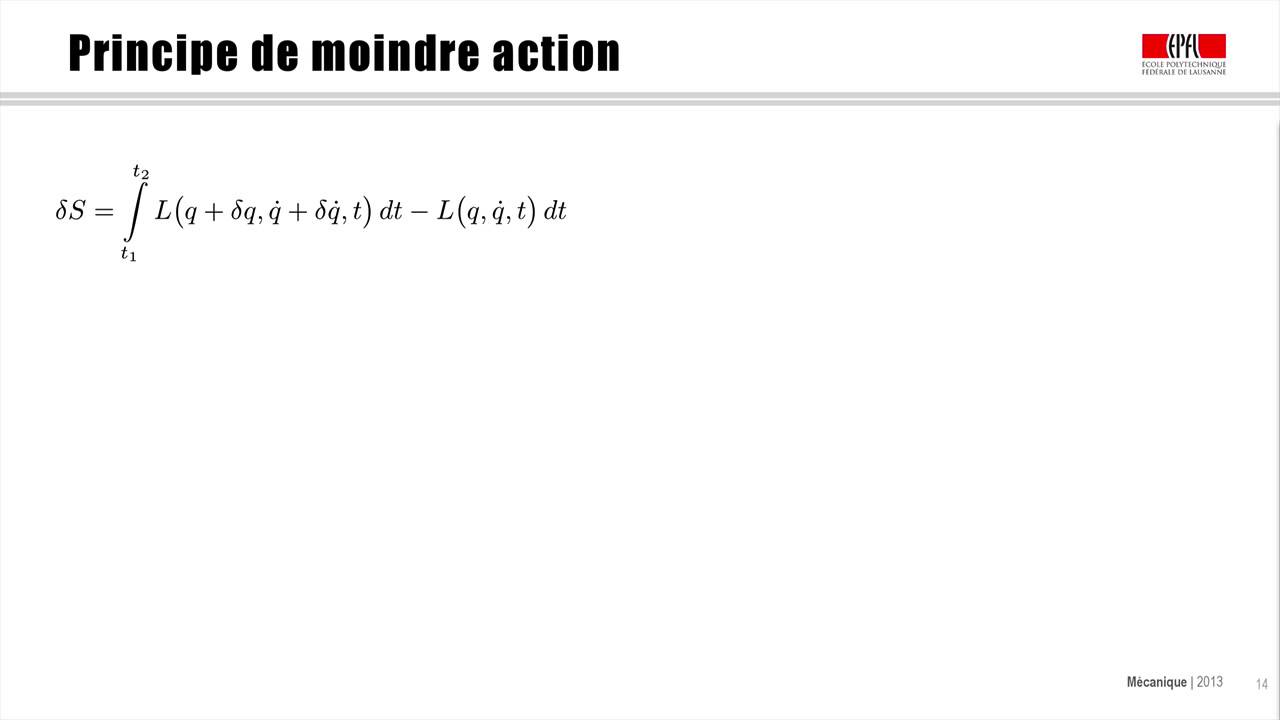
26.2 Principe de moindre action
Keywords
Summary
143 words
Critical Evaluation
Value of the Information & Strength of the Argument
The video provides a solid introduction to the principle of least action, a cornerstone of theoretical physics. It offers a clear derivation of the Euler-Lagrange equations from the variational principle, which is valuable for understanding the foundation of Lagrangian mechanics. The argumentation is logical and step-by-step, making the mathematical reasoning accessible. The application to a constrained system demonstrates the power of the method in deriving equations of motion and constraint forces, which is a key technique in advanced mechanics. The lecture effectively bridges the gap between Newtonian and Lagrangian formulations.
Scientific Rigor, Source Quality, Title Accuracy
The scientific rigor is high, as the content is presented by an EPFL professor and follows standard textbook derivations. The video does not cite external sources, but the material is well-established in classical mechanics. The title accurately reflects the content, focusing on the principle of least action. The lecture is part of a structured MOOC, ensuring pedagogical quality. No comments were provided for analysis.
169 words
Title / Content Match
The title accurately reflects the content, which focuses on the principle of least action and its application.
Quality & Reliability
8/10
The video is an educational lecture from an EPFL MOOC, presented by Prof. Ansermet. It provides a clear derivation of the principle of least action and demonstrates its application to find constraint forces using Lagrange multipliers. The content is mathematically rigorous and aligns with standard classical mechanics textbooks.
Key Moments
Markers derived by PSI from the transcript: the creator did not define chapters.
- Introduction to the principle of least action and the definition of action.
- Statement that Euler-Lagrange equations imply extremum of action and vice versa.
- Derivation of the Euler-Lagrange equations using integration by parts.
- Application to a cylinder on an inclined plane, introducing Lagrange multipliers.
- Derivation of equations of motion for the constrained system.
- Summary of the method and its validity for holonomic constraints.
Cited Sources
- MOOC Mécanique - Coursera — The full MOOC associated with this video.
Concurring Sources
- Classical Mechanics (Goldstein) — Standard textbook covering variational principles and Lagrange multipliers.
Contribution & Novelties
The video provides a concise and clear exposition of the principle of least action, which is a fundamental concept in physics. Its originality lies in the pedagogical approach, linking the variational principle to the derivation of constraint forces via Lagrange multipliers, which is often a challenging topic for students. The lecture effectively demonstrates the equivalence between Newtonian and Lagrangian mechanics.
Pour aller plus loin :
- Principle of least action - Wikipedia — Overview and historical context.
- Lagrangian mechanics - Wikipedia — Detailed treatment of Lagrangian formalism.
- Lagrange multiplier - Wikipedia — Mathematical method used for constraints.
96 words
Radar Profile
The radar profile shows high scores in quality, technical level, and reliability, with a slightly lower score in quantity of information. This indicates a focused, rigorous lecture that may not cover a broad range of topics but excels in depth and accuracy.