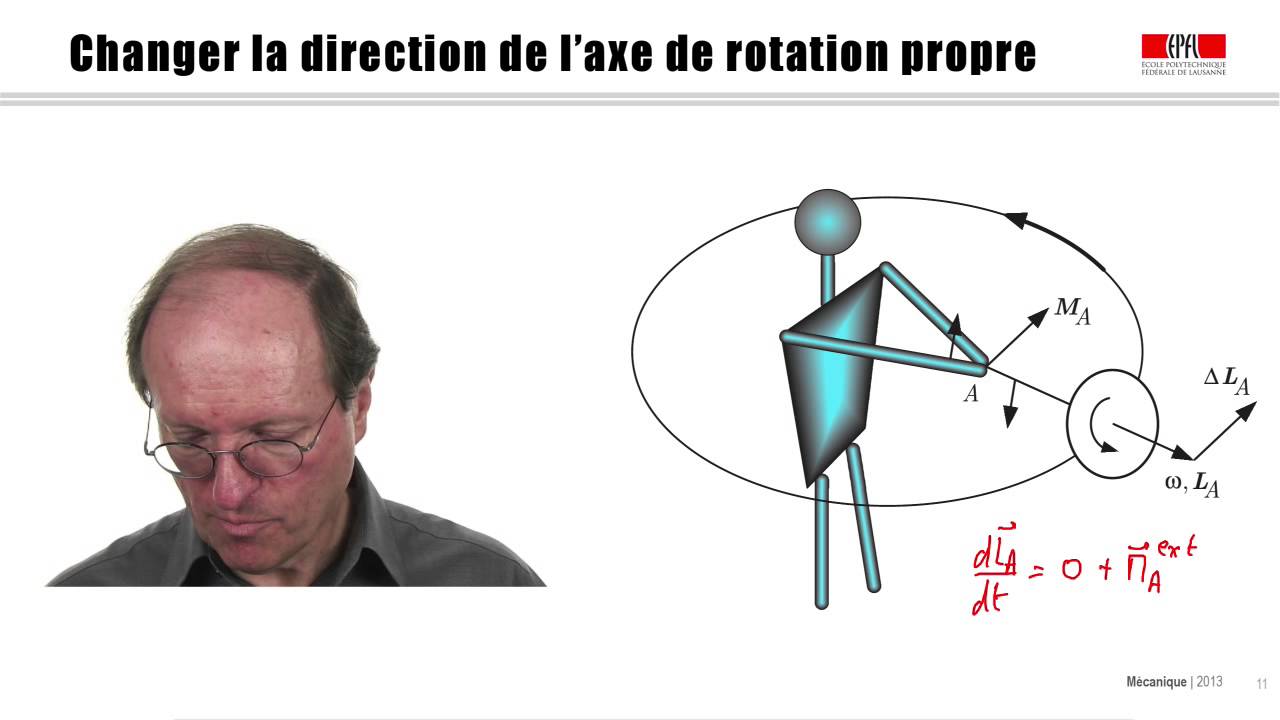
21.2 Discussion qualitative des effets gyroscopiques
Keywords
Summary
152 words
Critical Evaluation
Value of the Information & Strength of the Argument
The video provides valuable insights into gyroscopic phenomena, which are often counterintuitive. The argumentation is solid, as each example is systematically analyzed using the angular momentum theorem and vector diagrams. The instructor carefully explains the direction of torques and angular momentum changes, making the reasoning transparent. The examples are well-chosen to illustrate different aspects of gyroscopic effects, from precession to reaction forces and the difference between point masses and rigid bodies. The qualitative approach is effective for building intuition, and the mathematical derivations are kept at an appropriate level for the target audience.
Scientific Rigor, Source Quality, Title Accuracy
The scientific rigor is high, as the content is based on established principles of classical mechanics. The instructor is a professor at EPFL, and the video is part of a structured MOOC, ensuring pedagogical quality. However, the video does not cite specific sources or references beyond the course itself, which limits the verifiability of the content. The title accurately reflects the content, which is a qualitative discussion of gyroscopic effects. The description provides a link to the full MOOC on Coursera, which serves as a primary reference. No comments were provided for analysis.
201 words
Title / Content Match
The title accurately reflects the content, which is a qualitative discussion of gyroscopic effects in rigid body dynamics.
Quality & Reliability
8/10
The video is a lecture from a reputable MOOC by EPFL, presented by Prof. Ansermet. It relies on established principles of rigid body dynamics and provides qualitative explanations with clear diagrams. The content is accurate and well-structured, though it lacks explicit citations to external sources.
Key Moments
Markers derived by PSI from the transcript: the creator did not define chapters.
- Introduction to the lesson and overview of topics: precession of a top, bicycle wheel, motorcycle lean, and rotating pendulum.
- Application of angular momentum theorem to a spinning top, leading to precession.
- Analysis of forces and torques when reorienting a spinning bicycle wheel, including reaction forces.
- Explanation of why a motorcycle leans in a turn due to gyroscopic effects.
- Introduction to the rotating pendulum experiment with a bar and a point mass.
- Detailed analysis of the forces on the bar and point mass, showing different inclination angles.
- Conclusion and emphasis on the distinction between point mass and rigid body dynamics.
Cited Sources
- MOOC Mécanique - Coursera — The full MOOC course by Prof. Ansermet, providing additional resources and context for the lecture.
Concurring Sources
- MOOC Mécanique - Coursera — The full course provides consistent and complementary material on mechanics.
Contribution & Novelties
The video offers a clear qualitative explanation of gyroscopic effects, which is valuable for building intuition in rigid body dynamics. It emphasizes the application of the angular momentum theorem and the distinction between point mass and rigid body treatments, which is often a source of confusion. The examples are practical and relatable, enhancing understanding.
Pour aller plus loin :
- Gyroscope - Wikipedia — Provides a comprehensive overview of gyroscope physics and applications.
- Precession - Wikipedia — Explains the phenomenon of precession in detail.
- Angular momentum - Wikipedia — Covers the fundamental concept of angular momentum and its conservation.
98 words
Radar Profile
The radar profile shows high scores in quality of information and reliability, with moderate scores in quantity and technical level. This indicates a well-structured and accurate lecture, though it may not cover an extensive amount of content or delve into highly advanced mathematics.