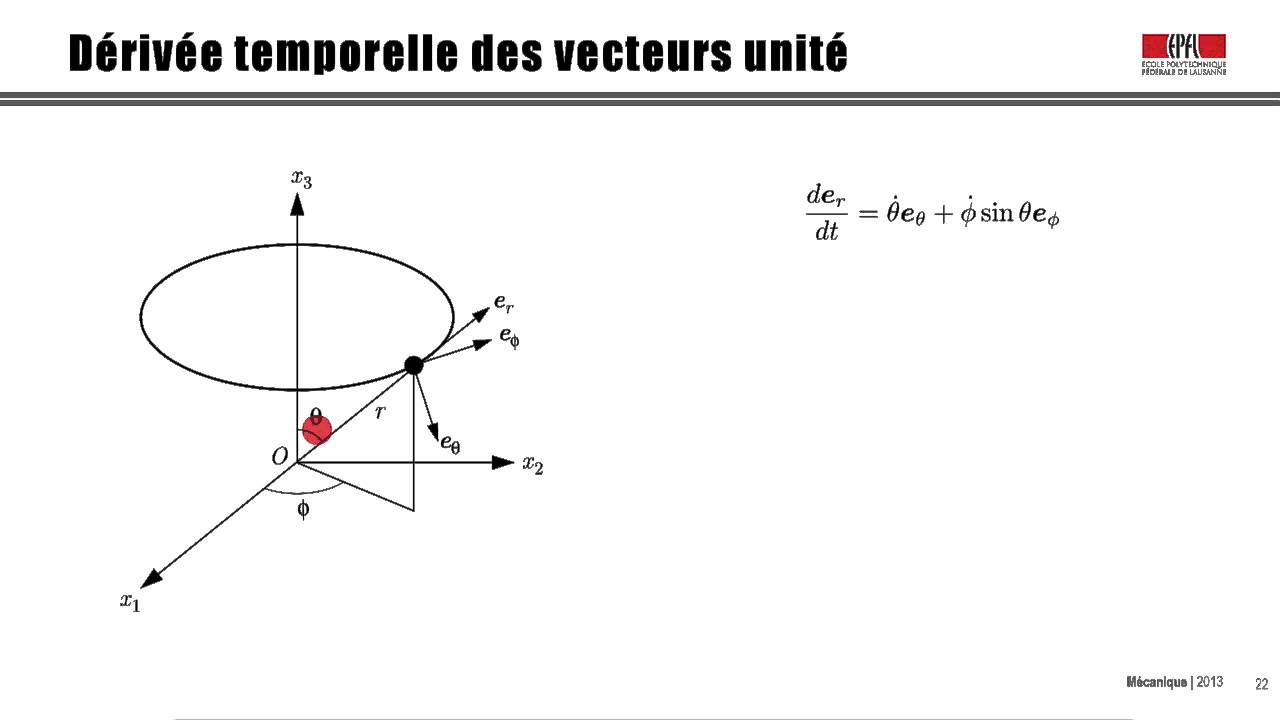
7.2 Vitesse en coord. cylindriques et sphériques
Keywords
Summary
175 words
Critical Evaluation
Value of the Information & Strength of the Argument
The video provides a clear and rigorous derivation of velocity in cylindrical and spherical coordinates, which is fundamental in mechanics. The argumentation is solid, using geometric reasoning and referencing prior knowledge of circular motion to justify the derivatives of basis vectors. The instructor carefully explains each step, making the content accessible while maintaining mathematical precision. The value lies in the pedagogical approach that emphasizes understanding over memorization, and the logical progression from cylindrical to spherical coordinates reinforces the concepts.
Scientific Rigor, Source Quality, Title Accuracy
The scientific rigor is high, as the derivations are mathematically correct and consistent with standard physics textbooks. The video is produced by EPFL, a reputable institution, and is part of a structured MOOC. The title accurately reflects the content, which is specifically about velocity in these coordinate systems. No external sources are cited in the video, but the description links to the full MOOC on Coursera, which provides additional resources. The content is self-contained and relies on established principles of mechanics.
175 words
Title / Content Match
The title accurately describes the content, which focuses on deriving velocity expressions in cylindrical and spherical coordinates.
Quality & Reliability
8/10
The video is a clear, well-structured lecture from an EPFL MOOC, with rigorous mathematical derivations and geometric justifications. The content is accurate and aligns with standard physics textbooks.
Key Moments
Markers derived by PSI from the transcript: the creator did not define chapters.
- Introduction to the lesson and objective: deriving velocity in cylindrical and spherical coordinates.
- Definition of cylindrical coordinates and basis vectors.
- Derivation of time derivatives of cylindrical basis vectors.
- Expression for velocity in cylindrical coordinates.
- Introduction to spherical coordinates and basis vectors.
- Derivation of time derivatives of spherical basis vectors using geometric arguments.
- Expression for velocity in spherical coordinates.
- Summary of results for both coordinate systems.
Cited Sources
- MOOC Mécanique (Coursera) — Full course associated with this video, providing additional materials and exercises.
Concurring Sources
- Classical Mechanics (Goldstein) — Standard textbook that covers kinematics in various coordinate systems, consistent with the video's content.
Contribution & Novelties
The video offers a clear and intuitive derivation of velocity in cylindrical and spherical coordinates, emphasizing geometric understanding. It is particularly useful for students who want to grasp the origin of the formulas rather than just memorize them. The approach of deriving basis vector derivatives using rotation concepts is pedagogically effective.
Pour aller plus loin :
- Cylindrical coordinate system — Provides a comprehensive overview of cylindrical coordinates and their applications.
- Spherical coordinate system — Detailed explanation of spherical coordinates and their use in physics.
- Del in cylindrical and spherical coordinates — Extends the concepts to gradient, divergence, and curl, which are essential for advanced mechanics and electromagnetism.
107 words
Radar Profile
The radar profile shows high scores across all dimensions, indicating a well-rounded educational video with strong technical content and reliable information. The balance between quantity and quality of information is excellent, and the technical level is appropriate for the target audience.