12.1 Collisions
Keywords
Summary
162 words
Critical Evaluation
Value of the Information & Strength of the Argument
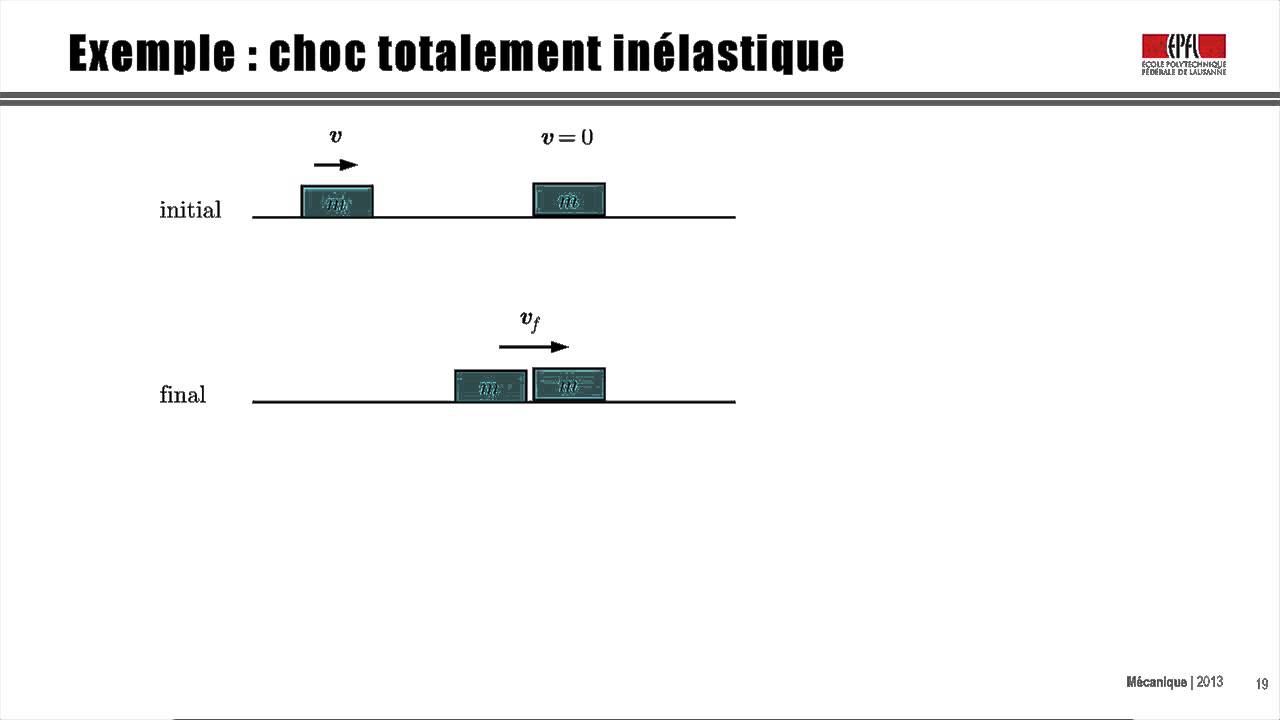
The video provides a clear and valuable introduction to the physics of collisions, emphasizing the fundamental principles of conservation of momentum and energy. The argumentation is solid, with a step-by-step derivation of the inelastic collision example, showing how kinetic energy is lost. The instructor also carefully explains the conditions under which momentum conservation holds during a collision, using the concept of finite external forces. The counter-example of a ball bouncing on the ground effectively illustrates the limitations of the model. The presentation is logical and builds on previous knowledge, making it a useful educational resource.
Scientific Rigor, Source Quality, Title Accuracy
The scientific rigor is high, as the content is based on well-established principles of classical mechanics. The instructor correctly applies Newton’s laws and conservation principles, and the derivations are accurate. However, the video does not cite specific sources or references, relying instead on the authority of the EPFL MOOC. The title ‘12.1 Collisions’ is appropriate and accurately reflects the content. The video is part of a structured course, which adds to its credibility. No comments were provided for analysis.
189 words
Title / Content Match
The title '12.1 Collisions' is concise and accurately reflects the content, which focuses on the analysis of collisions using conservation laws.
Quality & Reliability
8/10
The video is a clear and rigorous tutorial on collisions, presented by a professor from EPFL. It correctly applies Newton's laws and conservation principles, with a solid derivation of the inelastic collision example. The content is accurate and well-structured, though it lacks citations to external sources.
Key Moments
Markers derived by PSI from the transcript: the creator did not define chapters.
- Introduction to the lesson on collisions, defining elastic and inelastic collisions.
- Review of Newton's third law and conservation of momentum for isolated systems.
- Example of two masses sticking together on an air track, showing momentum conservation and loss of kinetic energy.
- Introduction of a model for collisions with brief impacts, integrating Newton's second law over the collision time.
- Counter-example of a ball bouncing on the ground, illustrating when the model fails due to singular forces.
- Conclusion summarizing the conditions for momentum conservation during collisions.
Cited Sources
- MOOC Mécanique EPFL — The video is part of the EPFL MOOC on mechanics, and the full course is available on Coursera.
Concurring Sources
- Conservation of momentum — The video's application of momentum conservation aligns with the standard physics principle.
Contribution & Novelties
The video provides a clear pedagogical explanation of collisions, emphasizing the distinction between elastic and inelastic collisions and the conditions for momentum conservation. It offers a practical model for analyzing collisions with brief impacts, which is a common simplification in mechanics. The counter-example of a ball bouncing on the ground is particularly instructive, highlighting the importance of finite external forces.
Pour aller plus loin :
- Elastic collision — Provides a detailed mathematical treatment of elastic collisions in one and two dimensions.
- Inelastic collision — Discusses the concept of inelastic collisions and the loss of kinetic energy.
- Conservation of momentum — Explains the principle of conservation of momentum and its derivation from Newton’s laws.
- Newton’s laws of motion — Reviews the three laws, including the third law which underlies momentum conservation.
130 words
Radar Profile
The radar profile shows high scores in quality of information and reliability, with slightly lower scores in quantity and technical level. This indicates a focused, accurate tutorial that could benefit from more depth or additional examples.