19.1 Dynamique du solide
Keywords
Summary
164 words
Critical Evaluation
Value of the Information & Strength of the Argument
The video provides a solid foundation in rigid body dynamics, with clear derivations of key formulas. The argumentation is rigorous, building from fundamental principles to more complex concepts. The use of mathematical notation is precise, and the lecturer explains each step, making it accessible for students with a background in mechanics. The value lies in its pedagogical clarity and the logical progression from point mass dynamics to rigid body dynamics.
Scientific Rigor, Source Quality, Title Accuracy
The scientific rigor is high, as the content is based on established physics principles and presented by an expert. However, the video does not cite specific sources or references, relying instead on the lecturer’s expertise. The title accurately describes the content, which is a lecture on rigid body dynamics. The video is part of a structured MOOC, which adds to its credibility.
147 words
Title / Content Match
The title accurately reflects the content, which covers the dynamics of rigid bodies.
Quality & Reliability
8/10
The video is an educational lecture from a reputable institution (EPFL) by a professor, presenting rigorous derivations of solid mechanics principles. The content is mathematically sound and well-structured, though it lacks explicit citations to external sources.
Key Moments
Markers derived by PSI from the transcript: the creator did not define chapters.
- Introduction to the lesson on rigid body dynamics.
- Review of the theorems of center of mass and angular momentum for systems of particles.
- Derivation of the angular momentum theorem with respect to the center of mass.
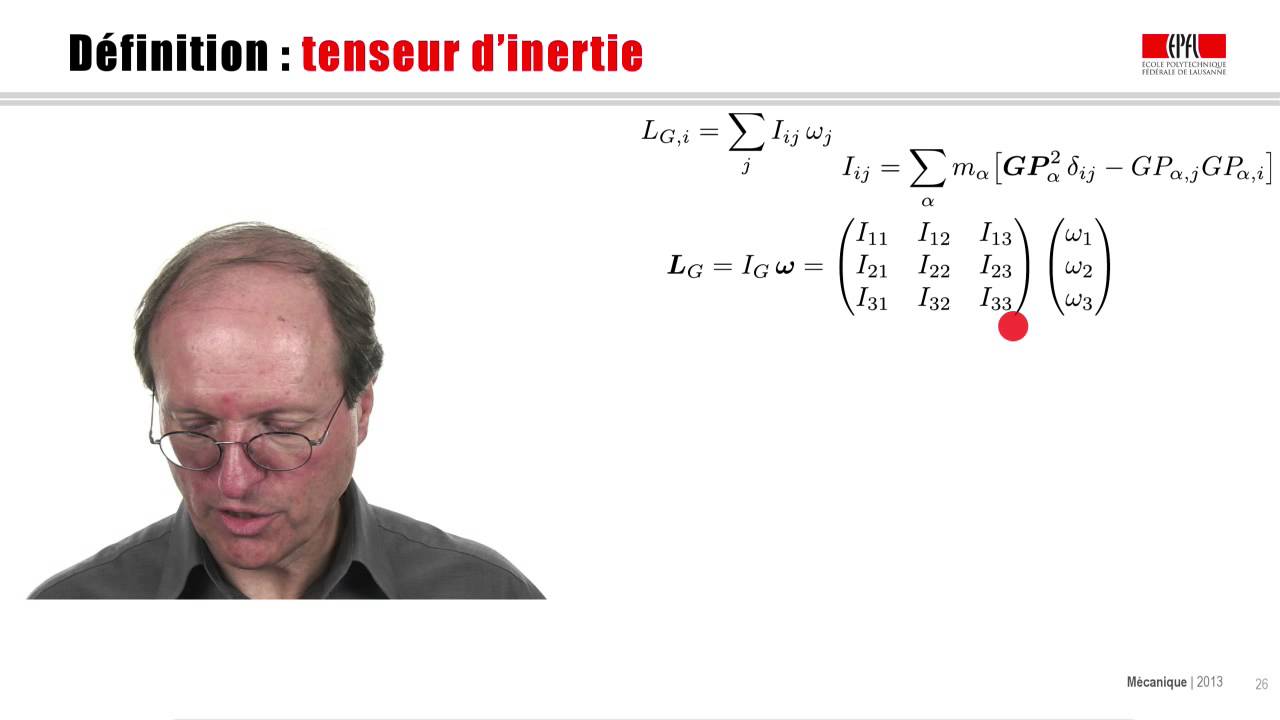
- Introduction of the inertia tensor and its components.
- Discussion on the symmetry and diagonalization of the inertia tensor, leading to principal axes.
- Definition of moment of inertia for rotation about a fixed axis.
- Expression for kinetic energy of a rotating rigid body as 1/2 I ω².
Cited Sources
- Coursera: Mécanique de Newton — Part of the MOOC where this video is hosted.
- Coursera: Mécanique du point matériel — Another part of the MOOC, related to point mechanics.
Concurring Sources
- Classical Mechanics by Goldstein — Standard textbook covering rigid body dynamics in depth.
Contribution & Novelties
The video provides a clear and rigorous introduction to rigid body dynamics, emphasizing the derivation of the inertia tensor and its properties. It bridges the gap between point mass mechanics and rigid body mechanics, offering a solid foundation for further study.
Pour aller plus loin :
- Inertia tensor — Wikipedia article on the inertia tensor, providing a comprehensive overview.
- Euler’s equations — Wikipedia article on Euler’s equations for rigid body motion, which build on the concepts introduced.
- Principal axes — Wikipedia article on principal axes, explaining the concept in more detail.
91 words
Radar Profile
The radar profile shows high scores in information quantity, quality, technical level, and reliability, indicating a well-rounded educational resource. The video excels in providing detailed and accurate content, making it suitable for learners seeking a thorough understanding of rigid body dynamics.
💬 No comments were provided for analysis.