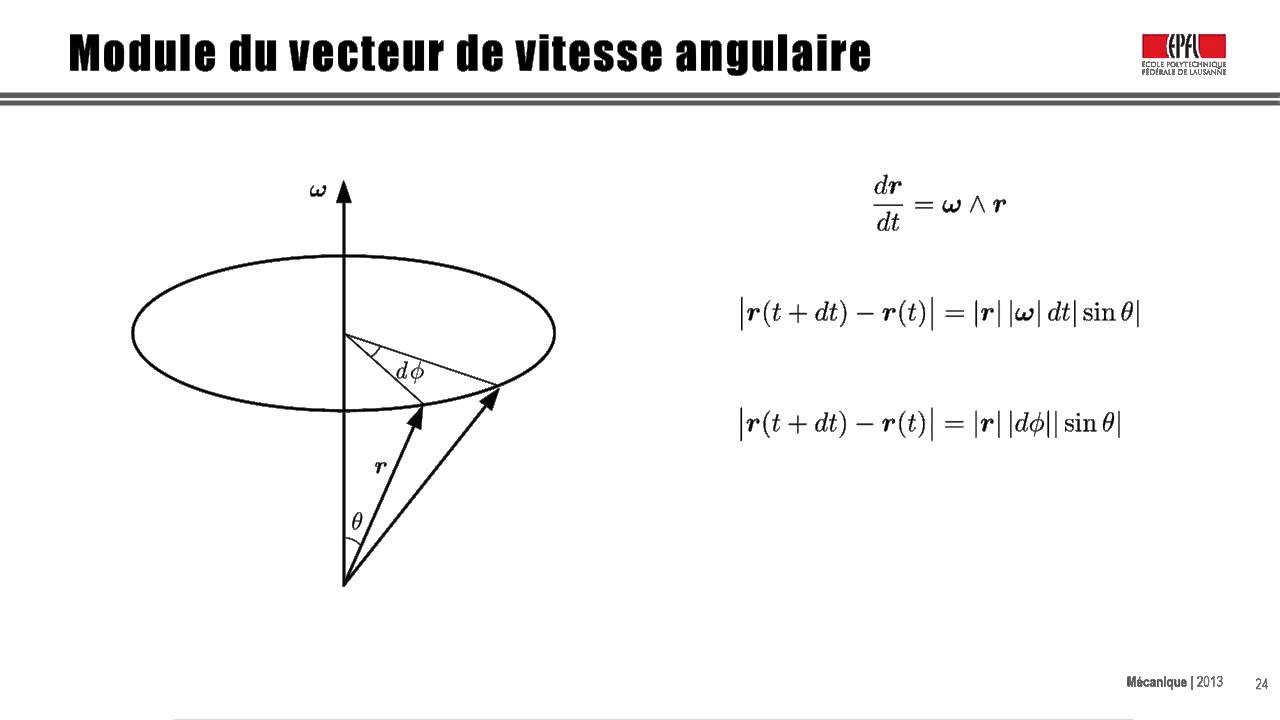
8.2 Vitesse angulaire
Keywords
Summary
193 words
Critical Evaluation
Value of the Information & Strength of the Argument
The video provides a solid, mathematically rigorous introduction to angular velocity, emphasizing the geometric interpretation of the vector. The argumentation is clear and step-by-step, with derivations that are easy to follow. The use of diagrams and geometric reasoning enhances understanding. The value lies in its pedagogical clarity and the connection between abstract formalism and physical intuition. The presentation is well-structured, building from the Poisson formulas to applications, making it a valuable resource for students learning classical mechanics.
86 words
Title / Content Match
The title accurately reflects the content, which focuses on the concept of angular velocity and its geometric interpretation.
Quality & Reliability
8/10
The video is a clear, rigorous lecture from an EPFL professor, part of a MOOC. It presents mathematical derivations and geometric interpretations accurately, with no apparent errors. The content is well-structured and pedagogically sound.
Key Moments
Markers derived by PSI from the transcript: the creator did not define chapters.
- Introduction to the lesson on angular velocity.
- Review of Poisson formulas and definition of angular velocity vector.
- Demonstration that Poisson formulas describe a rotation: fixed direction and preserved lengths/angles.
- Geometric derivation of the magnitude of angular velocity as scalar angular speed.
- Application to uniform circular motion: velocity and centripetal acceleration.
- Application to spherical coordinates: angular velocity vectors for φ and θ.
- Summary and note on vector addition of angular velocities.
Cited Sources
- MOOC Mécanique (Coursera) — The video is part of this MOOC, and the link is provided in the description for the full course.
Concurring Sources
- Classical Mechanics (Goldstein) — Standard textbook that covers angular velocity and rotating frames in detail, consistent with the video's content.
Contribution & Novelties
The video provides a clear and rigorous explanation of the angular velocity vector, emphasizing its geometric interpretation. It bridges the gap between the formal Poisson formulas and physical intuition, making the concept accessible. The applications to circular motion and spherical coordinates illustrate the utility of the formalism.
Pour aller plus loin :
- Angular velocity (Wikipedia) — Provides a comprehensive overview of angular velocity, including its vector nature and applications.
- Poisson’s formula (Wikipedia) — Discusses the Poisson formulas used in kinematics of rotating frames.
- Centripetal force (Wikipedia) — Explains centripetal acceleration, which is derived in the video for uniform circular motion.
100 words
Radar Profile
The radar profile shows high scores in information quality, technical level, and reliability, with slightly lower but still good scores in information quantity. This indicates a well-produced, technically sound educational video that is reliable and informative, though it may not cover an extensive breadth of topics.
💬 No comments were provided for analysis.