3.2 Balistique sans frottement
Keywords
Summary
172 words
Critical Evaluation
Value of the Information & Strength of the Argument
The lecture provides a solid foundation for understanding projectile motion. It clearly explains the physical model (force due to gravity) and the mathematical derivation of the equations of motion. The argumentation is logical and step-by-step, making it easy to follow. The emphasis on the distinction between the force model and the kinematic acceleration is valuable for avoiding common misconceptions. The choice of coordinates and the simplification of initial conditions are well-justified, demonstrating good problem-solving methodology.
Scientific Rigor, Source Quality, Title Accuracy
The scientific rigor is high: the content is accurate and presented in a pedagogical manner. The source is the EPFL MOOC, a reputable institution. The title accurately reflects the content. No external sources are cited within the video, but the description links to the full Coursera course, which serves as a reference. The lecture is self-contained and does not rely on dubious claims.
153 words
Title / Content Match
The title accurately reflects the content: the lecture focuses on ballistic motion without air resistance, as part of a broader mechanics course.
Quality & Reliability
8/10
The content is a clear, rigorous lecture from an established academic institution (EPFL). It correctly applies Newton's laws and derives the equations of motion for projectile motion without friction. The presentation is methodical and pedagogically sound, with appropriate emphasis on the distinction between the model of force and the kinematic acceleration.
Key Moments
Markers derived by PSI from the transcript: the creator did not define chapters.
- Introduction: applying Newton's laws to ballistic motion, systematic approach.
- Modeling the gravitational force: F = mg, with g as a vector.
- Deriving the equation a = g and discussing its meaning.
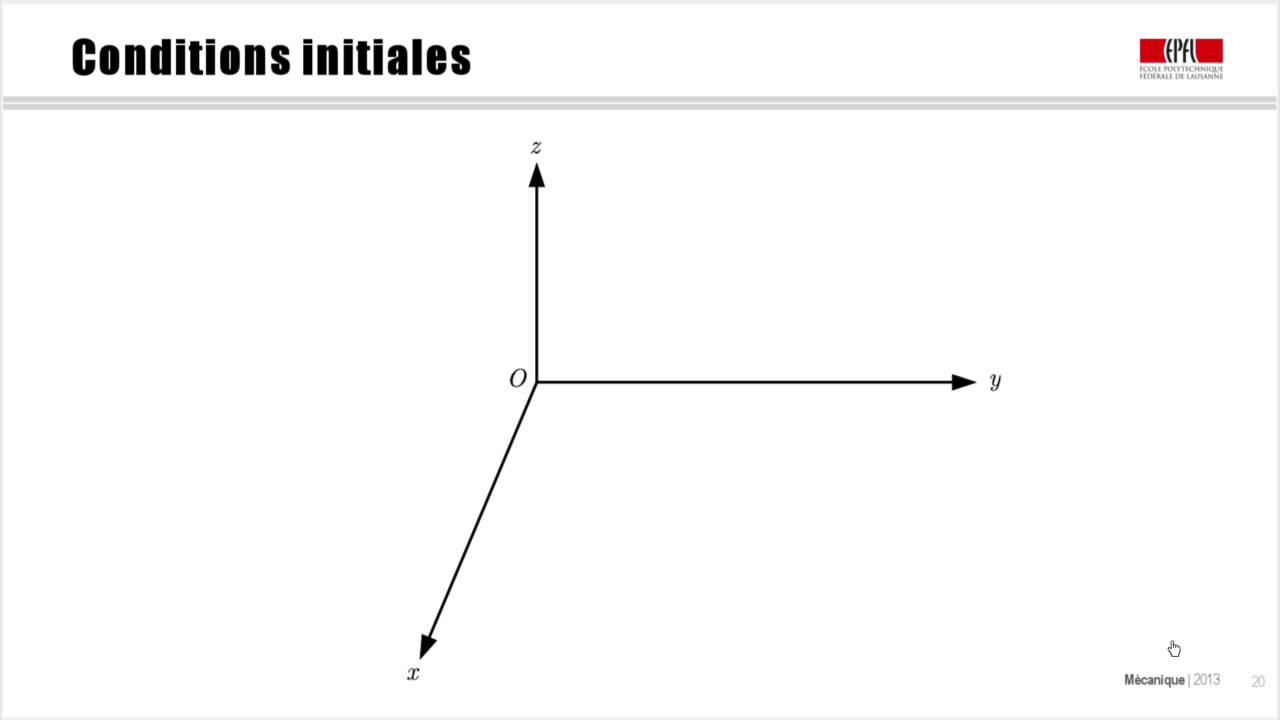
- Choosing coordinate system and expressing acceleration in Cartesian coordinates.
- Writing the differential equations from F = ma.
- Integrating the equations with initial conditions.
- Simplifying by setting initial position at origin and velocity in x-z plane.
- Eliminating time to find the parabolic trajectory.
Cited Sources
- MOOC Mécanique - Coursera — Full course associated with this lecture.
Concurring Sources
- Projectile motion - Wikipedia — Standard treatment of projectile motion without air resistance.
Contribution & Novelties
This lecture provides a clear and systematic introduction to projectile motion without friction, emphasizing the methodology of applying Newton’s laws. It is particularly useful for beginners in mechanics. The novelty lies in the pedagogical approach, highlighting the distinction between the force model and acceleration, and the importance of coordinate choice.
Pour aller plus loin :
- Projectile motion - Wikipedia — General overview and formulas.
- Newton’s laws of motion - Wikipedia — Foundational principles.
- Equations of motion - Wikipedia — Derivation and applications.
82 words
Radar Profile
The radar profile shows high scores in quality, rigor, and reliability, with moderate scores in quantity and technical depth. This indicates a focused, well-explained tutorial that may not cover advanced topics but is excellent for foundational understanding.