17.2 Principes de conservation, applications
Keywords
Summary
123 words
Critical Evaluation
Value of the Information & Strength of the Argument
The video provides valuable insights into the application of conservation laws, a fundamental concept in mechanics. The argumentation is solid, with each example carefully derived from first principles. The instructor clearly explains the assumptions and approximations, such as neglecting second-order terms, which strengthens the logical flow. The use of concrete examples (cannon, rocket, rotating stool, central force) helps to illustrate abstract concepts, making the content both instructive and engaging.
Scientific Rigor, Source Quality, Title Accuracy
The scientific rigor is high, as the content is based on well-established physics principles and presented by an academic expert. The quality of sources is adequate, though the video does not cite specific references; it is part of a structured MOOC, and the description links to the full course on Coursera. The title accurately reflects the content, which is a focused application of conservation principles. No public comments were provided, so no analysis of viewer feedback is possible.
162 words
Title / Content Match
The title accurately reflects the content, which focuses on applying conservation principles to specific mechanical systems.
Quality & Reliability
8/10
The video is an educational lecture from an established academic institution (EPFL), presenting classical mechanics derivations with clear mathematical steps. The content is accurate and well-structured, though it lacks explicit citations to external sources.
Key Moments
Markers derived by PSI from the transcript: the creator did not define chapters.
- Introduction to the lecture and overview of topics.
- Example 1: Recoil of a cannon using an air track and piston.
- Derivation of the change in velocity for the cannon recoil.
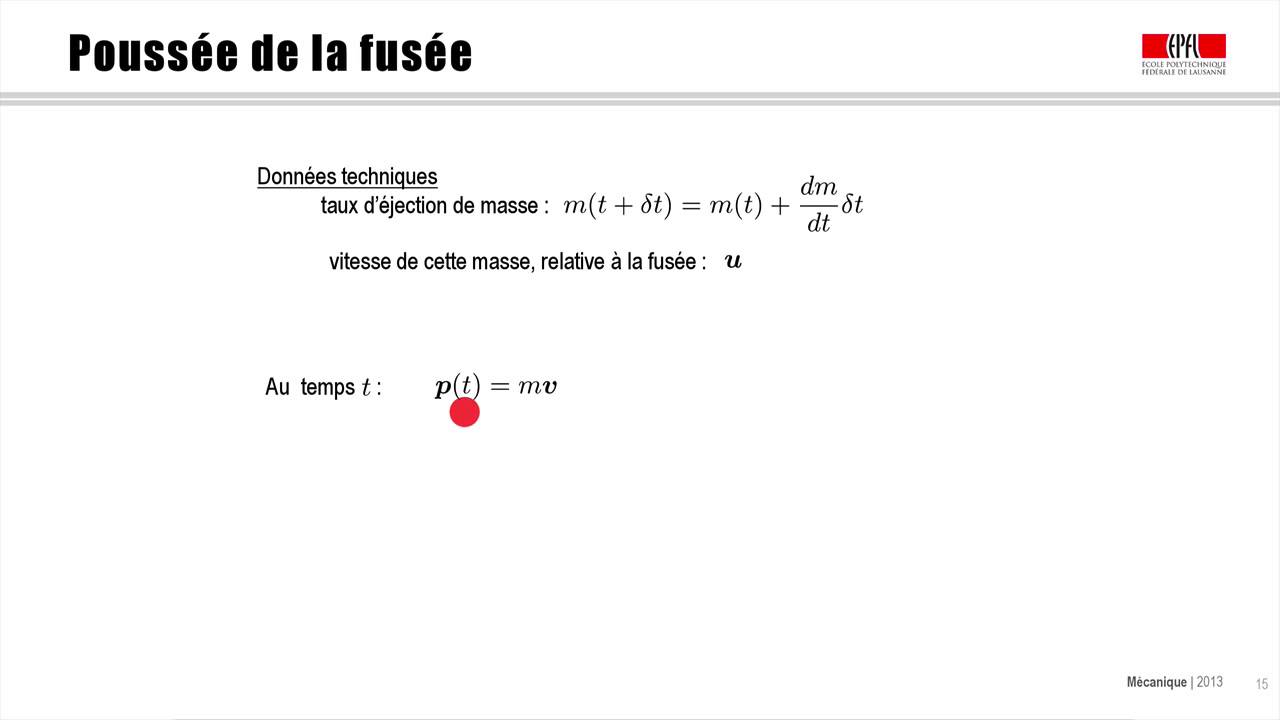
- Example 2: Rocket propulsion, introduction of variables and rocket equation.
- Derivation of the rocket equation and thrust term.
- Example 3: Person on a rotating stool, conservation of angular momentum.
- Example 4: Mass on a table with central force, effect of changing radius.
Cited Sources
- MOOC Mécanique (Coursera) — The video is part of this MOOC, and the link is provided in the description for the full course.
Concurring Sources
- MOOC Mécanique (Coursera) — The video is part of this MOOC, and the link is provided in the description for the full course.
Contribution & Novelties
The video offers a clear and systematic application of conservation principles to classic mechanics problems, which is valuable for learners. It bridges theoretical concepts with practical examples, enhancing understanding.
Pour aller plus loin :
- Conservation of momentum — Provides foundational background on the principle.
- Rocket equation — Detailed derivation and applications.
- Angular momentum — Explains the concept and its conservation.
- Central force — Discusses central force problems and their properties.
70 words
Radar Profile
The radar profile shows high scores in quality and reliability, with moderate scores in quantity and technical level. This indicates a focused, well-explained lecture that may not cover a broad range of topics but excels in depth and accuracy.