24.3 Unité : eV, mesure d'énergie cinétique relativiste, effet Compton
Keywords
Summary
216 words
Critical Evaluation
Value of the Information & Strength of the Argument
The video provides valuable insights into experimental verification of relativistic mechanics. It clearly explains the theoretical background and then shows real experiments, including a Van de Graaff generator and a Compton scattering demonstration. The argumentation is solid: the instructor derives the second-order correction to kinetic energy, explains the need for high energies, and presents experimental data that match the relativistic prediction. The Compton effect is demonstrated with a clear experimental setup and results. The explanations are logical and build on previous lessons, making the content coherent and convincing.
Scientific Rigor, Source Quality, Title Accuracy
The scientific rigor is high, as the content is based on established physics and presented by a professor from a reputable institution. The video is part of a structured MOOC, and the experimental demonstrations are relevant and well-explained. The title accurately describes the content. No external sources are cited within the video, but the description links to the full MOOC on Coursera, which serves as a reference. The video does not include any advertising or sponsored content.
180 words
Title / Content Match
The title accurately reflects the content: it covers the electron-volt unit, measurement of relativistic kinetic energy, and the Compton effect.
Quality & Reliability
8/10
The video is part of a formal MOOC by EPFL, presented by a professor. It explains relativistic kinetic energy and the Compton effect with experimental demonstrations. The content is accurate and well-structured, though it is an educational presentation rather than a peer-reviewed source.
Key Moments
Markers derived by PSI from the transcript: the creator did not define chapters.
- Introduction to the lesson: testing relativistic kinetic energy and Compton effect.
- Derivation of relativistic kinetic energy and second-order correction.
- Introduction of the electron-volt unit and conversion to joules.
- Discussion of electron rest energy and required acceleration voltage.
- Demonstration of a Van de Graaff generator producing kilovolts.
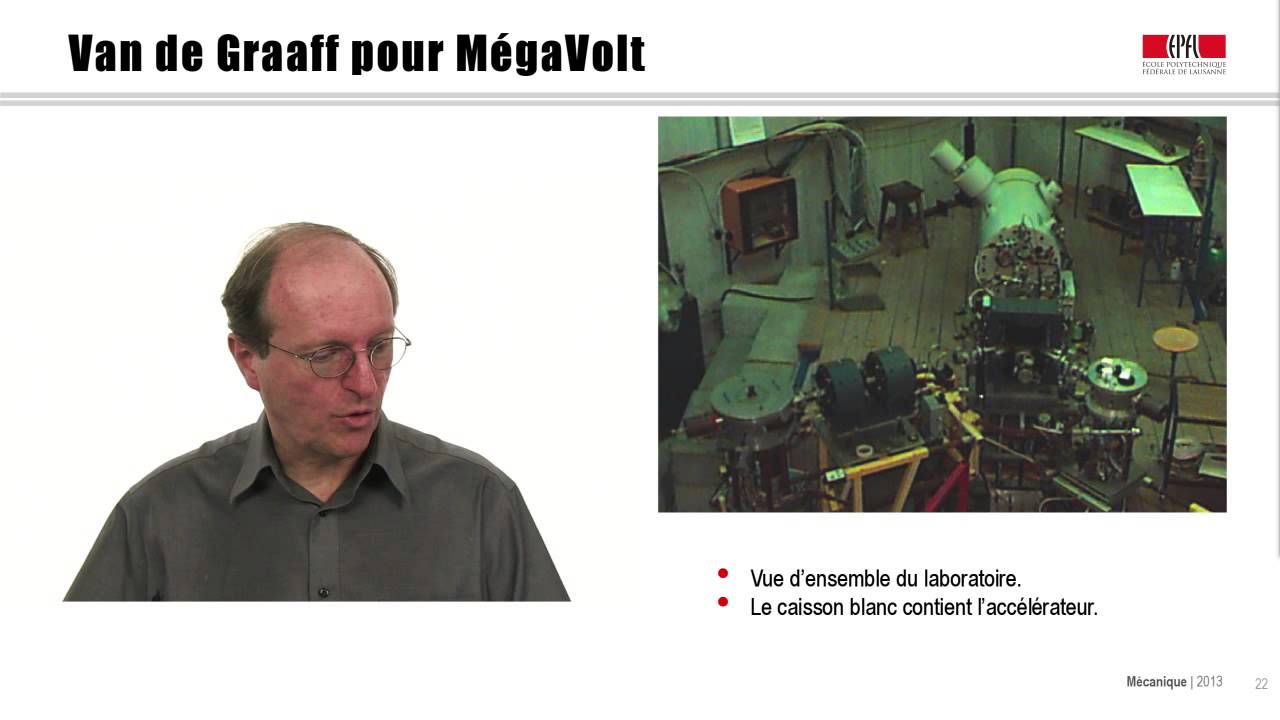
- Description of a large Van de Graaff installation at EPFL.
- Explanation of time-of-flight and calorimetric measurement of electron energy.
- Presentation of experimental results confirming relativistic prediction.
- Introduction to the Compton effect and experimental setup.
- Demonstration of Compton effect with absorber before and after scatterer.
Cited Sources
- MOOC Mécanique EPFL — Full course on Coursera, referenced in the video description.
Concurring Sources
- MOOC Mécanique EPFL — The video is part of this MOOC, which provides consistent educational content.
Contribution & Novelties
The video provides a clear pedagogical explanation of relativistic kinetic energy and the Compton effect, with experimental demonstrations. It effectively uses the electron-volt unit and shows how to measure relativistic effects. The novelty lies in the integration of theory and experiment in a concise format.
Pour aller plus loin :
- Relativistic kinetic energy — Wikipedia article on relativistic kinetic energy.
- Compton scattering — Wikipedia article on the Compton effect.
- Electronvolt — Wikipedia article on the electronvolt unit.
- Van de Graaff generator — Wikipedia article on the Van de Graaff generator.
90 words
Radar Profile
The radar profile shows high scores in quality and reliability, with moderate scores in quantity and technical level. This indicates a well-structured educational video with accurate content, though it may not cover an extensive amount of material or require advanced technical background.