10.1 Puissance, travail, énergie
Keywords
Summary
129 words
Critical Evaluation
Value of the Information & Strength of the Argument
The video provides a solid foundation for understanding work and energy, with clear definitions and a rigorous derivation of the work-energy theorem. The argumentation is logical and builds on previously established concepts (Newton’s laws). The explanation of the geometric interpretation of work (only the tangential component of force does work) is particularly valuable. The final clarification about the kilowatt-hour is a practical addition.
Scientific Rigor, Source Quality, Title Accuracy
The scientific rigor is high, as the content is based on fundamental physics principles and presented by an academic expert. The sources are not explicitly cited in the video, but the link to the Coursera course is provided in the description. The title accurately reflects the content. No comments were provided for analysis.
131 words
Title / Content Match
The title accurately reflects the content, which covers power, work, and energy.
Quality & Reliability
9/10
The content is a clear, rigorous introduction to work and energy, based on Newton's laws, presented by a professor from a reputable institution (EPFL). The mathematical derivations are correct and well-explained.
Key Moments
Markers derived by PSI from the transcript: the creator did not define chapters.
- Introduction to the lesson on power, work, and energy.
- Definition of instantaneous power as the scalar product of force and velocity.
- Definition of work as the time integral of power and line integral along trajectory.
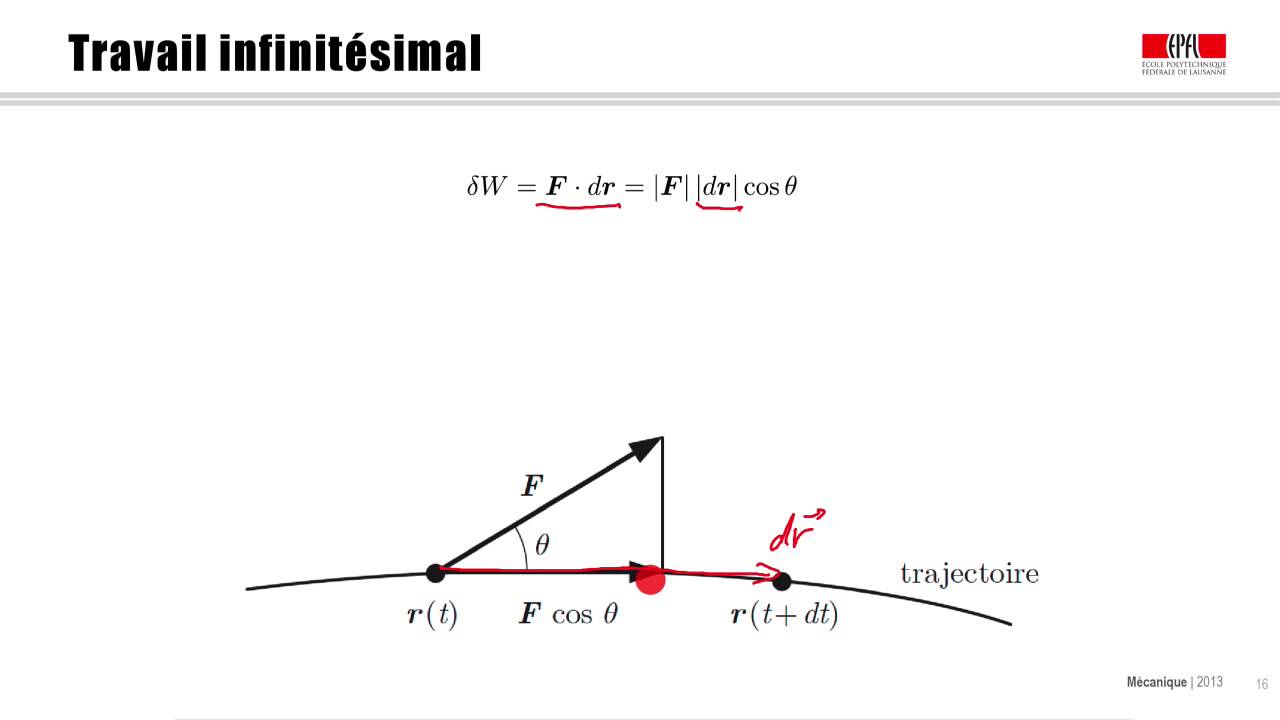
- Geometric interpretation of work: only the tangential component of force contributes.
- Definition of kinetic energy and statement of the work-energy theorem.
- Proof of the work-energy theorem using Newton's second law.
- Review of SI units: newton, joule, watt, and clarification of kilowatt-hour.
Cited Sources
- MOOC Mécanique - Coursera — The full MOOC is available on Coursera.
Concurring Sources
- Work-Energy Theorem — The work-energy theorem is a standard principle in classical mechanics.
Contribution & Novelties
This video provides a clear and concise introduction to work and energy, with a rigorous derivation of the work-energy theorem. It is part of a larger MOOC, so it serves as a foundational lesson. The explanation of the kilowatt-hour is a practical addition.
Pour aller plus loin :
- Work (physics) — Wikipedia article on work, providing broader context and examples.
- Kinetic energy — Wikipedia article on kinetic energy, including relativistic and quantum aspects.
- Power (physics) — Wikipedia article on power, with definitions and applications.
84 words
Radar Profile
The radar profile shows high scores in quality, technical level, and reliability, with a slightly lower score in quantity of information due to the short duration. This indicates a focused, high-quality educational video.