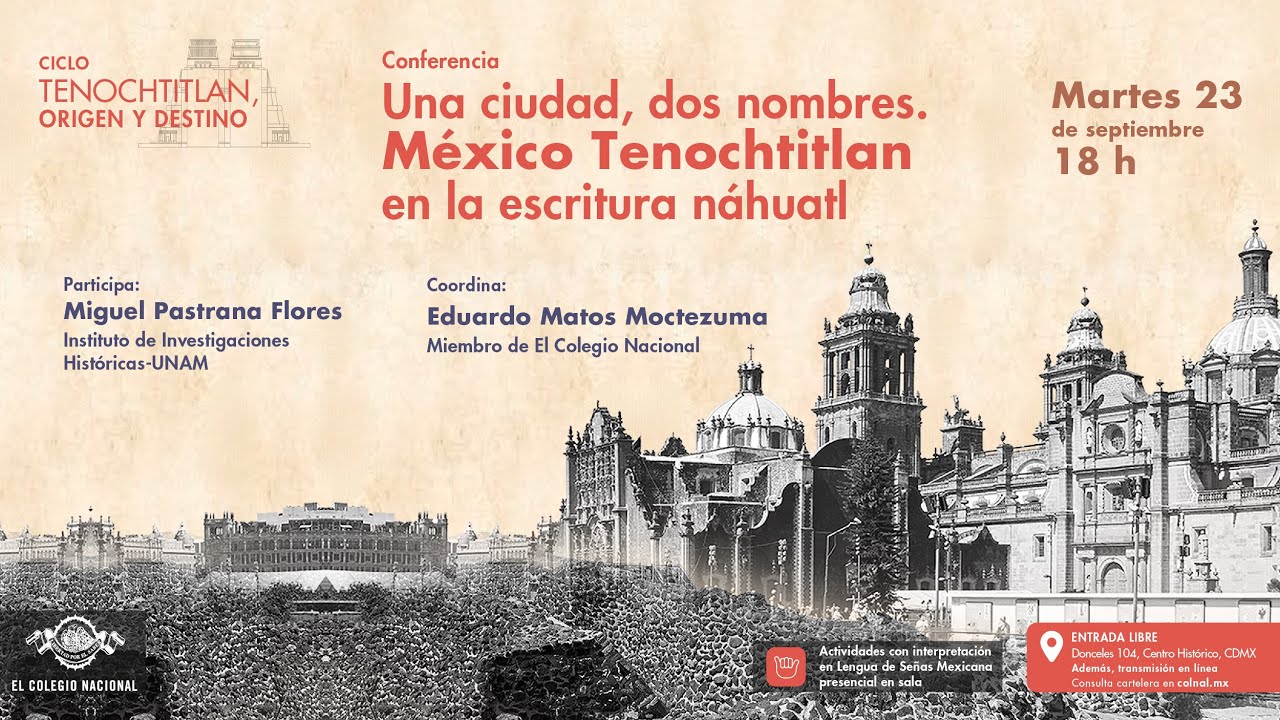
Una ciudad, dos nombres. México Tenochtitlan en la escritura náhuatl
Keywords
Summary
173 words
Critical Evaluation
The lecture provides a rigorous and insightful analysis of the dual naming of México-Tenochtitlan, emphasizing the importance of understanding the Nahuatl writing system before engaging in etymological debates. Pastrana demonstrates deep expertise in Mesoamerican historiography and linguistics, drawing on primary sources such as the Codex Mendoza and the work of scholars like Ignacio Guzmán Betancourt. His methodological approach is sound: he distinguishes between the graphic representation, the phonetic value, and the semantic meaning of glyphs, warning against the common pitfall of interpreting glyphs symbolically without linguistic grounding. The examples he provides, such as the glyph for Coatepec and the deceptive use of the xiuhuitzolli, effectively illustrate his points. The lecture is well-structured, moving from general observations about writing systems to specific case studies, and it is accessible to a non-specialist audience without oversimplifying the complexity of the subject. One minor limitation is that the lecture does not delve into the broader historical context of the city’s founding or the political implications of the dual name, but this is not its stated purpose. The speaker also acknowledges unresolved questions, such as the absence of the name Mexico in pre-conquest sources, which adds to the credibility of the presentation. Overall, this is a high-quality, scholarly contribution that clarifies common misconceptions and provides a solid foundation for further study.
216 words
Title / Content Match
The title accurately reflects the content, which focuses on the dual naming of Mexico-Tenochtitlan and its representation in Nahuatl writing.
Quality & Reliability
9/10
The speaker is a specialist in Nahuatl historiography from UNAM, and the content is based on primary sources (codices) and a long scholarly tradition. The presentation is rigorous, with clear methodological explanations and caution about interpretations.
Key Moments
Markers derived by PSI from the transcript: the creator did not define chapters.
- Introduction by Eduardo Matos Moctezuma, presenting the speaker and the topic.
- Pastrana begins his lecture, discussing the historical debate on the dual name.
- Explanation of the writing systems: alphabetic, logographic, and syllabic.
- Discussion of the glyph for Tenochtitlan and its components.
- Examples of logograms and syllabograms in Nahuatl writing, including Coatepec and Coscatecutlan.
- Warning against symbolic interpretations and emphasis on phonetic reading.
- Discussion of the absence of the name Mexico in pre-conquest sources.
- Further examples of glyphs and their phonetic values.
- Conclusion and invitation for questions.
Cited Sources
- Codex Mendoza — Mentioned as an example of a codex containing the glyph for Tenochtitlan.
- Ignacio Guzmán Betancourt's compilation on the debate — Cited as a comprehensive compilation of 500 years of etymological debates on the toponyms.
Concurring Sources
- Codex Mendoza — Primary source that contains the glyph for Tenochtitlan, supporting the discussion.
Dissenting Sources
- Alternative etymologies of Mexico — The lecture notes that there is no consensus on the etymology of Mexico, with many competing theories.
Contribution & Novelties
The lecture offers a fresh perspective on the study of Nahuatl toponyms by prioritizing the analysis of the writing system over purely etymological speculation. It provides a methodological framework for interpreting glyphs phonetically, which can be applied to other Mesoamerican texts. The emphasis on the absence of the name Mexico in pre-conquest sources opens new avenues for research.
Pour aller plus loin :
- Nahuatl writing system — Overview of the logographic and syllabic nature of Nahuatl script.
- Codex Mendoza — Primary source for studying Aztec glyphs and place names.
- Mesoamerican writing systems — Contextualizes Nahuatl writing within broader Mesoamerican traditions.
100 words
Radar Profile
The radar profile shows high scores in quantity and quality of information, reflecting the depth and reliability of the content. The technical level is also high, indicating a specialized audience, while the overall reliability is strong due to the speaker's expertise and use of primary sources.
💬 Sur les 0 commentaires analysés, aucune tendance n'est disponible.