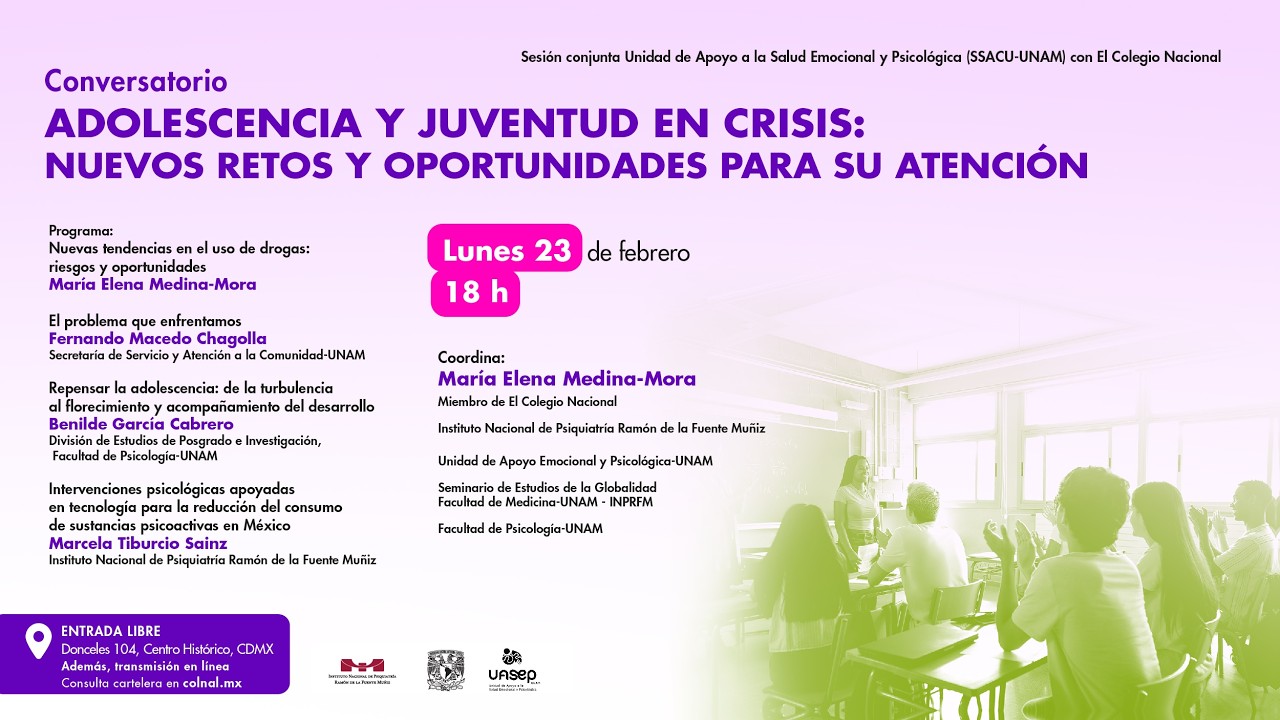
Adolescencia y juventud en crisis. Nuevos retos y oportunidades para su atención
Keywords
Summary
185 words
Critical Evaluation
The video provides a valuable overview of the mental health challenges facing adolescents and youth, particularly within the Mexican university context. The panelists are credible experts from reputable institutions, and they present institutional data that underscores the severity of the issue. The discussion is well-structured, moving from problem definition to potential solutions. However, the content is largely descriptive and lacks rigorous scientific depth; specific statistics are mentioned without detailed methodological context, and the effectiveness of the interventions is not thoroughly evaluated. The sources cited are primarily institutional reports and program descriptions, with limited peer-reviewed literature. The panel does not engage with potential criticisms or alternative approaches, which weakens the critical analysis. The title accurately reflects the content, and the video successfully raises awareness about the crisis and the need for action. Overall, it is a informative discussion for a general audience, but it falls short of a comprehensive scientific review.
150 words
Title / Content Match
The title accurately reflects the content, which addresses the crisis in adolescent and youth mental health and discusses new challenges and opportunities for care.
Quality & Reliability
7/10
The video features experts from UNAM and the National Institute of Psychiatry, providing institutional data and program descriptions. However, it is primarily a panel discussion with limited peer-reviewed references, and some claims lack detailed methodological transparency.
Key Moments
Markers derived by PSI from the transcript: the creator did not define chapters.
- Introduction by María Elena Medina-Mora, setting the stage for the discussion on adolescent and youth mental health.
- Fernando Macedo Chagolla begins his presentation on the problem of mental health in universities, highlighting the impact of the pandemic.
- Discussion of the historical evolution of psychological services at UNAM, from the 1954 psychology laboratory to current programs.
- Presentation of data from the medical exam showing rising depressive symptoms among students, with a peak in 2024.
- Explanation of the new AI-assisted medical exam that adapts questions based on risk factors.
- Marcela Tiburcio Sainz discusses the challenges of substance use and the need for digital interventions.
- Benilde García Cabrero presents digital intervention programs and their positive results.
- Panel discussion on the importance of early intervention and reducing stigma.
- Q&A session with the audience, addressing questions about implementation and accessibility.
Cited Sources
- UNAM's Unidad de Apoyo a la Salud Emocional y Psicológica — Mentioned as a key initiative to consolidate mental health services at UNAM.
Concurring Sources
- WHO: Mental health of adolescents — Supports the claim of increasing mental health issues among adolescents globally.
Contribution & Novelties
The video provides an insider perspective on the mental health crisis in Mexican universities, highlighting the institutional response at UNAM. It emphasizes the integration of services and the use of technology, such as AI-assisted screening, which is a novel approach. The discussion also underscores the long-term impact of the pandemic on youth mental health.
Pour aller plus loin :
- World Health Organization: Adolescent mental health — Provides global statistics and context on adolescent mental health.
- National Institute of Mental Health: Child and Adolescent Mental Health — Offers resources and research on youth mental health.
- The Lancet Psychiatry Commission on youth mental health — A comprehensive review of youth mental health challenges and solutions.
113 words
Radar Profile
The radar profile shows high scores in quantity of information and global reliability, indicating a well-informed discussion. However, the technical level is moderate, reflecting the accessible nature of the content. The quality of information is good but could be enhanced with more rigorous scientific references.
💬 Sur les 0 commentaires analysés, aucune tendance n'a pu être dégagée.