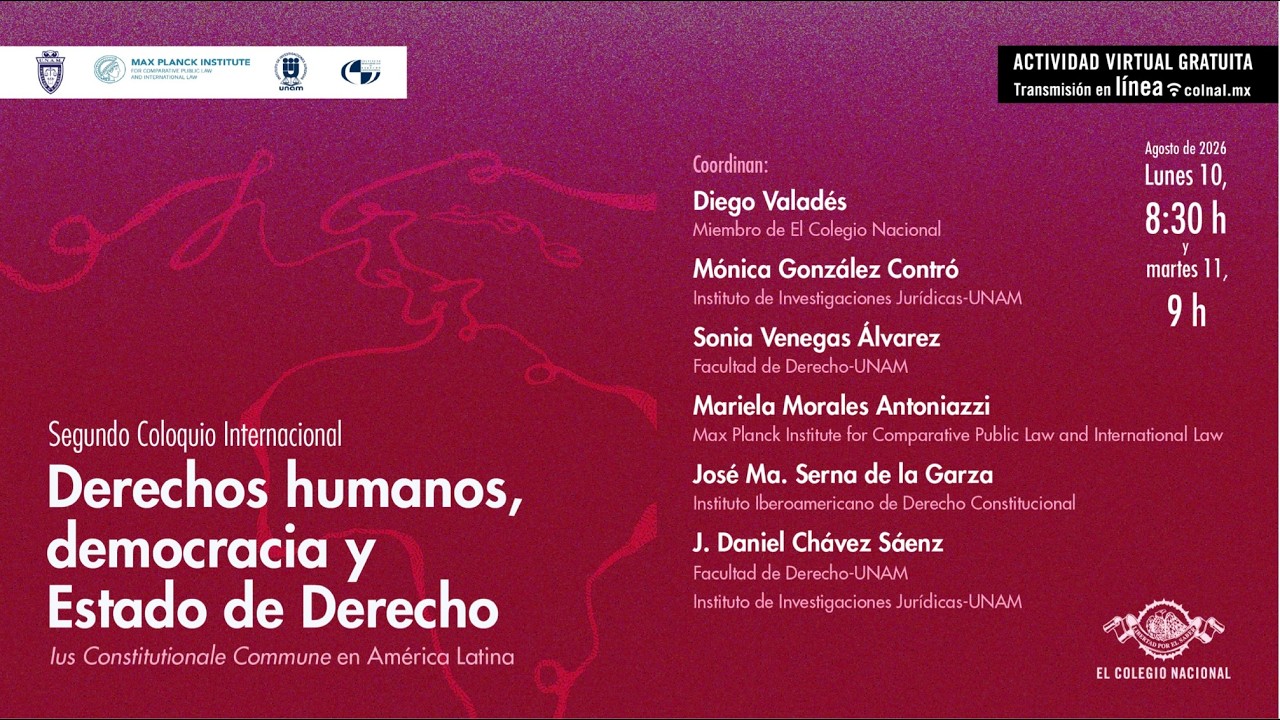
Segundo Coloquio Internacional Derechos humanos, democracia y Estado de Derecho | Día 2, 1a Mesa
Keywords
Summary
208 words
Critical Evaluation
The video provides a high-level academic discussion on two interconnected themes: the amparo as a cornerstone of Latin American constitutionalism and the relationship between corruption and human rights. The keynote by Brewer-Carías is a comprehensive comparative analysis, drawing on his extensive scholarship and practical experience. He effectively demonstrates the amparo’s evolution from a national remedy to an international human right, supported by references to the American Convention and Inter-American Court jurisprudence. The comments by Morales and Brito add valuable perspectives, emphasizing empirical data and the amparo’s role in democratic resilience. The panel on corruption is equally rigorous, with each speaker bringing distinct expertise: Basterra focuses on the impact on DESCA and vulnerable groups, citing key Court cases; Camarillo provides a detailed account of Mexico’s anti-corruption framework; Orias offers a practitioner’s view on the need to integrate human rights and anti-corruption agendas; and Hernández discusses constitutional responses, including a proposed amendment to the American Convention. The arguments are well-supported by legal sources, including conventions, court decisions, and reports. The discussion is balanced, acknowledging both progress and persistent challenges, such as judicial independence and impunity. The video’s strength lies in its depth and the authority of the speakers. However, as a colloquium, it lacks the interactive element of Q&A, and some presentations are time-constrained, limiting deeper exploration. The technical quality is good, with clear audio and visuals. Overall, the content is highly informative and reliable, suitable for an academic audience.
238 words
Title / Content Match
The title accurately reflects the content: a session of an international colloquium on human rights, democracy, and rule of law, with a keynote on amparo and a panel on corruption and human rights.
Quality & Reliability
8/10
The video features renowned legal scholars and practitioners, including Allan R. Brewer-Carías, a prominent constitutional law expert, and Mariela Morales Antoniazzi from the Max Planck Institute. The content is well-structured, citing specific legal cases, conventions, and reports. The arguments are grounded in legal doctrine and jurisprudence, though the format is a colloquium with presentations and comments rather than a peer-reviewed study.
Key Moments
Markers derived by PSI from the transcript: the creator did not define chapters.
- Introduction by Diego Valadés and welcome to the colloquium.
- Mario Molina introduces Allan Brewer-Carías for the keynote lecture.
- Brewer-Carías begins his lecture on the amparo as a mechanism of Ius Constitutionale Commune.
- Discussion on the internationalization of amparo through Article 25 of the American Convention.
- Analysis of the characteristics of amparo: simplicity, speed, and effectiveness.
- Brewer-Carías discusses challenges to amparo, including judicial independence and the Venezuelan case.
- Mariela Morales comments on the amparo's empirical impact and democratic resilience.
- Rodrigo Brito comments on the amparo as a common constitutional standard.
- Transition to the panel on corruption and human rights.
- Marcela Basterra discusses the impact of corruption on DESCA and vulnerable groups.
- Beatriz Camarillo analyzes Mexico's anti-corruption framework.
- Ramiro Orias discusses the need to integrate human rights and anti-corruption agendas.
- Antonio María Hernández proposes constitutional reforms and a right to a life free from corruption.
Cited Sources
- American Convention on Human Rights — Referenced as the basis for the right to judicial protection (Article 25) and the amparo.
- Inter-American Court of Human Rights — Mentioned for its jurisprudence on amparo, corruption, and human rights.
- Ius Constitutionale Commune en América Latina — Referenced as the theoretical framework of the colloquium.
- Comisión Interamericana de Derechos Humanos - Corrupción y Derechos Humanos — Cited as a key report on corruption and human rights.
- Carta Democrática Interamericana — Referenced in discussions on democracy and anti-corruption.
- Convención Interamericana contra la Corrupción — Mentioned as an international instrument against corruption.
- Convención de las Naciones Unidas contra la Corrupción — Referenced in the panel on corruption.
Concurring Sources
- American Convention on Human Rights — The amparo is grounded in Article 25, which is consistently cited by speakers.
- Inter-American Court of Human Rights — The Court's decisions on amparo and corruption are referenced and align with the speakers' arguments.
- Comisión Interamericana de Derechos Humanos - Corrupción y Derechos Humanos — The report's findings are echoed in the panel discussions.
Dissenting Sources
- No discordant sources identified — The speakers present a cohesive view, with no conflicting sources mentioned.
Contribution & Novelties
The video provides a comprehensive and up-to-date analysis of the amparo as a key institution of Latin American constitutionalism, integrating national and international perspectives. It offers empirical data on the use of amparo in countries like Colombia and Costa Rica, and discusses recent Inter-American Court decisions, such as Chirino v. Venezuela and Capriles v. Venezuela, which are significant for the region. The panel on corruption highlights the need to bridge human rights and anti-corruption agendas, proposing innovative legal reforms, including a right to a life free from corruption.
Pour aller plus loin :
- Ius Constitutionale Commune en América Latina — This concept is central to the colloquium and provides a framework for regional constitutional convergence.
- Inter-American Court of Human Rights — The Court’s jurisprudence is essential for understanding the amparo and corruption-related human rights violations.
- Corruption and Human Rights: Inter-American Standards — This report by the IACHR is a key reference for the panel’s discussion.
- Carta Democrática Interamericana — Relevant for understanding the link between democracy and anti-corruption efforts.
169 words
Radar Profile
The radar profile shows high scores across all dimensions, indicating a well-balanced and reliable content. The video excels in providing substantial information, high-quality analysis, and technical depth, making it a valuable resource for legal scholars and practitioners.
💬 No comments were provided for analysis.