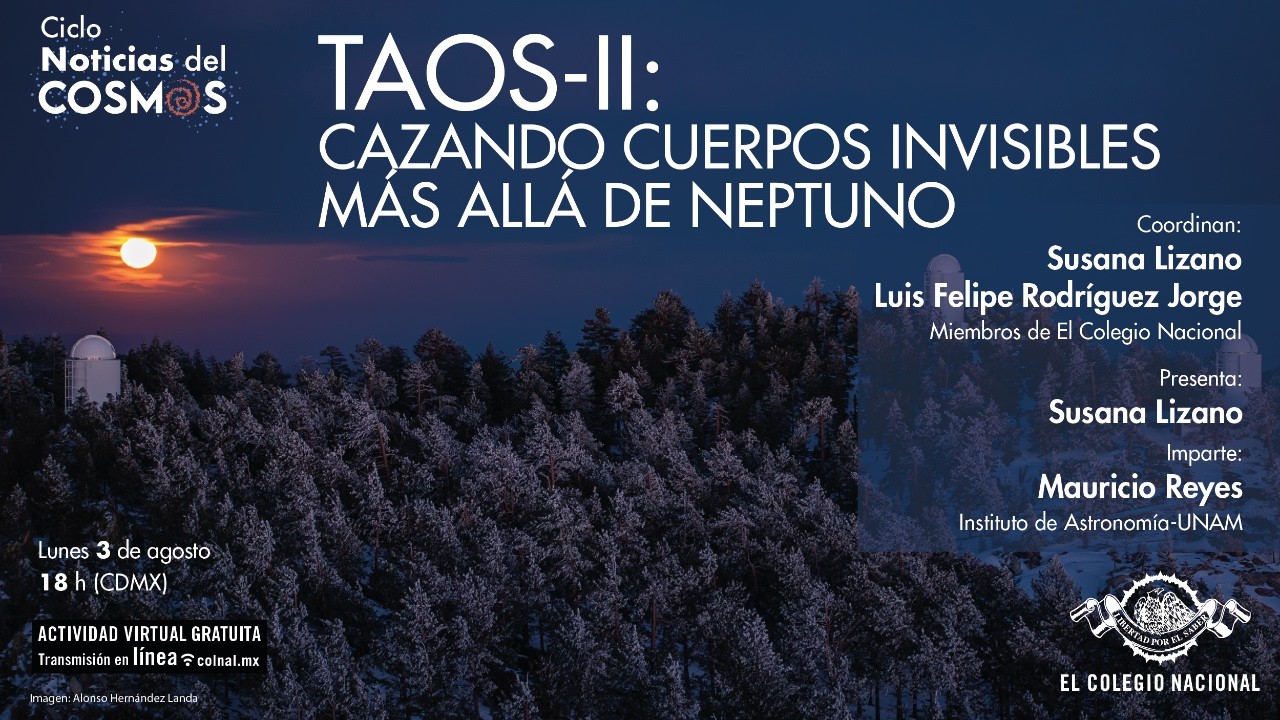
TAOS-II: cazando cuerpos invisibles más allá de Neptuno | Noticias del cosmos
Keywords
Summary
205 words
Critical Evaluation
The talk provides a solid overview of the scientific motivation and methodology behind the TAOS-II project. Dr. Reyes effectively communicates the importance of searching for small bodies in the outer solar system, linking theoretical expectations with observational strategies. The argument for the existence of these objects is well-founded, drawing on the observed stability of the short-period comet population and the orbital anomalies of extreme TNOs. The presentation is scientifically rigorous, with appropriate caveats about the uncertainties involved. The use of stellar occultations is a clever and proven technique, and the project’s design is well-explained. However, the talk is primarily a science communication piece, so some technical details are simplified, and the audience is not expected to have advanced knowledge. The speaker’s expertise is evident, and the content aligns with current research in planetary science. The title accurately reflects the content, and the talk successfully conveys the excitement of the search. The main limitation is that it does not provide deep technical details or quantitative results, but it serves its purpose as an informative lecture. Overall, the talk is of high quality, with clear explanations and a logical structure.
188 words
Title / Content Match
The title accurately reflects the content, which focuses on the search for small, invisible bodies beyond Neptune using the TAOS-II project.
Quality & Reliability
8/10
The talk is given by a researcher from the Institute of Astronomy at UNAM, with a clear presentation of the scientific rationale and methods of the TAOS-II project. The content is consistent with established knowledge in planetary science, though some claims are theoretical (e.g., the existence of small bodies) and the talk is aimed at a general audience, which may simplify some details.
Key Moments
Markers derived by PSI from the transcript: the creator did not define chapters.
- Introduction and welcome by Susana Lizano, presenting the speaker Mauricio Reyes.
- Discussion of the structure of the solar system, including the Kuiper Belt and Oort Cloud.
- Explanation of the known trans-Neptunian objects and the estimated number of smaller bodies.
- Presentation of the comet injection rate as evidence for the existence of small bodies.
- Introduction of the TAOS-II project and its goal to detect small bodies via occultations.
- Description of the TAOS-II telescope network and observational strategy.
- Discussion of the challenges in detecting occultations and the expected detection rates.
- Preliminary results and future plans for the TAOS-II project.
- Q&A session with the audience.
Cited Sources
- TAOS-II project website — Mentioned as the project's official site for more information.
Concurring Sources
- NASA Solar System Exploration: Kuiper Belt — Provides general information on the Kuiper Belt, consistent with the talk's description.
Contribution & Novelties
The talk provides an accessible overview of the TAOS-II project, which is a novel approach to detecting small bodies in the outer solar system using stellar occultations. It highlights the scientific motivation and the technical challenges, making it a valuable resource for those interested in planetary science.
Pour aller plus loin :
- Kuiper belt — Provides background on the region beyond Neptune.
- Stellar occultation — Explains the technique used by TAOS-II.
- Planet Nine — Discusses the hypothetical planet that may explain the orbits of extreme TNOs.
86 words
Radar Profile
The radar profile shows high scores in information quantity, quality, and reliability, with a moderate technical level. This indicates a well-balanced presentation that is both informative and scientifically sound, suitable for a general audience interested in astronomy.
💬 No comments were provided for analysis.