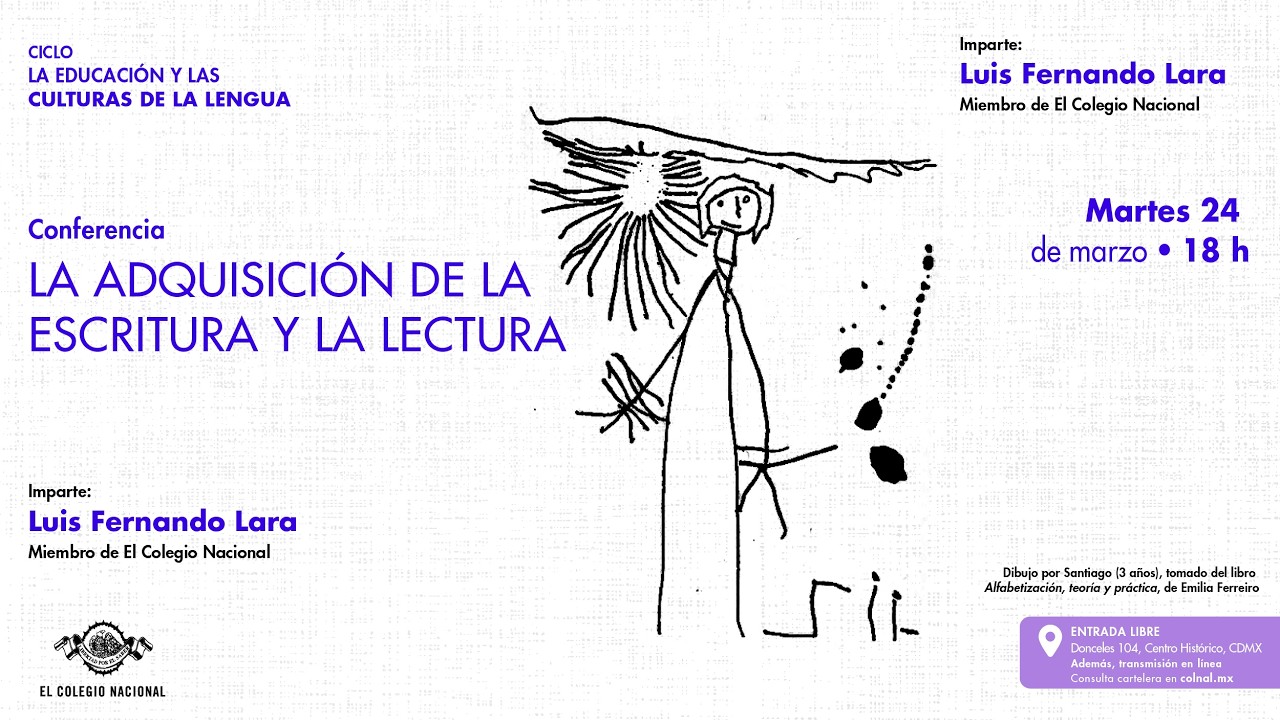
La adquisición de la escritura y la lectura | La educación y las culturas de la lengua
Keywords
Summary
169 words
Critical Evaluation
The lecture provides a comprehensive and authoritative overview of the psycholinguistic foundations of literacy acquisition, drawing on established research in developmental psychology and linguistics. Lara’s expertise is evident in his detailed explanations of articulatory phonetics and his integration of theoretical frameworks from Piaget and Ferreiro. The argumentation is solid, with clear connections between the neural basis of reading (Dehaene’s work) and the pedagogical implications for teaching reading and writing. The content is well-structured, progressing from the physiological aspects of speech production to the cognitive processes involved in understanding writing systems. The sources cited are reputable and relevant, including works by Ingram, Moscovitz, Jacobson, and Ferreiro. However, the lecture is primarily an expert opinion rather than a systematic review, and some claims, such as the universality of the open syllable, are presented without extensive empirical support. The title accurately reflects the content, and the lecture successfully bridges theoretical research and practical educational considerations. The presence of a brief mention of mirror neurons adds depth but is tangential. Overall, the lecture is highly informative and rigorous, though it may assume some prior knowledge of linguistics and psychology.
185 words
Title / Content Match
The title accurately reflects the content, which focuses on the acquisition of writing and reading within the context of language education and cultures.
Quality & Reliability
8/10
The lecture is delivered by a recognized linguist, Luis Fernando Lara, and draws on established research in psycholinguistics and developmental psychology (Piaget, Ferreiro, Dehaene). The content is well-structured and references specific studies, though it is presented as an expert opinion rather than a peer-reviewed synthesis.
Key Moments
Markers derived by PSI from the transcript: the creator did not define chapters.
- Introduction and recap of previous lectures on writing systems and neural basis of language.
- Explanation of the syllable as the basic unit of phonological development, citing Ingram and Moscovitz.
- Articulatory description of consonants and vowels, illustrating the formation of syllables.
- Introduction of Piaget's genetic epistemology and its relevance to literacy acquisition.
- Discussion of Emilia Ferreiro's research on children's construction of writing knowledge before schooling.
- Examples of children's early writing attempts and the distinction between drawing and writing.
- Role of imitation and mirror neurons in language development.
- Pedagogical implications: emphasis on syllabic and phonological teaching methods.
- Conclusion and preview of next session on semiotic function and meaning formation.
Cited Sources
- El papel de la sílaba en el desarrollo fonológico — Referenced as an article by David Ingram that discusses the role of the syllable in phonological development.
- La adquisición de la fonología — Referenced as a 1970 work by Arlin Moscovitz, considered the most explicit theory of syllabic development.
- Lenguaje infantil, afasia y universales fonológicos — Referenced as a book by Roman Jakobson that discusses the contrast of sonority in early syllable formation.
- Obra de Stanislas Dehaene — Referenced in the introduction as demonstrating the neural basis of reading and writing.
- Epistemología genética — Referenced as Piaget's theory underlying Ferreiro's research.
Concurring Sources
- Stanislas Dehaene - Reading in the Brain — Supports the neural basis of reading and the importance of phonological processing.
- Emilia Ferreiro - Los sistemas de escritura en el desarrollo del niño — Her research on children's writing development aligns with the lecture's focus.
Dissenting Sources
- Whole language approach — Contrasts with the syllabic/phonological method advocated in the lecture.
Contribution & Novelties
The lecture provides a comprehensive synthesis of psycholinguistic research on literacy acquisition, integrating neurological, phonological, and psychological perspectives. It emphasizes the syllable as the foundational unit, linking it to pedagogical strategies. The discussion of Ferreiro’s psychogenetic approach offers a valuable framework for understanding children’s early writing development.
Pour aller plus loin :
- Emilia Ferreiro — Overview of her contributions to literacy studies.
- Jean Piaget — Genetic epistemology and cognitive development.
- Stanislas Dehaene — Research on the neural basis of reading.
- Phonological awareness — Key concept in literacy acquisition.
- Mirror neurons — Neural basis of imitation and language.
97 words
Radar Profile
The radar profile shows high scores in information quantity, quality, and reliability, with a slightly lower technical level, indicating a lecture that is rich in content and well-supported but accessible to a general audience.