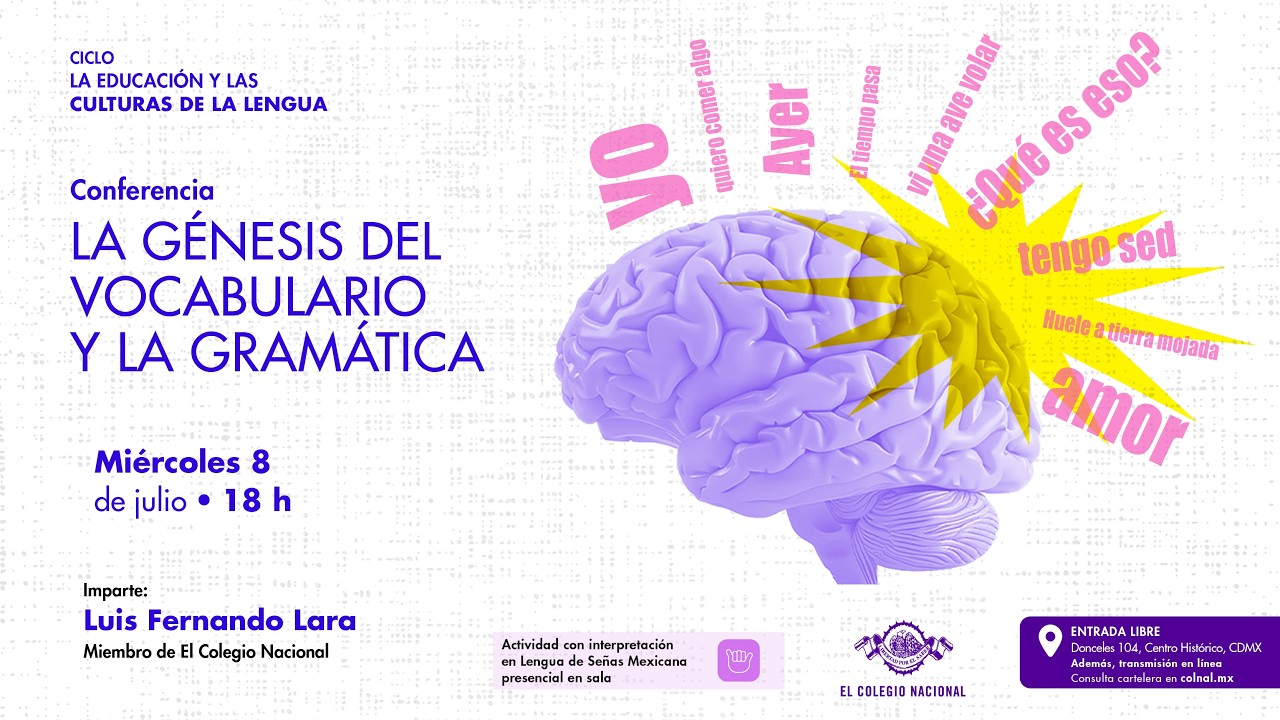
La génesis del vocabulario y la gramática | La educación y las culturas de la lengua
Keywords
Summary
163 words
Critical Evaluation
The lecture offers a rich and insightful perspective on language acquisition, blending linguistics, psychology, and biology. Lara’s argument is well-structured, moving from concrete examples (maternés, phonosymbolism) to theoretical frameworks (Piaget, Gestalt) and then to a critical evaluation of Chomsky’s universal grammar. His emphasis on semantic over syntactic analysis is a valuable contribution, and his call for phenomenological observation over aprioristic models is methodologically sound. The integration of Piaget’s theory and Gestalt psychology provides a coherent foundation for his claims, and the reference to Monod’s ‘Chance and Necessity’ adds a biological dimension. However, the lecture is primarily an opinion piece; while Lara cites specific studies (e.g., mirror neurons) and concepts, he does not present original empirical data. His critique of Chomsky, while valid, is somewhat polemical and could benefit from a more nuanced discussion of the evidence for and against universal grammar. The title accurately reflects the content, and the lecture is accessible to a general audience without oversimplifying. The presence of a brief sponsorship segment (approximately 30 seconds) does not detract from the scientific content. Overall, the lecture is intellectually stimulating and provides a solid overview of a complex topic, though it may not satisfy those seeking a balanced review of competing theories.
203 words
Title / Content Match
The title accurately reflects the content, which focuses on the origins and development of vocabulary and grammar in language acquisition.
Quality & Reliability
8/10
The speaker is a prominent linguist and member of El Colegio Nacional, providing a well-structured lecture grounded in established theories (Piaget, Gestalt, Chomsky) and his own research. The presentation is coherent and cites specific studies and concepts, though it is primarily an opinion piece with limited empirical data.
Key Moments
Markers derived by PSI from the transcript: the creator did not define chapters.
- Introduction and thanks; mention of sign language interpreters.
- Discussion of 'maternés' and phonosymbolism in early language acquisition.
- Explanation of Gestalt laws of perception and their relevance to language.
- Critique of Chomsky's universal grammar and introduction of alternative hypothesis.
- Discussion of Piaget's theory and the role of observation in language study.
- Explanation of morphemes, lexemes, and paradigms in Spanish.
- Conclusion and summary of the three characteristics of his approach.
Cited Sources
- El azar y la necesidad — Referenced as support for the hypothesis that genetic inheritance creates the capacity for language, not universal grammar.
- Piaget's theory of intelligence — Mentioned as foundational for understanding the mutual influence of intelligence and language formation.
- Gestalt psychology — Cited for laws of perception that apply to language acquisition.
Concurring Sources
- Piaget's theory of cognitive development — Supports the idea that language acquisition is linked to cognitive development.
- Gestalt psychology — Provides the laws of perception that Lara applies to language.
Dissenting Sources
- Universal grammar — Chomsky's hypothesis, which Lara critiques, posits innate syntactic rules, contrasting with his semantic and empirical approach.
Contribution & Novelties
The lecture provides a unique synthesis of Piagetian psychology, Gestalt perception, and linguistic semantics to argue against formalist approaches like Chomsky’s universal grammar. Lara’s emphasis on the semantic and phenomenological aspects of language acquisition offers a refreshing alternative to dominant syntactic theories. He also introduces the concept of ‘maternés’ and phonosymbolism as crucial elements in early language development.
Pour aller plus loin :
- Piaget’s theory of cognitive development — Relevant for understanding the cognitive basis of language acquisition.
- Gestalt psychology — Provides background on the laws of perception mentioned in the lecture.
- Universal grammar — For a detailed overview of Chomsky’s hypothesis and its critiques.
105 words
Radar Profile
The radar profile shows high scores in quantity and quality of information, with a strong technical level, indicating a dense and well-argued lecture. The overall reliability is high, reflecting the speaker's expertise and the coherent use of established theories.
💬 Sur les 0 commentaires analysés, aucune tendance n'a pu être dégagée.