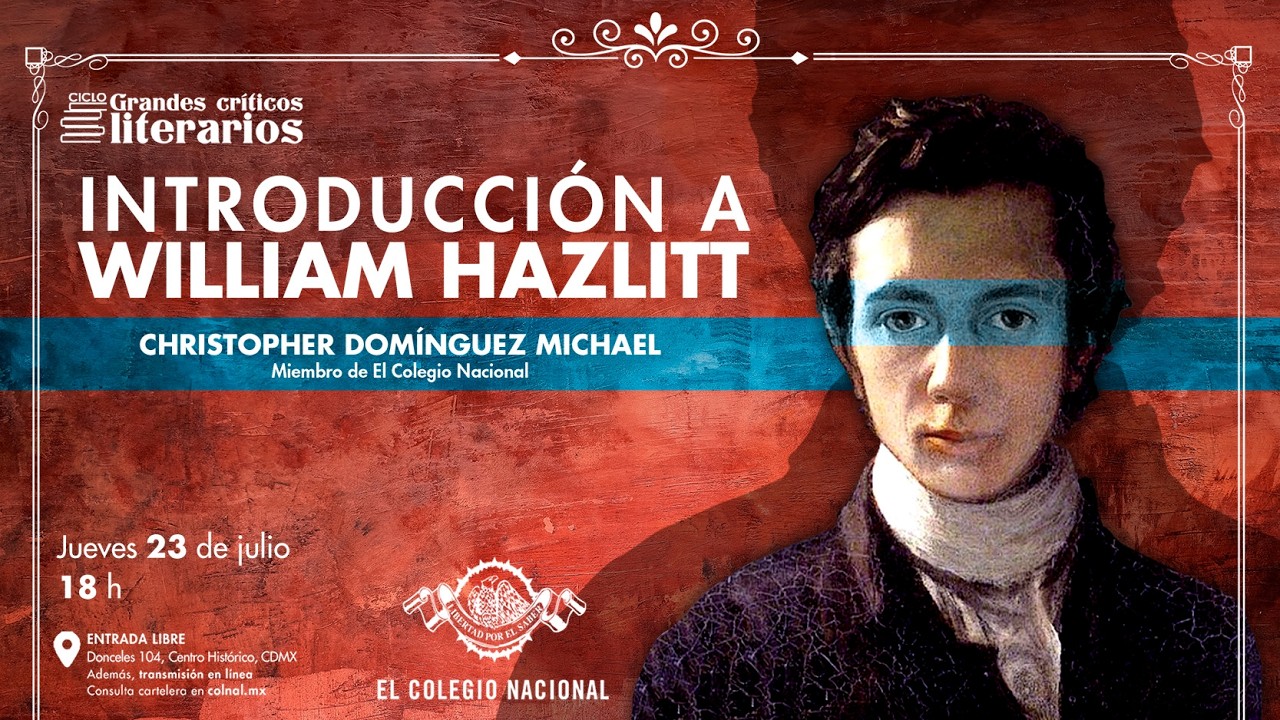
Introducción a William Hazlitt | Ciclo: Grandes críticos literarios
Keywords
Summary
160 words
Critical Evaluation
The lecture provides a rich, contextualized introduction to William Hazlitt, demonstrating the speaker’s deep familiarity with the subject. Domínguez Michael effectively situates Hazlitt within the intellectual and political currents of his time, particularly the English Enlightenment and the aftermath of the French Revolution. The discussion of Hazlitt’s Unitarian background and its influence on his secular morality is insightful, as is the analysis of his radical bonapartism and its consequences for his reputation. The speaker’s argument that Hazlitt’s political commitments were integral to his literary criticism is well-supported by references to his parliamentary reporting and his essays on the spirit of the age. The lecture also benefits from comparisons with contemporaries like Coleridge and Burke, clarifying Hazlitt’s unique position. However, the talk is primarily an opinion piece rather than a systematic scholarly analysis; it lacks citations and relies on the speaker’s authority. Some digressions, such as the extended discussion of the English Revolution and religious tolerance, while relevant, could have been more tightly connected to Hazlitt’s work. The title accurately reflects the content, and the lecture succeeds as an accessible introduction for a general audience. The absence of visual aids or structured presentation is compensated by the speaker’s engaging narrative style. Overall, the lecture is valuable for its synthesis of historical and literary insights, though it would benefit from more explicit references to primary sources.
224 words
Title / Content Match
The title accurately reflects the content: a lecture introducing William Hazlitt as part of a series on great literary critics.
Quality & Reliability
8/10
The speaker is a recognized literary critic and member of El Colegio Nacional, providing a well-informed and nuanced historical account. The lecture is based on established biographical and historical facts, though it includes personal interpretations and opinions. No external sources are cited, but the depth of knowledge and coherence support a high reliability score.
Key Moments
Markers derived by PSI from the transcript: the creator did not define chapters.
- Introduction to the lecture series and topic: William Hazlitt.
- Hazlitt's birth in 1778 and his Enlightenment background.
- Discussion of the English Revolution and its influence on English Enlightenment.
- Hazlitt's Unitarian upbringing and his father's connection to Adam Smith.
- Hazlitt's atheism and his generation's enthusiasm for the French Revolution.
- Hazlitt's defense of the French Revolution and Napoleon, and his biography of Napoleon.
- The conservative reaction after Napoleon's defeat and Hazlitt's radicalism.
- Hazlitt's invention of parliamentary reporting and his admiration for Edmund Burke.
- Hazlitt's major works and his view that literature and politics are intertwined.
Contribution & Novelties
The lecture offers a comprehensive and accessible introduction to William Hazlitt, emphasizing the interconnection between his political radicalism and his literary criticism. It provides valuable historical context, particularly regarding the English Enlightenment and the impact of the French Revolution on British intellectuals. The speaker’s expertise adds depth to the discussion of Hazlitt’s contributions to journalism and his major works.
Pour aller plus loin :
- William Hazlitt - Wikipedia — A general overview of Hazlitt’s life and works.
- The Spirit of the Age - Wikipedia — Information on one of Hazlitt’s most famous essay collections.
- Edmund Burke - Wikipedia — Background on the conservative thinker who influenced Hazlitt’s early views.
109 words
Radar Profile
The radar profile shows high scores in information quantity, quality, and reliability, with a slightly lower technical level, reflecting the lecture's accessible yet substantive nature. The balance suggests a well-rounded presentation suitable for a general audience interested in literary history.