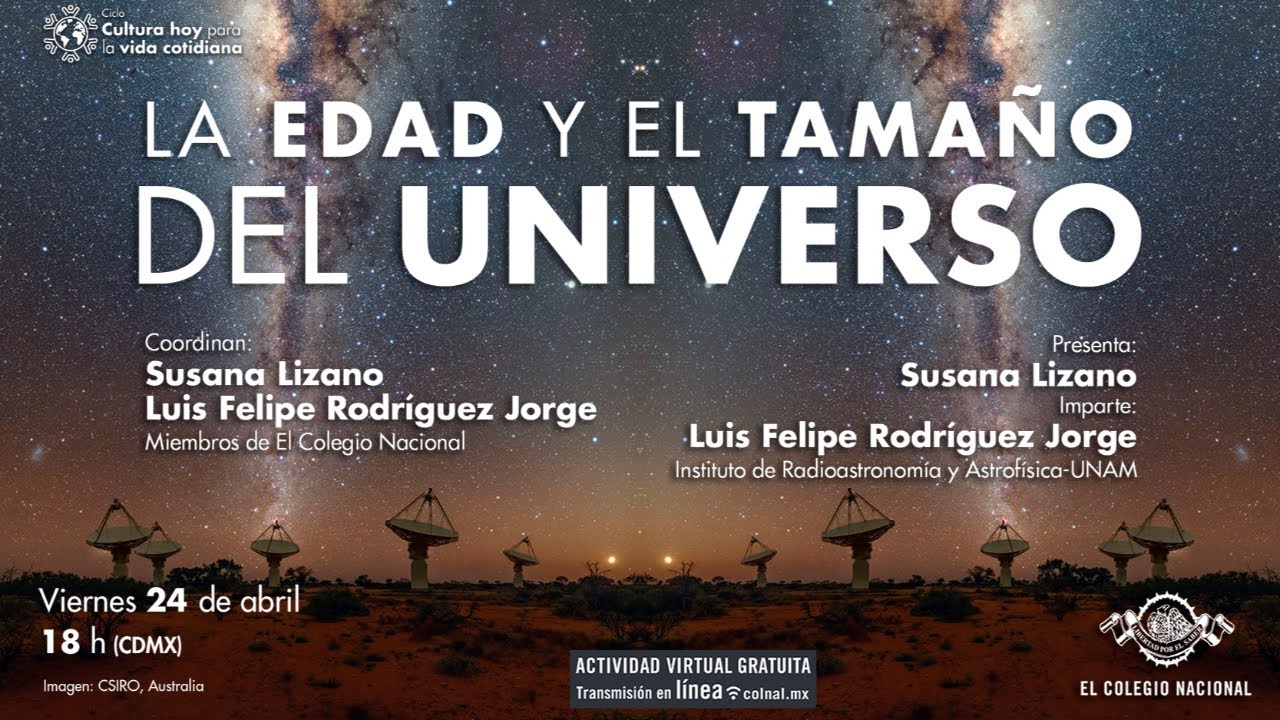
La edad y el tamaño del Universo
Keywords
Summary
192 words
Critical Evaluation
The lecture provides a solid, accessible overview of modern cosmology, delivered by an expert with deep knowledge of the field. The speaker’s credentials lend authority to the content, and the explanations are generally accurate and well-illustrated with analogies. The historical narrative, from the static universe to the discovery of expansion, is well presented, highlighting the contributions of Hubble and Lemaître. The use of the Doppler effect and the balloon analogy effectively conveys the concept of cosmic expansion. The derivation of the universe’s age from the Hubble constant is simplified but correct. The inclusion of the cosmic microwave background as evidence for the Big Bang is appropriate. However, the lecture is primarily a popular science talk, so it lacks detailed technical depth and specific citations to original research. Some topics, such as dark matter and dark energy, are mentioned but not elaborated upon. The Q&A section addresses audience questions, but the responses are brief. Overall, the lecture is informative and reliable, though it does not break new ground. The title accurately reflects the content, and the presentation is engaging. The main strength is the clarity of explanation for a general audience, while the main weakness is the lack of depth and references for those seeking more rigorous scientific detail.
208 words
Title / Content Match
The title accurately reflects the content: the lecture covers both the age and size of the universe, including the expansion, the Big Bang, and the cosmic microwave background.
Quality & Reliability
8/10
The lecture is given by a prominent radio astronomer, emeritus researcher at UNAM, with extensive publications and citations. The content is based on established cosmological knowledge (Hubble-Lemaître law, Big Bang theory, cosmic microwave background). The presentation is clear and accurate, with appropriate analogies. However, it is a popular science talk without detailed references or peer-reviewed sources cited in the video.
Key Moments
Markers derived by PSI from the transcript: the creator did not define chapters.
- Introduction by Susana Lizano, presenting the speaker Luis Felipe Rodríguez Jorge.
- Discussion of the scale of the universe and the question of its size.
- Introduction to the expansion of the universe and Edwin Hubble's discovery.
- Explanation of the Doppler effect and its application to galaxies.
- The Hubble-Lemaître law and the age of the universe calculation.
- Contextualizing the age of the universe with Earth's formation and human history.
- The balloon analogy to explain the expansion of space.
- The cosmic microwave background as evidence for the Big Bang.
- Discussion of the composition of the universe: dark matter and dark energy.
- The fate of the universe and possible scenarios.
Cited Sources
- El Colegio Nacional — Video source
Concurring Sources
- NASA - Universe — NASA's overview of the universe, consistent with the lecture's content.
Contribution & Novelties
The lecture provides a clear and accessible synthesis of current cosmological knowledge, emphasizing the historical development and key evidence. It does not present new research but offers a valuable educational resource.
Pour aller plus loin :
- Big Bang - Wikipedia — For a comprehensive overview of the Big Bang theory.
- Hubble’s law - Wikipedia — Detailed explanation of the Hubble-Lemaître law.
- Cosmic microwave background - Wikipedia — Information on the CMB as evidence for the Big Bang.
77 words
Radar Profile
The radar profile shows high scores in quality and reliability, reflecting the expert speaker and accurate content. The quantity of information is moderate, and the technical level is accessible, making it suitable for a general audience.
💬 No comments were provided for analysis.