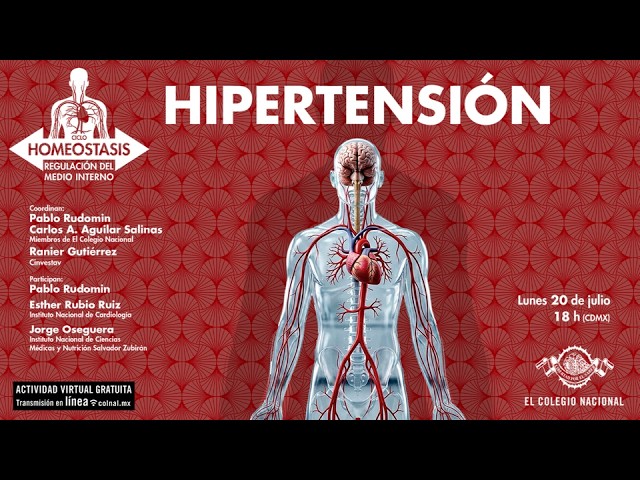
Hipertensión | Ciclo: Homeostasis: regulación del medio interno
Keywords
Summary
237 words
Critical Evaluation
The video provides a comprehensive and scientifically rigorous overview of blood pressure regulation and hypertension, presented by two experts in the field. Pablo Rudomin’s segment is particularly valuable for its historical perspective and detailed explanation of the experimental evidence supporting the role of baroreceptors in homeostasis. He clearly articulates the principle of causality in reflex physiology, referencing Descartes, and then systematically presents his own research from the 1960s, including experiments on the potentiation of baroreceptor reflexes during hypoxia and the dynamic control of blood pressure through carotid occlusion. His discussion of whether baroreceptor afferents are subject to presynaptic inhibition is nuanced, and he presents convincing experimental evidence that they are not, which is a key finding for understanding the stability of blood pressure regulation. The technical quality of the presentation is high, with clear diagrams and data, although there are some minor issues with slide sharing at the beginning. Jorge Oseguera’s segment on hypertension is clinically oriented, covering the pathophysiology, diagnosis, and treatment of hypertension, with a focus on the Mexican population. He provides practical insights based on his extensive clinical experience. The video is well-structured, but the lack of chapters makes it difficult to navigate. The sources cited are primarily the speakers’ own research and general knowledge, but no specific references are provided in the description. The video is an expert opinion and review of the topic, rather than a presentation of new original research. The audience is likely to be students, researchers, and healthcare professionals interested in cardiovascular physiology and hypertension. The video has a moderate number of views and likes, suggesting it is well-received. Overall, the content is accurate, well-argued, and scientifically sound, making it a valuable educational resource.
282 words
Title / Content Match
The title accurately reflects the content, which focuses on hypertension within the broader context of homeostasis and regulation of the internal environment.
Quality & Reliability
8/10
The video features two expert speakers (a physiologist and a cardiologist) from prestigious Mexican institutions, presenting both historical and current research on blood pressure regulation and hypertension. The content is scientifically rigorous, with references to classic experiments and mechanisms. However, the video is a recording of a live virtual conference with some technical issues and lacks structured chapters, which slightly affects accessibility.
Key Moments
Markers derived by PSI from the transcript: the creator did not define chapters.
- Introduction and coordination by Pablo Rudomin, Carlos Aguilar Salinas, and Ranier Gutiérrez.
- Pablo Rudomin begins his presentation on the principle of causality in reflex physiology, referencing Descartes.
- Explanation of baroreceptors in the carotid sinus and aortic arch, and their role in blood pressure regulation.
- Discussion of experiments on the potentiation of baroreceptor reflexes during hypoxia.
- Presentation of research on the dynamic control of blood pressure using carotid occlusion.
- Examination of whether baroreceptor afferents are subject to presynaptic inhibition, with experimental evidence.
- Conclusion of Rudomin's segment and transition to Jorge Oseguera's presentation on hypertension.
- Oseguera discusses the pathophysiology of hypertension, including risk factors and mechanisms.
- Clinical aspects of hypertension: diagnosis, treatment, and management strategies.
- Q&A session and closing remarks.
Cited Sources
- No specific sources cited in the video description — The video description does not list any external sources or references.
Concurring Sources
- Baroreflex — The baroreflex is a key mechanism for short-term blood pressure regulation, consistent with the video's content.
Contribution & Novelties
The video provides a unique combination of historical perspective and current research on blood pressure regulation, with a focus on the role of baroreceptors. Pablo Rudomin’s presentation offers original insights from his own experiments, which are not widely known. The discussion on the lack of presynaptic inhibition on baroreceptor afferents is a significant contribution to understanding the stability of blood pressure control. The clinical segment by Jorge Oseguera adds practical knowledge on hypertension management in the Mexican context.
Pour aller plus loin :
- Baroreceptor — Overview of baroreceptors and their role in blood pressure regulation.
- Nucleus tractus solitarius — Details on the brainstem nucleus involved in cardiovascular control.
- Hypertension — WHO fact sheet on hypertension, its prevalence, and management.
119 words
Radar Profile
The radar profile shows high scores in quality of information, technical level, and reliability, with a slightly lower score in quantity of information due to the limited number of specific sources cited. The video is strong in providing expert knowledge and experimental evidence, but may not cover all aspects of hypertension in depth.
💬 Sur les 0 commentaires analysés, aucune tendance n'a pu être dégagée.