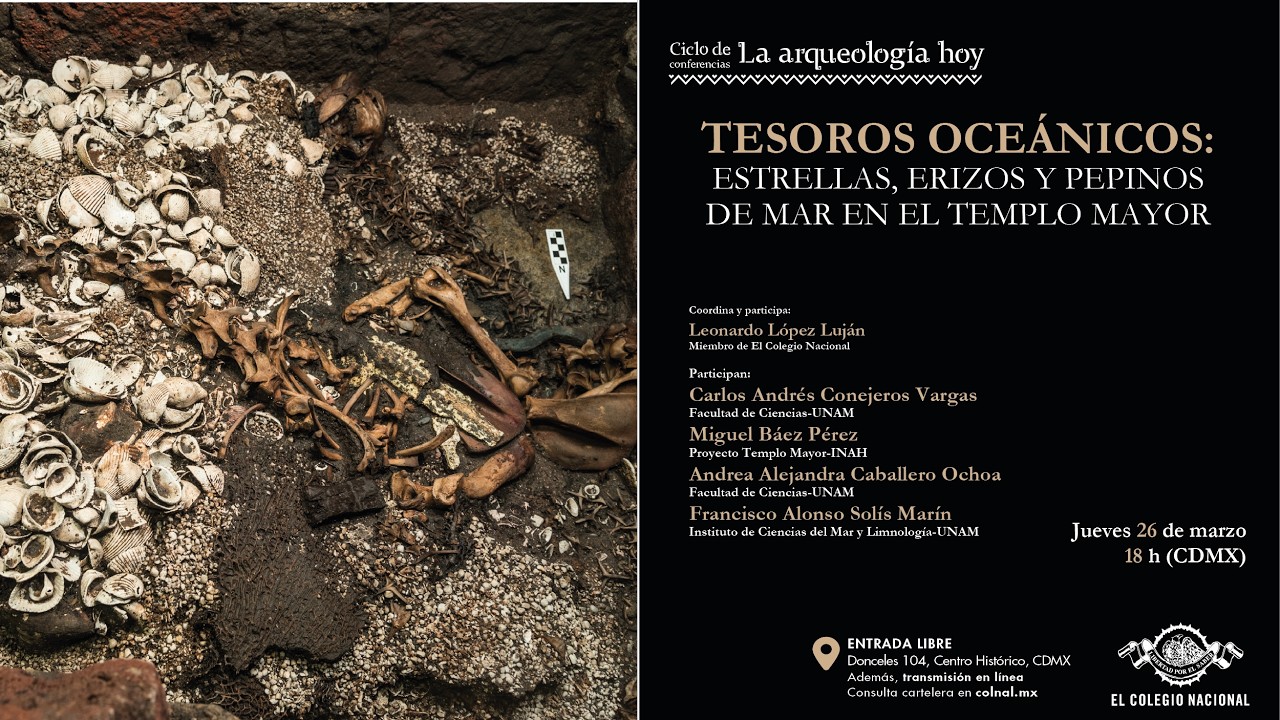
Tesoros oceánicos: estrellas, erizos y pepinos de mar en el Templo Mayor
Keywords
Summary
134 words
Critical Evaluation
The conference provides a valuable interdisciplinary perspective, combining marine biology and archaeology to interpret echinoderm remains in ritual contexts. The speakers are highly qualified, with extensive publication records, lending credibility to their statements. The argumentation is solid, grounded in systematic analysis of archaeological materials and comparison with modern biological data. However, the format is a conversational panel, which limits the depth of technical detail. The evidence presented is compelling but not fully detailed in this recording; for instance, specific species identifications and their cultural significance are mentioned but not exhaustively explained. The sources cited are primarily the speakers’ own research and institutional collaborations, which are reliable but not independently verified in this context. The title accurately reflects the content, and the discussion is well-structured. The main strength is the demonstration of how collaborative research can illuminate cultural practices. A minor weakness is the lack of visual aids in the audio-only version, which might hinder understanding of the archaeological contexts. Overall, the content is informative and scientifically sound, though it assumes some prior knowledge of Mesoamerican archaeology.
176 words
Title / Content Match
The title accurately reflects the content, which focuses on marine echinoderms found at the Templo Mayor and their cultural significance.
Quality & Reliability
8/10
The conference features recognized experts from UNAM and INAH, presenting interdisciplinary research on echinoderms in archaeological contexts. The discussion is grounded in systematic studies and published works, though it is a conversational format rather than a peer-reviewed presentation.
Key Moments
Markers derived by PSI from the transcript: the creator did not define chapters.
- Introduction by Leonardo López Luján, welcoming attendees and presenting the speakers.
- Announcements about upcoming conferences and publications, including the special issue of Arqueología Mexicana.
- Introduction of Francisco Solís Marín, detailing his expertise in echinoderm taxonomy.
- Introduction of Andrea Caballero, Miguel Báez, and Carlos Conejeros, highlighting their backgrounds.
- Start of the main discussion: the history of Templo Mayor excavations and the discovery of echinoderm remains.
- Explanation of the interdisciplinary approach and the significance of echinoderms in Mexica rituals.
- Discussion of specific species found and their possible origins from Pacific and Atlantic coasts.
- Challenges in preserving and analyzing echinoderm remains in archaeological contexts.
- Broader implications for understanding Mexica worldview and trade networks.
- Q&A session and concluding remarks.
Cited Sources
- Arqueología Mexicana — Mentioned as a publication with special issues on Mesoamerican historiography and Tlatelolco.
- Proyecto Templo Mayor — The archaeological project where the echinoderm remains were found.
- Instituto de Ciencias del Mar y Limnología, UNAM — Institution where the marine biology experts work.
Concurring Sources
- Arqueología Mexicana — The publication is mentioned as a source for related archaeological research.
Contribution & Novelties
This conference highlights the novel interdisciplinary approach combining marine biology and archaeology to study echinoderm remains in Mexica offerings. It provides new insights into the cultural significance of these marine organisms and their role in ritual practices, as well as evidence of long-distance trade networks. The collaboration between UNAM and INAH serves as a model for future research.
Pour aller plus loin :
- Echinodermata — Overview of the phylum, relevant for understanding the organisms discussed.
- Templo Mayor — Background on the main archaeological site.
- Mexica religion — Context for the ritual significance of offerings.
94 words
Radar Profile
The radar profile shows high scores in information quantity, quality, and reliability, with a slightly lower technical level, reflecting the accessible yet expert nature of the discussion.