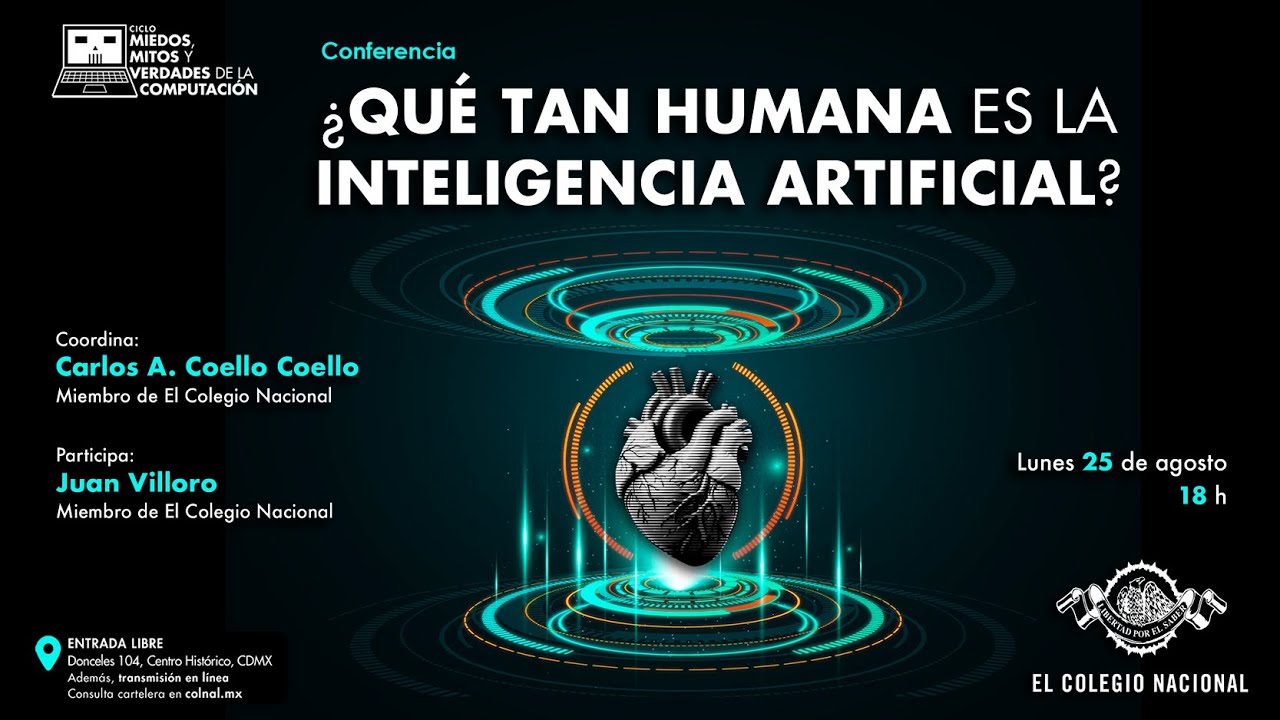
¿Qué tan humana es la inteligencia artificial?
Keywords
Summary
169 words
Critical Evaluation
The discussion provides a valuable interdisciplinary perspective on AI, combining technical insights from a leading researcher with humanistic reflections from a prominent writer. Carlos Coello Coello offers a clear and accurate historical context, correctly identifying the origins of AI in 1956 and explaining the ‘weak AI’ stance, which is a fundamental concept in the field. His reference to Asimov’s ‘The Bicentennial Man’ effectively illustrates philosophical questions about consciousness and mortality, though it remains a literary example rather than a scientific argument. Juan Villoro brings a critical social perspective, highlighting the potential cognitive decline associated with technology use, referencing the Flynn effect. However, his claims about the decline in human intelligence are presented without rigorous scientific backing, and the causal link to technology is oversimplified. The discussion is more of an opinion exchange than a rigorous scientific analysis, but it is well-informed and thought-provoking. The speakers acknowledge the benefits of AI while raising legitimate concerns about economic concentration and ethical implications. The lack of formal citations and the conversational format reduce the scientific rigor, but the content is generally reliable and aligns with mainstream views in the field. The title accurately reflects the content, and the discussion successfully addresses the question of AI’s ‘humanity’ from multiple angles. Overall, the video is a high-quality contribution to public understanding of AI, though it could benefit from more empirical evidence and specific references.
229 words
Title / Content Match
The title accurately reflects the central question of the debate, which explores the human aspects of AI from both technical and humanistic perspectives.
Quality & Reliability
7/10
The discussion features a leading AI researcher (Carlos Coello Coello) and a renowned writer (Juan Villoro), providing a balanced interdisciplinary perspective. The content is largely opinion and reflection rather than original research, but it is grounded in the speaker's expertise and references to literature and general knowledge. The lack of formal citations and the conversational format slightly reduce the score.
Key Moments
Markers derived by PSI from the transcript: the creator did not define chapters.
- Introduction by Carlos Coello Coello, setting the stage for the discussion on AI's humanity.
- Coello Coello explains the origins of AI in 1956 and the 'weak AI' position.
- Discussion of Asimov's 'The Bicentennial Man' and philosophical questions about consciousness and mortality.
- Juan Villoro begins his response, discussing the impact of automation and the decline in human cognitive abilities.
- Villoro highlights the benefits of AI while raising concerns about economic concentration and inequality.
- Discussion on how AI influences daily life, education, and writing.
- Audience Q&A session begins, addressing public fears and misconceptions about AI.
- Further discussion on ethical considerations and the future of AI.
- Closing remarks summarizing key points and emphasizing the need for informed dialogue.
Cited Sources
- No soy un robot — Book by Juan Villoro, referenced as inspiration for the discussion topic.
- The Bicentennial Man — Science fiction story by Isaac Asimov, cited by Carlos Coello Coello to illustrate philosophical questions about AI and humanity.
Concurring Sources
- No soy un robot — Book by Juan Villoro that aligns with the discussion's themes on digital society and AI.
Contribution & Novelties
The video offers a unique interdisciplinary dialogue between a computer scientist and a writer, providing both technical and humanistic perspectives on AI’s relationship with humanity. It demystifies common fears by clarifying the ‘weak AI’ position and emphasizes the importance of understanding AI as a tool rather than a threat. The discussion also touches on societal impacts such as cognitive decline and economic concentration, which are often overlooked in purely technical discussions.
Pour aller plus loin :
- Weak AI (Wikipedia) — Provides a definition and context for the ‘weak AI’ position mentioned in the video.
- Flynn effect (Wikipedia) — Explains the phenomenon of rising IQ scores and the recent decline, as referenced by Juan Villoro.
- The Bicentennial Man (Wikipedia) — Offers background on Asimov’s story and its themes.
127 words
Radar Profile
The radar profile shows a balanced distribution across the four dimensions, with slightly higher scores in quantity of information and reliability, reflecting the depth of the discussion and the credibility of the speakers. The technical level is moderate, suitable for a general audience, while the quality of information is strong due to the expert contributions.