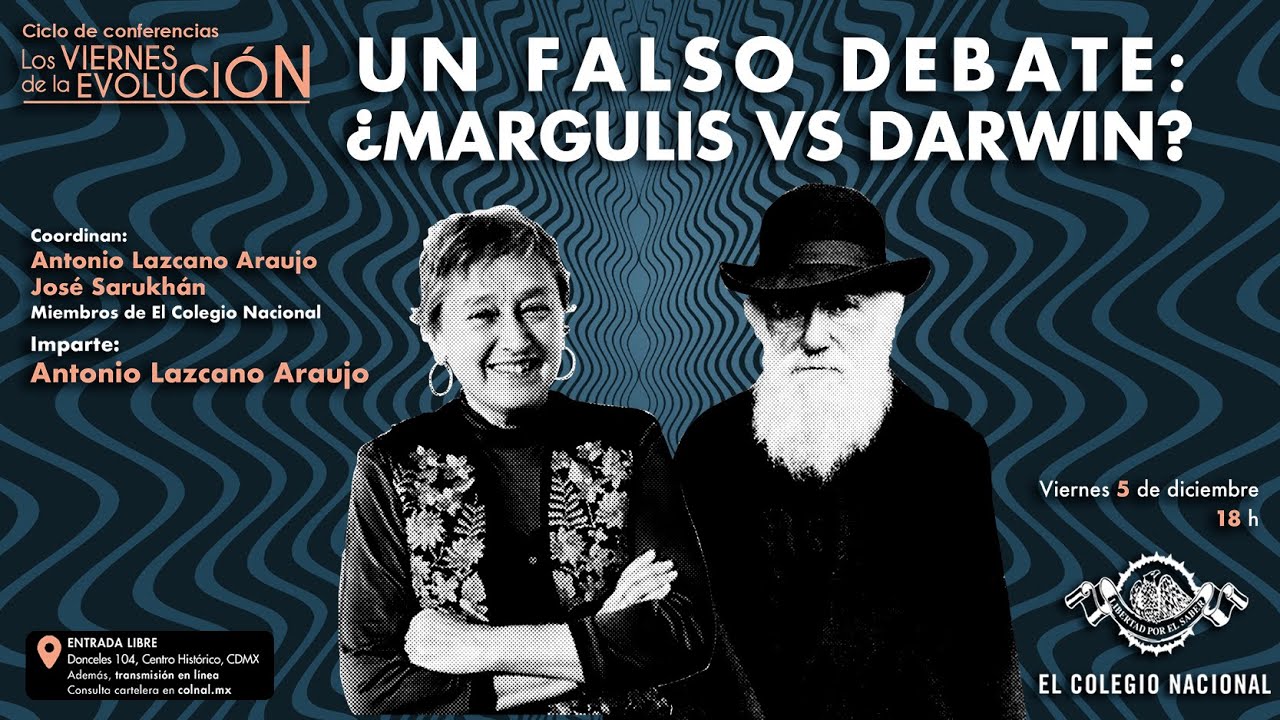
¿Un falso debate: Margulis vs Darwin? | Ciclo Los viernes de la evolución
Keywords
Summary
116 words
Critical Evaluation
The lecture provides a thorough and nuanced historical account of the development of endosymbiotic theory, effectively dismantling the notion of a conflict with Darwinism. Lazcano’s expertise is evident in his detailed knowledge of primary sources and personal interactions with Margulis, lending credibility to his narrative. He correctly emphasizes that Margulis’s work was not creationist but rather a scientific hypothesis with testable predictions, and he highlights the importance of recognizing her intellectual debts. The argumentation is solid, though it relies heavily on anecdotal evidence and historical interpretation rather than presenting new scientific data. The sources cited, including Darwin’s manuscripts and Margulis’s publications, are appropriate and well-integrated. The lecture’s technical level is accessible to a general audience while still providing depth for specialists. Overall, it is a valuable contribution to the history of science, clarifying misconceptions and celebrating Margulis’s legacy.
138 words
Title / Content Match
The title accurately reflects the content, which addresses the perceived conflict between Margulis's endosymbiotic theory and Darwinian evolution.
Quality & Reliability
9/10
The speaker is a renowned biologist and historian of science, providing a well-documented historical account with references to primary sources and personal anecdotes. The content is consistent with established scientific knowledge.
Key Moments
Markers derived by PSI from the transcript: the creator did not define chapters.
- Introduction and welcome to the lecture series.
- Discussion of Darwin's tree of life and its metaphorical significance.
- Early proposals of endosymbiosis by Mereschkovsky and others.
- Lynn Margulis's background and inspiration from Hans Ris.
- Margulis's 1967 paper and its rejection history.
- Clarification that Margulis's theory is not anti-Darwinian.
- Modern molecular evidence supporting endosymbiosis.
- Conclusion and Q&A session.
Cited Sources
- On the Origin of Species by Charles Darwin — Mentioned as the foundational work of evolutionary theory.
- The Cell in Development and Inheritance by Edmund B. Wilson — Cited as a key source that presented endosymbiotic ideas to Margulis.
- Margulis, L. (1967). On the origin of mitosing cells. Journal of Theoretical Biology. — The seminal paper proposing the endosymbiotic theory.
Concurring Sources
- Endosymbiotic theory - Wikipedia — Supports the historical account and scientific basis of endosymbiosis.
- Lynn Margulis - Wikipedia — Confirms biographical details and contributions.
Contribution & Novelties
The lecture provides a historical clarification of the relationship between endosymbiosis and Darwinian evolution, emphasizing that Margulis’s work builds upon rather than contradicts Darwin’s ideas. It offers personal insights into Margulis’s scientific journey and the intellectual context of her discoveries.
Pour aller plus loin :
- Endosymbiotic theory - Wikipedia — Provides a comprehensive overview of the theory and its development.
- Lynn Margulis - Wikipedia — Biographical details and contributions.
- Serial endosymbiosis theory - Wikipedia — Explains the specific hypothesis proposed by Margulis.
82 words
Radar Profile
The radar profile shows high scores in information quantity, quality, and reliability, with a slightly lower technical level, indicating a lecture that is both informative and accessible.