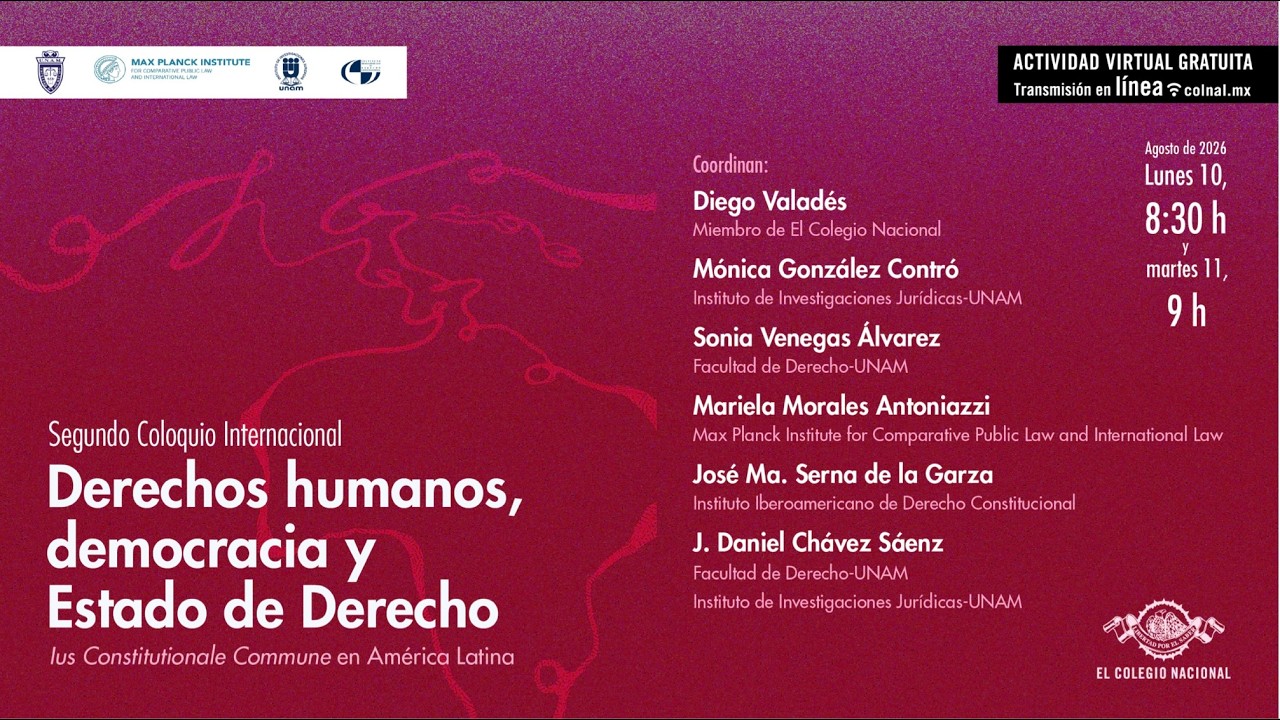
Segundo Coloquio Internacional Derechos humanos, democracia y Estado de Derecho | Día 1, 2a Mesa
Keywords
Summary
195 words
Critical Evaluation
The video provides a high-level academic discussion on the control of conventionality, a key concept in inter-American human rights law. The main speaker, Carolina Bejarano, demonstrates deep knowledge of Colombian constitutional law and its interaction with the Inter-American system. She presents a nuanced argument, distinguishing between the ‘bloque de constitucionalidad’ as a mechanism for incorporating international law and the ‘control de convencionalidad’ as a judicial function. Her analysis of recent Colombian jurisprudence is well-documented, referencing specific cases and dissenting opinions. The argumentation is solid, but it is an expert opinion rather than a peer-reviewed study, so some claims are not empirically verified. The panel format allows for diverse perspectives, but the time constraints limit the depth of each intervention. The sources cited are primarily legal documents and court rulings, which are appropriate for the topic. The title accurately reflects the content. Overall, the video is a valuable resource for legal scholars and practitioners interested in the evolution of conventionality control in Latin America.
163 words
Title / Content Match
The title accurately describes the event: a panel on human rights, democracy, and rule of law, specifically focusing on conventionality control.
Quality & Reliability
8/10
The video features legal scholars from prestigious institutions (Max Planck Institute, UNAM, etc.) discussing a specialized topic. The content is well-structured, with clear arguments and references to specific court decisions. However, it is a panel discussion, not a peer-reviewed publication, and some claims are not backed by citations.
Key Moments
Markers derived by PSI from the transcript: the creator did not define chapters.
- Introduction by moderator Patricia Cruz Marín, presenting the panel topic and speakers.
- Carolina Bejarano begins her presentation on conventionality control in Colombia, highlighting the 'bloque de constitucionalidad' as a key achievement.
- Bejarano discusses the relationship between the 'bloque' and conventionality control, referencing the C-327/2016 ruling.
- Analysis of recent changes in Colombian jurisprudence, including the C-146/2001 and C-030/2023 rulings.
- Bejarano presents her criticisms of the recent rulings, arguing that they conflate compliance with binding judgments and general concerns about conventional supremacy.
- Discussion on the role of all judges in applying the 'bloque de constitucionalidad' and the need to distinguish between dialogue and compliance.
- Bejarano concludes with a future agenda emphasizing complementarity and dialogue between national and inter-American courts.
- Other panelists (from Panama, Argentina, Brazil) provide their perspectives on conventionality control in their countries.
- Q&A session and closing remarks.
Cited Sources
- Constitución Política de Colombia (Artículo 93) — Mentioned as the constitutional basis for the 'bloque de constitucionalidad'.
- Sentencia C-146/01 (Corte Constitucional de Colombia) — Cited as the first conceptual shift separating the 'bloque' from conventionality control.
- Sentencia C-030/23 (Corte Constitucional de Colombia) — Cited as a key ruling limiting autonomous conventionality control.
- Caso Petro Urrego vs. Colombia (Corte Interamericana de Derechos Humanos) — Referenced as the Inter-American Court judgment that Colombia had to comply with.
Concurring Sources
- Sentencia C-327/16 (Corte Constitucional de Colombia) — Cited as an example where the Court performed conventionality control without naming it.
Dissenting Sources
Contribution & Novelties
The video provides an up-to-date analysis of the evolution of conventionality control in Colombia, particularly the recent jurisprudential shifts that limit its autonomous application. It offers a critical perspective on these developments, arguing for a nuanced approach that distinguishes between dialogue with inter-American precedents and compliance with binding judgments. This contributes to the ongoing academic debate on the relationship between national constitutions and international human rights law.
Pour aller plus loin :
- Control de convencionalidad (Wikipedia) — Provides a general overview of the concept.
- Bloque de constitucionalidad (Wikipedia) — Explains the concept in the context of Colombian constitutional law.
- Corte Interamericana de Derechos Humanos — Official site of the Inter-American Court, where relevant judgments can be found.
117 words
Radar Profile
The radar profile shows high scores in all dimensions, indicating a well-balanced and informative content. The video excels in the quality and quantity of information, with a high technical level suitable for an academic audience. The reliability is strong due to the expertise of the speakers and the use of legal sources.
💬 No comments were provided for analysis.