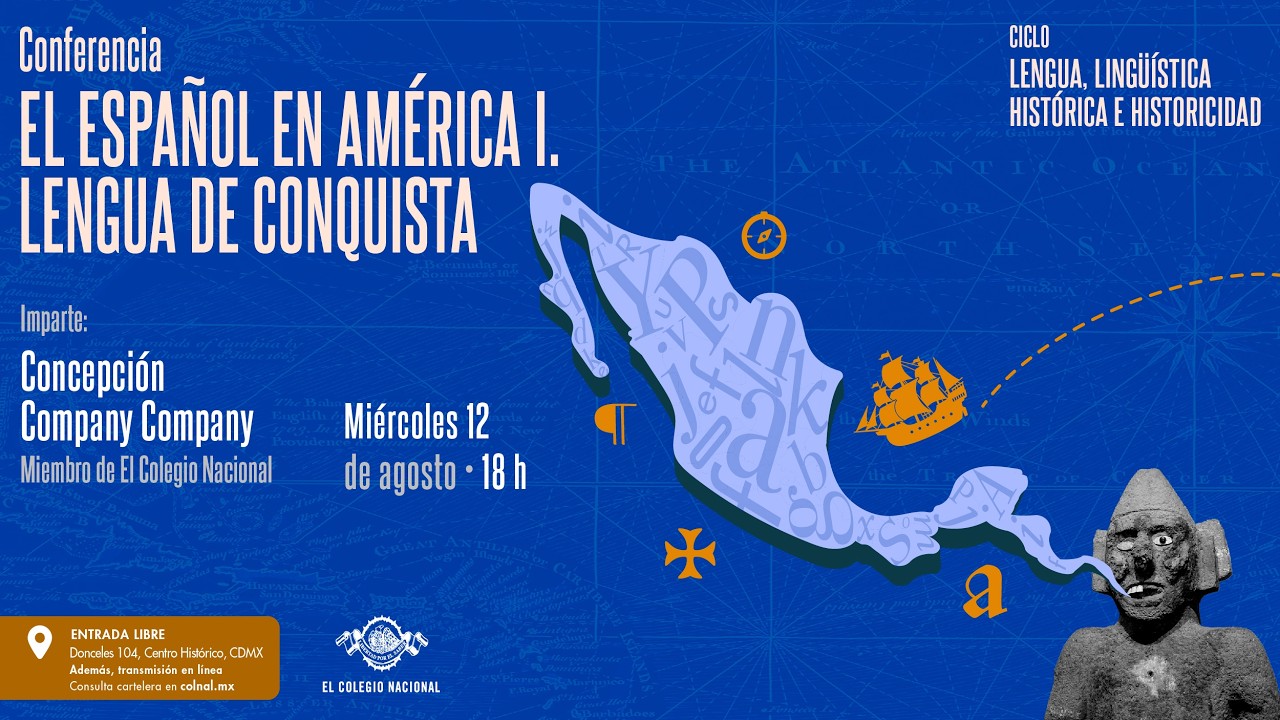
El español en América I. Lengua de conquista | Lengua, lingüística histórica e historicidad
Keywords
Summary
202 words
Critical Evaluation
Value of the Information & Strength of the Argument
The lecture provides valuable insights into the historical and sociolinguistic aspects of Spanish in the Americas. The speaker’s argumentation is solid, drawing on historical documents, linguistic principles, and examples from various languages. She effectively demonstrates how Spanish evolved from a language of conquest to a lingua franca and then to a patrimonial language, using concrete examples and historical references. The discussion on language contact and borrowing is nuanced, acknowledging both enrichment and prejudice. The speaker’s expertise is evident, and she presents a compelling case for the importance of language standardization and linguistic citizenship.
Scientific Rigor, Source Quality, Title Accuracy
The lecture demonstrates scientific rigor through the speaker’s expertise and the use of historical references, such as Alfonso X’s writings and the Popol Vuh. However, explicit citations to specific academic sources are limited, and the talk is primarily based on the speaker’s own knowledge and interpretation. The title accurately reflects the content, focusing on the role of Spanish as a language of conquest and its historical development. The lecture is well-structured and coherent, with clear arguments and examples.
186 words
Title / Content Match
The title accurately reflects the content: the lecture focuses on the role of Spanish as a language of conquest in the Americas and its historical development.
Quality & Reliability
8/10
The speaker is a recognized linguist (Concepción Company Company), and the content is well-structured, drawing on historical and linguistic evidence. However, it is primarily an expert opinion lecture with limited explicit citations to specific studies.
Key Moments
Markers derived by PSI from the transcript: the creator did not define chapters.
- Introduction: importance of language as a human right and the concept of linguistic citizenship.
- Discussion on the standardization of language and the role of schools in teaching the cultured variety.
- Introduction to the topic: Spanish in America as a language of conquest.
- Explanation of the cognitive principles: naming to exist and language as a support of perception.
- Discussion on language contact and borrowing, with examples from Arabic, French, and indigenous languages.
- The historical rarity: precise dating of the start of Spanish in America to October 12, 1492.
- Geographical rarity: the vast extension of Spanish-speaking territories in the Americas.
- Definition of a language of conquest and its characteristics, including catastrophe and colonial imposition.
- Transition from colonial language to lingua franca and then to patrimonial language.
- Conclusion: the importance of understanding the history of Spanish in America for linguistic identity.
Cited Sources
- Popol Vuh — Mentioned as an example of the principle of naming to exist in the Maya-Quiché tradition.
- General History of Alfonso X — Referenced to illustrate the connection between language and perception of the world.
- One Hundred Years of Solitude by Gabriel García Márquez — Cited as a modern example of the principle that things need names to exist.
Concurring Sources
- Popol Vuh — Supports the idea that naming is a universal cognitive principle in creation myths.
- Alfonso X's General History — Aligns with the speaker's argument about language and perception.
Contribution & Novelties
The lecture offers a comprehensive overview of the historical and sociolinguistic factors that shaped Spanish in the Americas, emphasizing the precise dating of its arrival and the cognitive principles underlying language contact. It provides a nuanced perspective on the evolution from a language of conquest to a lingua franca and patrimonial language.
Pour aller plus loin :
- Language contact — Provides background on the mechanisms and outcomes of language contact.
- Lingua franca — Explains the concept of a lingua franca and its role in communication.
- Spanish colonization of the Americas — Historical context for the spread of Spanish in the New World.
102 words
Radar Profile
The radar profile shows high scores in quantity and quality of information, with a moderate level of technicality. The high reliability score reflects the speaker's expertise, but the lack of explicit citations slightly reduces the overall reliability. The profile suggests a well-informed lecture that is accessible to a general audience.
💬 No comments were provided for analysis.