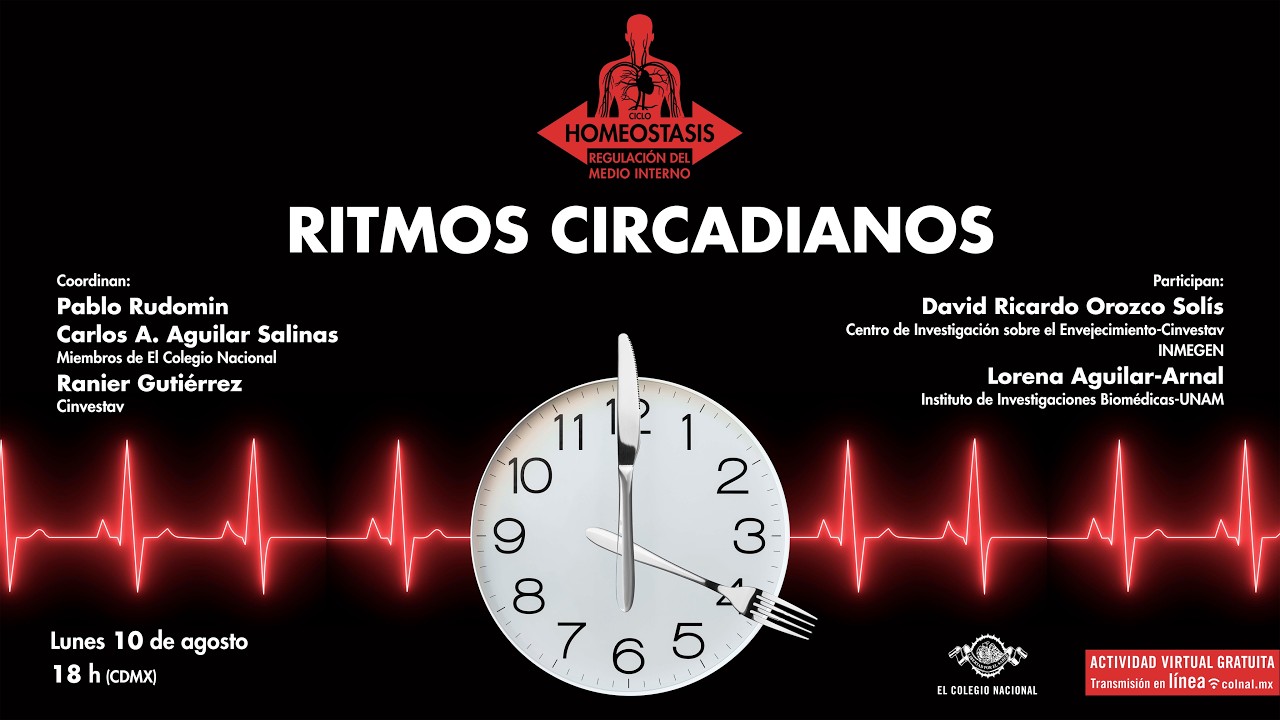
Ritmos circadianos | Ciclo: Homeostasis: regulación del medio interno
Keywords
Summary
197 words
Critical Evaluation
The video provides a comprehensive and scientifically rigorous overview of circadian rhythms, presented by two experts in the field. The content is well-structured, starting with fundamental concepts and progressing to molecular mechanisms, physiological implications, and potential therapeutic applications. The speakers cite key studies, including the Nobel Prize-winning work on clock genes, and present their own research, adding credibility. The argumentation is solid, with clear explanations of complex topics like the molecular feedback loop and NAD+ metabolism. However, the format is a live conference, which means some technical issues and informal asides are present. The discussion is thorough, but the depth may be challenging for a general audience. The sources cited are primarily from the speakers’ own publications and well-known studies, but no external references are provided in the description. The title accurately reflects the content, and the video successfully delivers on its promise to explore circadian rhythms and their impact on health. The main strength is the depth of scientific detail and the integration of basic and translational research. A potential weakness is the lack of visual aids for some complex concepts, and the reliance on animal models for some conclusions, which the speakers themselves acknowledge. Overall, this is a high-quality educational resource for those with a background in biology or medicine.
212 words
Title / Content Match
The title accurately reflects the content, which is a detailed lecture on circadian rhythms within a broader series on homeostasis.
Quality & Reliability
8/10
The video features two established researchers (Lorena Aguilar-Arnal and David Ricardo Orozco Solís) presenting their own published work and reviewing key literature. The content is scientifically accurate, with references to Nobel Prize-winning mechanisms and recent studies. However, the format is a live conference with limited peer review, and some claims are based on animal models that may not directly translate to humans.
Key Moments
Markers derived by PSI from the transcript: the creator did not define chapters.
- Introduction to circadian rhythms and their importance in homeostasis.
- Explanation of the suprachiasmatic nucleus as the central clock.
- Molecular mechanisms: CLOCK, BMAL1, PER, CRY feedback loop.
- Circadian regulation of metabolism and the role of NAD+.
- Discussion on circadian disruption and metabolic diseases.
- Evolutionary origins of circadian clocks and time-restricted feeding.
- Circadian rhythms and aging: hallmarks and interventions.
- Circadian disruption and mental health: depression and suicide.
- Q&A session on sleep, shift work, and practical recommendations.
Cited Sources
- Nobel Prize in Physiology or Medicine 2017 — Mentioned as the discovery of molecular mechanisms controlling circadian rhythms.
- Aguilar-Arnal L, et al. (2020) NAD+ and circadian rhythms — Speaker's own research on NAD+ and time-of-day effects.
- Orozco-Solis R, et al. (2024) Time-restricted feeding and aging — Speaker's research on time-restricted feeding and longevity.
Concurring Sources
- Circadian rhythms and metabolism (Bass & Takahashi, 2010) — Supports the link between circadian disruption and metabolic disease.
- Time-restricted feeding and metabolic health (Panda et al., 2015) — Supports the benefits of time-restricted feeding.
Dissenting Sources
- Intermittent fasting: potential risks and benefits — Some studies suggest intermittent fasting may have adverse effects in certain populations, contrasting with the positive portrayal in the video.
Contribution & Novelties
The video provides an up-to-date synthesis of circadian biology, integrating molecular mechanisms with physiological and clinical implications. It highlights the importance of chrononutrition and chronotherapy, and presents novel findings on NAD+ and time-restricted feeding. The discussion on circadian rhythms and mental health adds a valuable perspective.
Pour aller plus loin :
- Circadian rhythm - Wikipedia — Overview of circadian rhythms.
- Suprachiasmatic nucleus - Wikipedia — Detailed information on the central clock.
- NAD+ - Wikipedia — Background on NAD+ metabolism.
79 words
Radar Profile
The radar profile shows high scores in quantity and quality of information, with a strong technical level, indicating a dense and scientifically robust presentation. The reliability is also high, reflecting the expertise of the speakers and the use of established research.
💬 Sur les 0 commentaires analysés, aucune tendance n'a pu être dégagée.