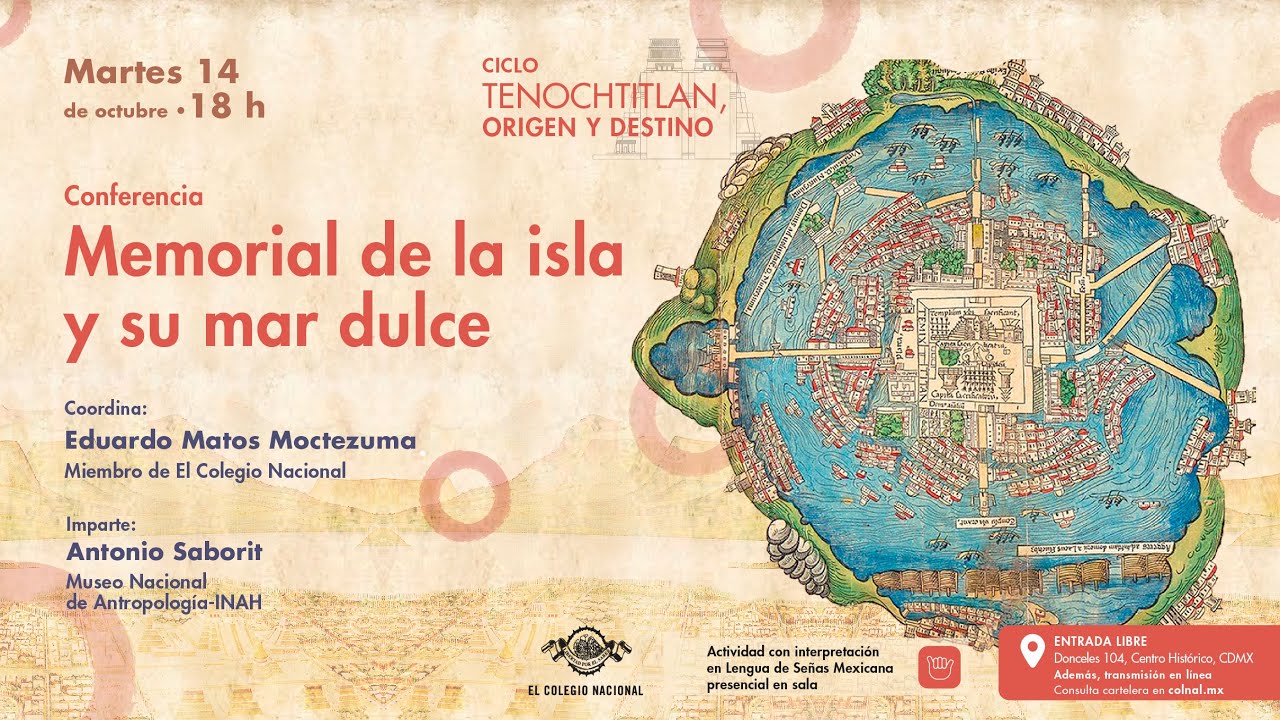
Memorial de la isla y su mar dulce | Ciclo: Tenochtitlan, origen y destino
Keywords
Summary
156 words
Critical Evaluation
The lecture provides a comprehensive and engaging overview of the geological and historical origins of Tenochtitlan, drawing on a wide range of sources, from geological studies to colonial chronicles. Saborit’s expertise is evident in his ability to synthesize complex information into a coherent narrative. The argumentation is generally solid, though the lecture is more of a narrative exposition than a critical analysis. He does not engage with alternative interpretations or debates, but rather presents a straightforward account. The scientific rigor is high in terms of factual accuracy, but the lack of explicit citations during the talk makes it difficult to verify specific claims. The sources mentioned, such as Clavijero and Galindo y Villa, are credible, but the lecture would benefit from more direct references. The title accurately reflects the content, focusing on the island and its freshwater lake. Overall, the lecture is valuable for its interdisciplinary approach and depth of information, but it could be enhanced by more critical engagement with the material.
163 words
Title / Content Match
The title accurately reflects the content, focusing on the island of Tenochtitlan and its freshwater lake, though the lecture extends to broader geological and historical context.
Quality & Reliability
8/10
The lecture is delivered by a recognized historian and director of the National Museum of Anthropology, providing a well-structured narrative based on historical and geological evidence. However, it is a single expert's perspective without explicit citations during the talk, and some geological details are presented in a literary style.
Key Moments
Markers derived by PSI from the transcript: the creator did not define chapters.
- Introduction by Patricia Ledesma Bouchá, welcoming the audience and introducing Dr. Antonio Saborit.
- Saborit begins his lecture, dedicating it to Bertina Olmedo and starting with the geological formation of the Basin of Mexico.
- Discussion of the impact of the meteorite that created the Chicxulub crater and its effects on the region.
- Description of the lake system that formed in the Basin of Mexico and the fauna that inhabited it.
- Mention of early human presence and archaeological evidence in the region.
- Foundation of Tenochtitlan and its initial growth as an island city.
- Details on the reign of Acamapichtli and the division of the city into four sectors.
- Discussion of Huitzilihuitl's agricultural innovations, including chinampas.
- Chimalpopoca's construction of an aqueduct and other public works.
- Itzcoatl's defeat of Azcapotzalco and the formation of the Triple Alliance.
Cited Sources
- Historia antigua de México — Cited by Saborit for information on the early rulers and the city's foundation.
- Jesús Galindo y Villa — Quoted for the description of the Basin of Mexico as a hydrographic basin.
- Pablo Martínez del Río — Borrowed the image of the 'olla' to describe the basin.
- Francisco Javier Clavijero — Cited for descriptions of the fauna and the early history of the Mexica.
Concurring Sources
- Historia antigua de México — Clavijero's work aligns with Saborit's account of the Mexica rulers and the city's foundation.
Dissenting Sources
- Alternative theories on the founding of Tenochtitlan — Some historians propose different dates or circumstances for the city's founding, which are not addressed in the lecture.
Contribution & Novelties
This lecture offers a unique interdisciplinary perspective, combining geological history with the cultural and political development of Tenochtitlan. It provides a comprehensive narrative that situates the city’s founding within the deep time of the Basin of Mexico, emphasizing the importance of the lake ecosystem. The lecture also highlights lesser-known details, such as the specific rulers and their contributions, and the archaeological findings that illuminate the city’s early layout.
Pour aller plus loin :
- Chicxulub crater — Provides background on the meteorite impact mentioned in the lecture.
- Chinampa — Explains the agricultural technique discussed in the context of Huitzilihuitl’s reign.
- Basin of Mexico — Offers additional information on the geological and hydrological features of the region.
115 words
Radar Profile
The radar profile shows high scores in quantity and quality of information, reflecting the lecture's rich content and scholarly depth. The technical level is also high, indicating a sophisticated audience. The reliability is strong, though the lack of explicit citations slightly lowers the score.
💬 Sur les 0 commentaires analysés, aucune tendance n'a pu être dégagée.