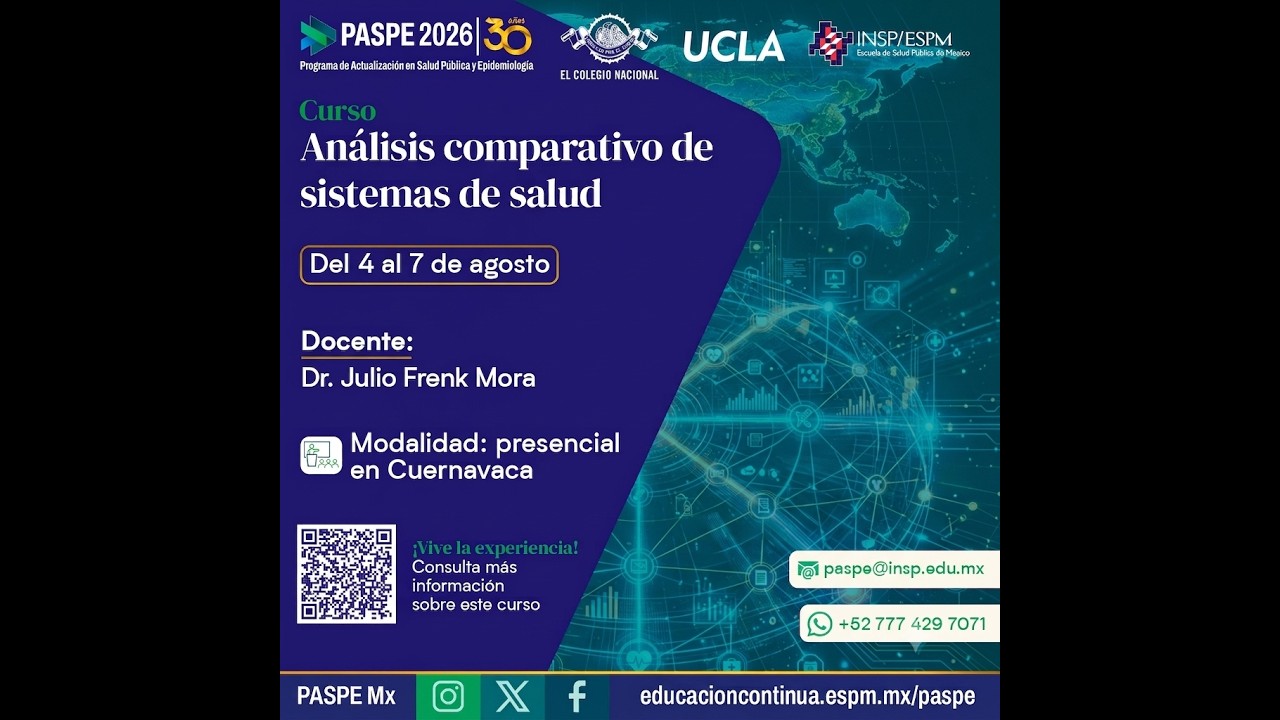
Curso "Análisis comparativo de sistemas de salud" Día 1
Keywords
Summary
191 words
Critical Evaluation
The lecture provides a solid conceptual foundation for understanding health systems, delivered by an authoritative figure in the field. Frenk’s framework, distinguishing objects and levels of analysis, is a valuable heuristic that clarifies the scope of public health and health systems research. The emphasis on the population level as the defining characteristic of public health is a key insight that helps differentiate it from clinical and biomedical approaches. The argument that health systems are a major economic sector is well-supported with examples, such as the US healthcare system representing nearly 20% of the economy and being the largest employer. However, the lecture is introductory and does not delve into specific comparative analyses or empirical evidence. It relies heavily on the speaker’s authority and conceptual reasoning rather than citing specific studies or data. The mention of Foucault and Donabedian adds intellectual depth, but the discussion remains at a high level. The course structure, with subsequent days covering different models, promises a more detailed comparative analysis, but this first session is primarily a framework-setting exercise. The adéquation between title and content is strong, as the lecture directly addresses the comparative analysis of health systems by establishing the conceptual tools needed for such analysis. Overall, the content is rigorous and valuable for students and professionals in public health, but it is not a comprehensive comparative analysis in itself.
225 words
Title / Content Match
The title accurately reflects the content: the first day of a course on comparative analysis of health systems, focusing on conceptual foundations.
Quality & Reliability
8/10
The speaker is a renowned global expert in health systems, with extensive academic and policy experience. The content is conceptually rigorous, well-structured, and based on established frameworks. However, it is primarily an introductory lecture without empirical data or citations to specific studies, and the presentation is not peer-reviewed.
Key Moments
Markers derived by PSI from the transcript: the creator did not define chapters.
- Introduction and welcome; course logistics and collaboration with El Colegio Nacional.
- Overview of the course structure: conceptual foundations today, OECD model tomorrow, public monopoly and segmented models on Thursday.
- Philosophy of the course: quote from Donabedian on the link between ideas and action; introduction to the forthcoming textbook.
- Presentation of the matrix: objects of analysis (health conditions and social response) and levels of analysis (sub-individual, individual, population).
- Definition of public health as the population-level study of health conditions and responses; distinction from clinical and biomedical research.
- Discussion of health conditions: diseases, risk factors, and developmental states; distinction between health needs and health conditions.
- Introduction to the organized social response: health systems, resources, services, and policies; focus of the course.
- Economic importance of health systems: largest sector in the US economy, major employer, and global significance.
- Historical perspective: evolution of social responses to health from family and religious institutions to specialized health systems.
- Conclusion and preview of next session on the OECD model.
Cited Sources
- Understanding Public Health: Clear Thinking for Effective Action — Forthcoming textbook by Julio Frenk and colleagues, to be published by Cambridge University Press in October.
- La salud de la población: hacia una nueva salud pública — Earlier book by Julio Frenk, published by Fondo de Cultura Económica, capturing the initial conceptual framework.
Concurring Sources
- World Health Organization - Health Systems — Provides a global overview of health systems and their functions, aligning with the conceptual framework presented.
Dissenting Sources
- No discordant sources identified — The lecture is conceptual and does not present controversial claims; no sources directly contradict the content.
Contribution & Novelties
The lecture provides a clear conceptual framework for analyzing health systems, emphasizing the population level as the defining characteristic of public health. It distinguishes between health conditions and social response, and between needs and conditions. The course aims to develop a rigorous comparative perspective, moving beyond specific country policies to generalizable concepts.
Pour aller plus loin :
- Avedis Donabedian — The mentor cited by Frenk; his work on quality of care is foundational.
- World Health Organization - Health Systems — Official WHO page on health systems, providing global context.
- OECD Health Statistics — Data and reports on health systems in OECD countries, relevant to the course’s comparative analysis.
108 words
Radar Profile
The radar profile shows high scores in quality of information and reliability, reflecting the speaker's expertise and the conceptual rigor. The quantity of information is moderate, as the lecture is introductory and focuses on foundations. The technical level is moderate, suitable for a general audience but with some specialized terminology.
💬 No comments were provided for analysis.