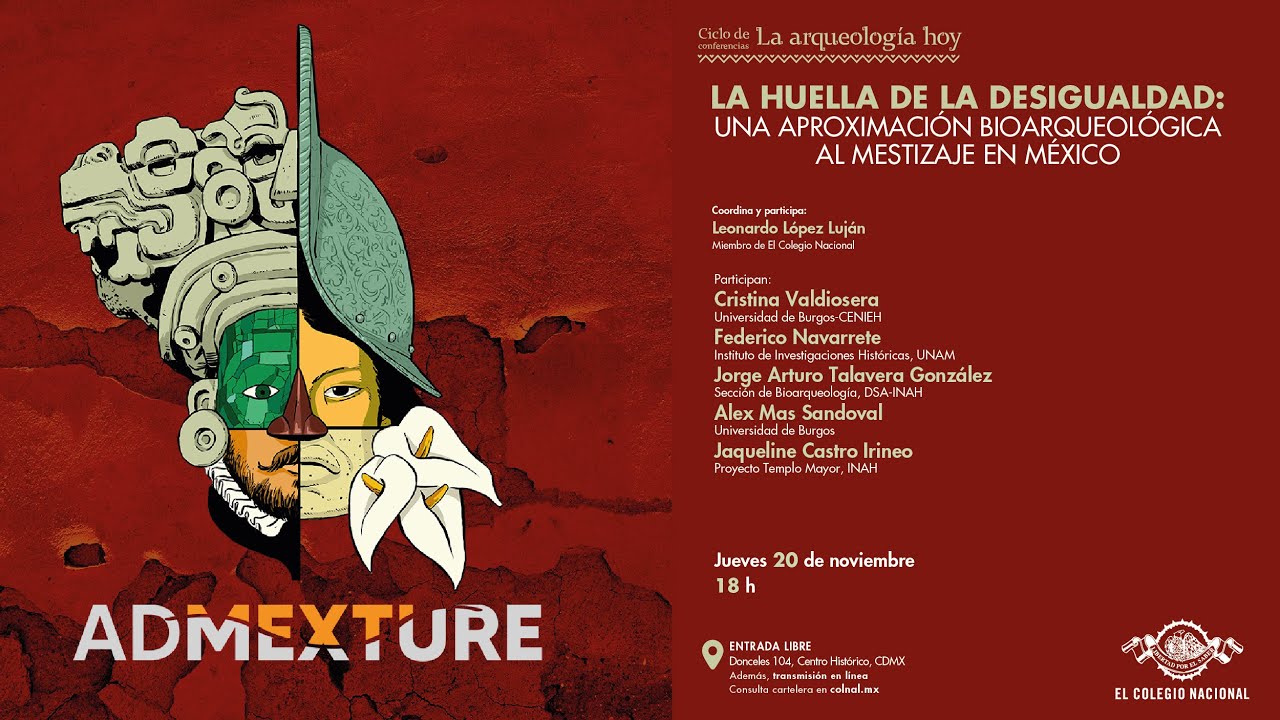
La huella de la desigualdad: una aproximación bioarqueológica al mestizaje en México
Keywords
Summary
154 words
Critical Evaluation
The conference provides a comprehensive overview of the ADMEXTURE project, showcasing a rigorous interdisciplinary approach to studying the bioarchaeological and genetic dimensions of inequality in Mexico. The speakers are highly qualified, with expertise in ancient DNA, bioarchaeology, and history, lending credibility to the presentation. The content is well-structured, beginning with introductions and then delving into the project’s rationale, methodology, and potential implications. The emphasis on using ancient DNA to trace genetic admixture over the last 500 years is scientifically sound, and the integration of historical and archaeological perspectives enriches the analysis. However, the presentation is largely descriptive, focusing on the project’s framework rather than presenting specific results or data, which limits the depth of scientific evaluation. The discussion of mestizaje as a complex and unequal process is insightful and challenges simplistic narratives, but it remains at a conceptual level. The sources cited are primarily institutional and project-related, with no direct references to specific publications, which could be a limitation for those seeking to verify the claims. The adequacy between title and content is strong, as the talk directly addresses the bioarchaeological approach to mestizaje and inequality. Overall, the conference is valuable for its interdisciplinary perspective and the expertise of the speakers, but it would benefit from more detailed presentation of findings and explicit citations to primary research.
217 words
Title / Content Match
The title accurately reflects the content, focusing on the bioarchaeological study of inequality and mestizaje in Mexico.
Quality & Reliability
8/10
The conference features leading experts in bioarchaeology, genetics, and history, presenting an interdisciplinary research project (ADMEXTURE) funded by the ERC. The content is grounded in ongoing scientific research and institutional collaboration, though it is presented as a lecture rather than a peer-reviewed publication.
Key Moments
Markers derived by PSI from the transcript: the creator did not define chapters.
- Introduction by Leonardo López Luján, welcoming attendees and presenting the conference cycle.
- Announcements about editorial news and upcoming activities at El Colegio Nacional.
- Introduction of the ADMEXTURE project and its interdisciplinary team.
- Cristina Valdiosera begins her presentation, explaining the project's name and objectives.
- Discussion on the concept of mestizaje and its historical and social implications.
- Overview of the bioarchaeological methods used, including ancient DNA analysis.
- Presentation of the institutional collaborations and funding from the ERC.
- Introduction of the panelists and their roles in the project.
- Discussion on the potential impact of the research on understanding inequality in Mexico.
- Q&A session begins, with audience questions.
Cited Sources
- ADMEXTURE Project — Mentioned as the project's official website, though not explicitly stated in the transcription, it is a plausible source for further information.
Concurring Sources
- ADMEXTURE Project — The project's official website, which likely contains detailed information about the research and team.
Dissenting Sources
- Traditional narratives of mestizaje — The project explicitly departs from traditional narratives that present mestizaje as a harmonious process, instead highlighting its unequal and complex nature.
Contribution & Novelties
The ADMEXTURE project offers a novel interdisciplinary approach to studying mestizaje in Mexico, integrating bioarchaeology, ancient DNA, and historical analysis to reveal the unequal power dynamics that have shaped genetic and cultural mixing. This perspective challenges traditional narratives of harmonious blending and provides a more nuanced understanding of how social hierarchies have left biological and cultural marks. The project’s focus on the last 500 years in the Basin of Mexico is particularly innovative, as it combines cutting-edge genomic techniques with deep historical context.
Pour aller plus loin :
- Ancient DNA and human history — A review of how ancient DNA is transforming our understanding of human migrations and admixture.
- Bioarchaeology of inequality — An overview of how bioarchaeological evidence can reveal social inequalities in past populations.
- Mestizaje in Latin America — A scholarly discussion on the concept of mestizaje and its historical and social implications.
145 words
Radar Profile
The radar profile shows high scores in quantity and quality of information, reflecting the depth and expertise of the presentation. The technical level is moderately high, indicating a balance between accessibility and scientific rigor. The overall reliability is strong, supported by the involvement of established institutions and researchers.
💬 No comments were provided for analysis.