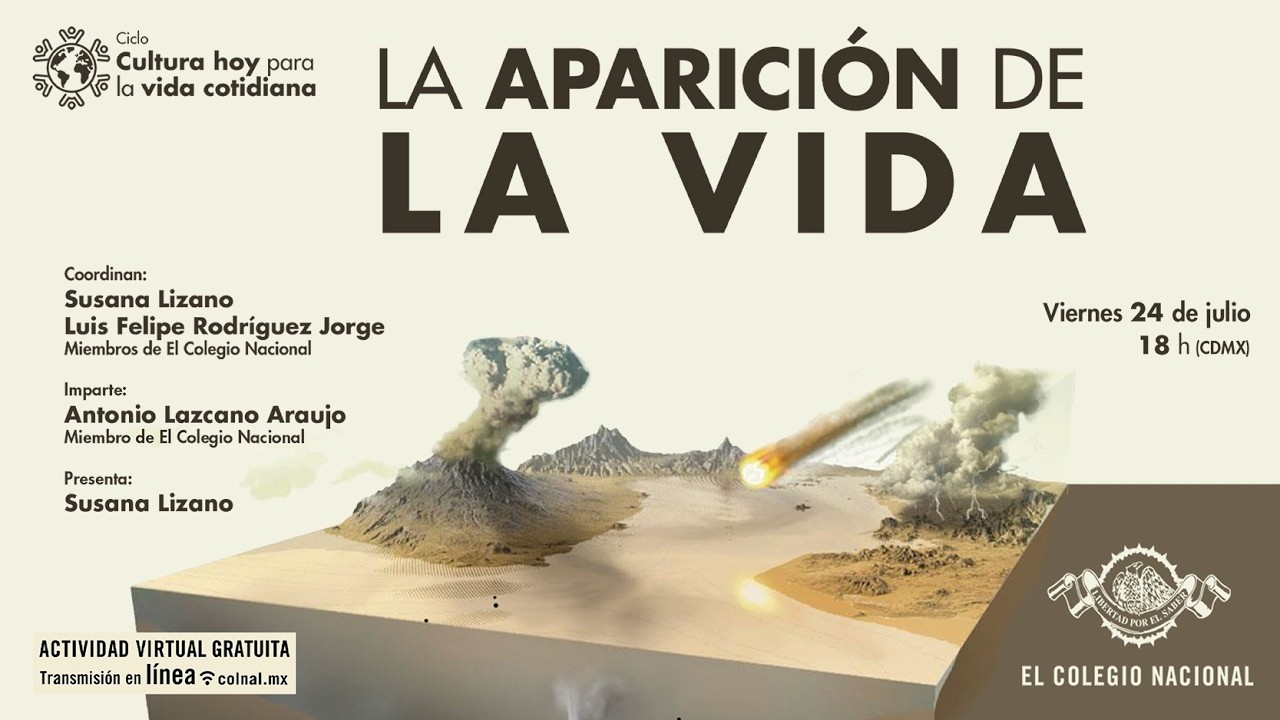
La aparición de la vida | Ciclo: Cultura hoy para la vida cotidiana
Keywords
Summary
180 words
Critical Evaluation
The lecture is a masterful synthesis of the current scientific understanding of the origin of life, delivered by one of the leading experts in the field. Lazcano’s presentation is both accessible and rigorous, striking a balance between detailed scientific evidence and clear explanations for a general audience. He effectively contextualizes the topic within the broader cultural and historical framework, emphasizing the importance of science in everyday life. The argumentation is solid, built upon well-established theories and empirical data, such as the Miller-Urey experiment, the analysis of the Murchison meteorite, and the geological evidence for early life. He is careful to distinguish between established facts and hypotheses, such as the RNA world, and acknowledges the gaps in our knowledge. The sources cited are credible, including the work of Oparin, Joan Oró, and NASA missions. The lecture’s structure is logical, progressing from the historical background to the astronomical and geological context, then to the chemical evidence and current hypotheses. The inclusion of a Q&A session adds value, as it allows for clarification of complex points and demonstrates the speaker’s ability to engage with audience questions. The title accurately reflects the content, and the lecture fulfills its promise of providing a comprehensive overview. The only minor weakness is that some topics, such as the RNA world, are covered relatively briefly, but this is understandable given the time constraints. Overall, this is an excellent presentation that is both informative and thought-provoking, suitable for anyone interested in the origins of life.
246 words
Title / Content Match
The title accurately reflects the content, which is a comprehensive overview of the origin of life on Earth.
Quality & Reliability
9/10
The speaker is a renowned expert in origin of life studies, with a long career and numerous publications. The content is based on established scientific evidence and presented with appropriate nuance. The lecture is well-structured and avoids overstatement.
Key Moments
Markers derived by PSI from the transcript: the creator did not define chapters.
- Introduction by Susana Lizano, presenting Antonio Lazcano and the lecture topic.
- Lazcano begins his talk, emphasizing the importance of science in culture and introducing the evolutionary perspective.
- Discussion of Oparin's hypothesis and the concept of the primordial soup.
- Explanation of the formation of the solar system and Earth, with evidence from lunar craters.
- Analysis of the Murchison meteorite and its organic compounds, highlighting the work of Joan Oró.
- Discussion of the Miller-Urey experiment and the synthesis of amino acids under early Earth conditions.
- Introduction of the RNA world hypothesis and the idea of life's building blocks.
- Exploration of the possibility of life elsewhere in the universe and the implications of astrobiology.
- Q&A session begins, addressing audience questions about the definition of life and the role of chance.
- Concluding remarks and final thoughts on the origin of life.
Cited Sources
- El Colegio Nacional — Institution hosting the lecture and providing the platform for the event.
Concurring Sources
- NASA Astrobiology — NASA's astrobiology program supports research on the origin of life, aligning with the lecture's themes.
Dissenting Sources
Contribution & Novelties
This lecture provides a comprehensive and up-to-date overview of the origin of life, synthesizing historical perspectives with modern evidence. It emphasizes the gradual emergence of life from chemical processes, supported by meteorite analysis and laboratory experiments. The speaker’s expertise adds authority, and the lecture serves as an excellent educational resource.
Pour aller plus loin :
- Miller-Urey experiment — A classic experiment demonstrating the formation of organic compounds from inorganic precursors.
- RNA world hypothesis — A key hypothesis about the early stages of life.
- Murchison meteorite — A meteorite containing amino acids and other organic molecules.
95 words
Radar Profile
The radar profile shows high scores in information quantity, quality, and reliability, with a slightly lower technical level, indicating a lecture that is both informative and accessible to a general audience.
💬 Sur les 0 commentaires analysés, aucune tendance n'est disponible.