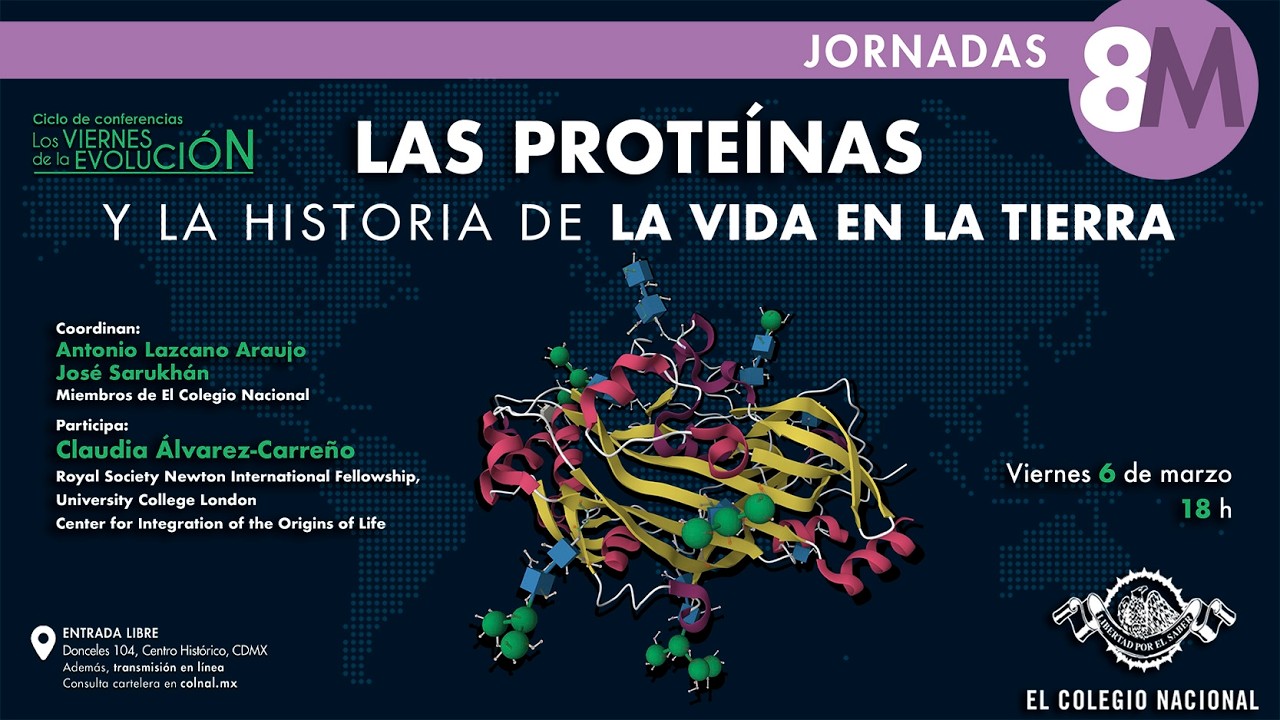
Las proteínas y la historia de la vida en la Tierra | JORNADAS 8M🟣
Keywords
Summary
188 words
Critical Evaluation
The lecture provides a comprehensive and accessible overview of the role of proteins in the history of life, delivered by a specialist with strong credentials. The speaker effectively combines broad evolutionary context with detailed molecular explanations, making complex concepts understandable without oversimplifying. The argumentation is solid, grounded in established scientific knowledge and her own research, which adds credibility. The use of analogies, such as the pearl necklace and the egg-cooking example, helps illustrate abstract concepts. The lecture is well-structured, moving from the big picture to specific molecular details and then to her research approach. The scientific rigor is high, with appropriate caveats about the limitations of our knowledge and the relative timing of events. The sources are not explicitly cited in the lecture, but the speaker mentions her affiliations and collaborators, and the content aligns with current scientific understanding. The title accurately reflects the content, and the lecture successfully conveys the importance of proteins in understanding the history of life. The only minor weakness is the lack of explicit references to specific studies, but this is typical for a general audience lecture. Overall, this is an excellent presentation that is both informative and engaging.
194 words
Title / Content Match
The title accurately reflects the content, which focuses on the role of proteins in the history of life on Earth, from their molecular structure to their evolutionary significance.
Quality & Reliability
9/10
The lecture is given by a specialist in molecular evolution and protein structure, with a PhD and postdoctoral experience at recognized institutions. The content is based on established scientific knowledge and her own research, presented with appropriate nuance and references to the scientific community. The format is a formal academic conference, which adds to its reliability.
Key Moments
Markers derived by PSI from the transcript: the creator did not define chapters.
- Introduction and welcome by Antonio Lazcano and José Sarukhán, presenting Claudia Álvarez-Carreño.
- Claudia begins her talk, thanking the organizers and introducing the topic.
- She poses the questions 'Where do we come from? What are we? Where are we going?' and gives a personal answer, tracing human origins back to the universe.
- She explains her research focus: the period after the emergence of genes and the genetic code, using protein models.
- She describes the structure of proteins, from amino acids to three-dimensional folding, using the analogy of a pearl necklace with magnets.
- She discusses the energy landscape of protein folding and how mutations can alter it, using the example of a cooked egg.
- She introduces her method of ancestral sequence reconstruction and structural comparison to study protein evolution.
- She presents examples of protein families and their evolutionary history, highlighting the recruitment of proteins for new functions.
- She discusses the last universal common ancestor and the importance of proteins in understanding the origins of life.
- She concludes with a summary and acknowledgments, emphasizing the collaborative nature of the research.
Cited Sources
- No explicit sources cited in the video — The speaker mentions her affiliations and collaborators but does not cite specific publications.
Concurring Sources
- Wikipedia: Protein structure — Provides background on protein structure, which aligns with the lecture's explanations.
- Wikipedia: Origin of life — Discusses the origin of life, a central theme of the lecture.
Dissenting Sources
- No discordant sources found — The content is consistent with current scientific consensus.
Contribution & Novelties
The lecture provides an original perspective by combining molecular biology, evolutionary biology, and astrobiology to explain the role of proteins in the history of life. It offers a clear explanation of protein structure and function, and how their evolution can be traced using computational methods. The speaker’s research on ancestral sequence reconstruction and protein recruitment adds new insights into the origins of life.
Pour aller plus loin :
- Ancestral sequence reconstruction — A key method used in the lecture to infer ancient protein sequences.
- Last universal common ancestor — Central concept in the study of life’s origins.
- Protein folding — Fundamental process discussed in the lecture.
106 words
Radar Profile
The radar profile shows high scores in quality of information and reliability, with slightly lower scores in quantity and technical level. This indicates a well-balanced lecture that is both informative and accessible, with a strong scientific foundation.
💬 No comments were provided for analysis.