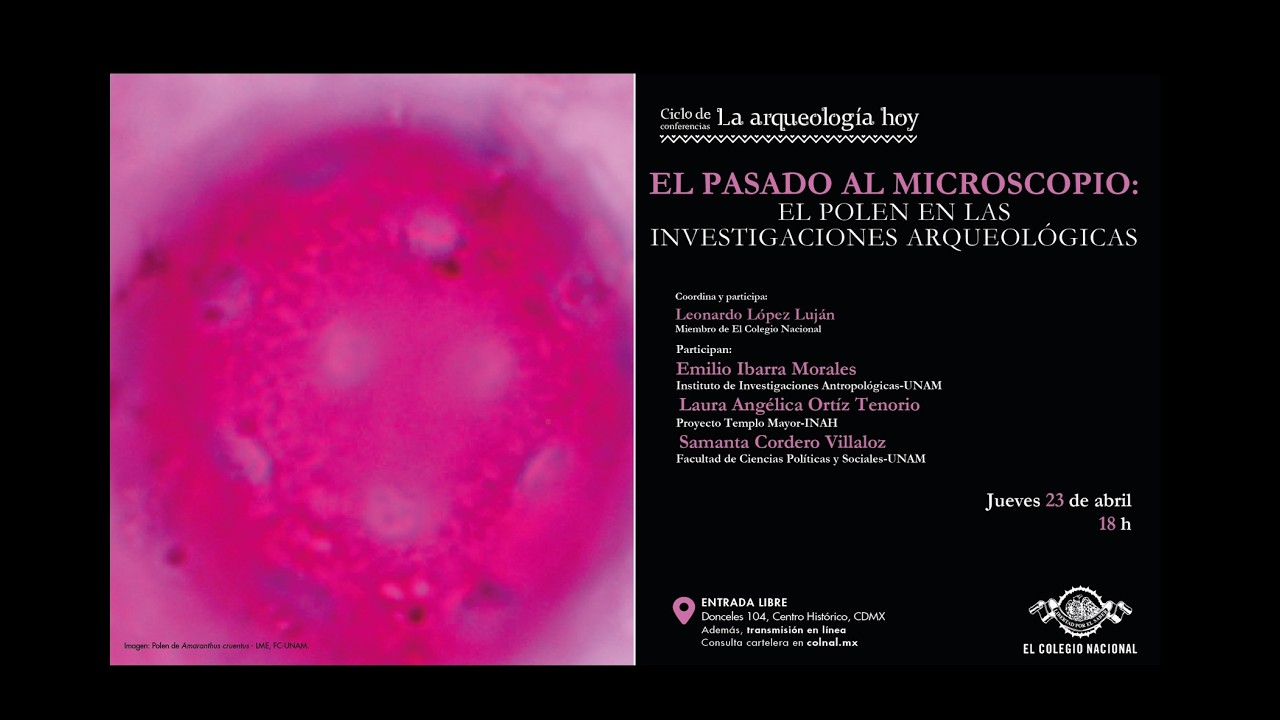
El pasado al microscopio: el polen en las investigaciones arqueológicas
Keywords
Summary
149 words
Critical Evaluation
The conference offers a valuable introduction to archaeopalynology, a specialized field that is often underrepresented in public discourse. The speakers are credible experts with extensive experience, lending authority to the content. The presentation is well-structured, starting with basic definitions and progressing to specific case studies, making it accessible to a general audience while still providing substantive information. The discussion of the Templo Mayor offerings and Teotihuacan excavations illustrates the practical applications of pollen analysis, demonstrating how it can uncover details about ritual practices and environmental conditions. The speakers also address methodological challenges, such as contamination and interpretation, which adds depth to the presentation. However, the content is primarily descriptive rather than critical; the speakers do not engage with debates or controversies within the field. Additionally, while the speakers mention their own research, they do not provide specific citations or references to published studies, which limits the ability to verify claims. The video’s production quality is high, with clear visuals and good audio. The title accurately reflects the content, and the conference format allows for audience engagement. Overall, this is a solid educational resource for those interested in the intersection of botany and archaeology, though it may not satisfy viewers seeking a more critical or technical analysis.
206 words
Title / Content Match
The title accurately reflects the content, which focuses on the application of pollen analysis in archaeological research.
Quality & Reliability
8/10
The video features established researchers from UNAM and INAH, presenting a well-structured overview of archaeopalynology. The content is based on their expertise and specific case studies, with no apparent sensationalism. However, it is a conference aimed at a general audience, so technical details are simplified and not all claims are backed by specific citations.
Key Moments
Markers derived by PSI from the transcript: the creator did not define chapters.
- Introduction by Leonardo López Luján, welcoming attendees and presenting the speakers.
- Emilio Ibarra Morales begins the presentation, explaining what pollen is and its role in plant reproduction.
- Discussion on the methods of pollen extraction and identification in archaeological contexts.
- Laura Angélica Ortíz Tenorio presents case studies from the Templo Mayor, focusing on ritual offerings.
- Samantha Cordero Villaloz discusses the application of pollen analysis at Teotihuacan and other sites.
- Challenges and limitations of archaeopalynology are addressed, including contamination and interpretation issues.
- Q&A session with the audience, where speakers answer questions about their research.
- Concluding remarks and thanks to the audience.
Cited Sources
- Arqueología Mexicana — Mentioned as a publication by INAH and Editorial Raíces, with recent issues on prehispanic and colonial Tlatelolco and codices.
- Proyecto Templo Mayor — Referenced as the project where Laura Ortíz Tenorio conducts pollen analysis on ritual offerings.
- Instituto de Investigaciones Antropológicas, UNAM — Mentioned as the laboratory where the speakers work, specializing in paleoethnobotany and paleoenvironment.
Concurring Sources
- Palynology and Archaeology — General reference on the use of palynology in archaeological research.
Contribution & Novelties
The video provides a comprehensive overview of archaeopalynology, a niche field, and highlights its applications in Mesoamerican archaeology. It showcases recent research from the Templo Mayor and Teotihuacan, offering insights into ritual plant use and environmental reconstruction. The speakers emphasize the interdisciplinary nature of the field and its potential to answer questions about ancient human-environment interactions.
Pour aller plus loin :
- Palynology (Wikipedia) — Provides a general introduction to the study of pollen and spores.
- Archaeobotany (Wikipedia) — Overview of the analysis of plant remains in archaeological contexts.
- Templo Mayor Museum — Background on the Aztec temple and its archaeological significance.
101 words
Radar Profile
The radar profile shows high scores in information quantity, quality, and reliability, with a moderate technical level. This indicates a well-balanced presentation that is both informative and credible, suitable for a general audience interested in archaeological science.
💬 Sur les 0 commentaires analysés, aucune tendance n'est disponible.