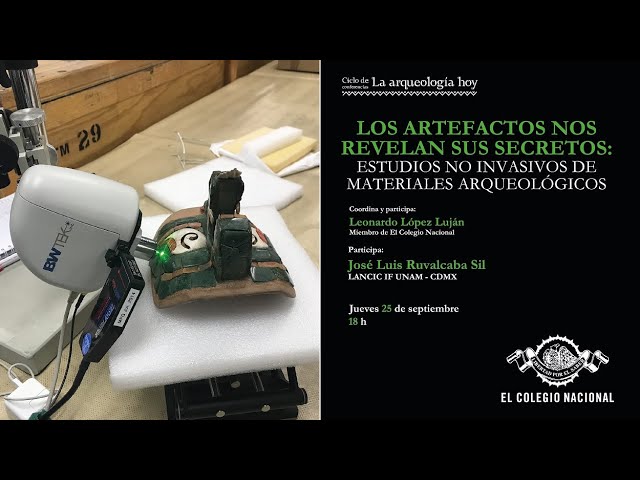
Los artefactos nos revelan sus secretos: estudios no invasivos de materiales arqueológicos
Keywords
Summary
152 words
Critical Evaluation
The presentation offers a valuable overview of non-invasive archaeometric techniques applied to Mesoamerican artifacts. The speaker’s expertise is evident, and the case studies are well-chosen to illustrate the potential of these methods. The discussion of the Tlaltecuhtli pigments is particularly insightful, linking the identified materials to historical sources like the Florentine Codex. The obsidian study is also notable for its large sample size and the integration of ritual and non-ritual contexts, providing a more nuanced understanding of obsidian procurement and distribution. However, the talk is primarily descriptive, with limited critical discussion of the limitations of the techniques or the potential for misinterpretation. The speaker does not address the challenges of calibrating portable XRF instruments or the potential for surface contamination. Additionally, the presentation assumes a certain level of familiarity with archaeometric concepts, which might limit accessibility for a general audience. The sources cited are credible, including publications in PNAS and studies by the Getty Conservation Institute, but the talk does not provide a comprehensive review of the field. Overall, the content is scientifically sound and informative, but it could benefit from a more critical approach and a clearer explanation of the methods for non-specialists.
194 words
Title / Content Match
The title accurately reflects the content, which focuses on non-invasive studies of archaeological materials.
Quality & Reliability
8/10
The speaker is a recognized expert in archaeometry from UNAM, and the presentation includes specific case studies with published results in peer-reviewed journals. However, the talk is a conference presentation without detailed methodological transparency, and some claims are based on the speaker's own research without independent verification.
Key Moments
Markers derived by PSI from the transcript: the creator did not define chapters.
- Introduction by Leonardo López Luján, welcoming the audience and presenting the speaker.
- Discussion of the first case study: analysis of pigments on the Tlaltecuhtli sculpture using XRF and XRD.
- Presentation of the second case study: compositional analysis of obsidian artifacts from Templo Mayor using portable XRF.
- Explanation of the results showing the diversity of obsidian sources and the implications for trade networks.
- Introduction of the third case study, possibly on other materials like ceramics or metals.
- Discussion of the importance of non-invasive techniques for preserving cultural heritage.
- Conclusion and Q&A session with the audience.
Cited Sources
- Color in Mexica monumental sculpture — Mentioned as a study published in Res: Anthropology and Aesthetics, involving the analysis of pigments on the Tlaltecuhtli sculpture.
- Compositional analysis of obsidian artifacts from Templo Mayor — Mentioned as a study published in PNAS, analyzing obsidian artifacts from the Templo Mayor.
Concurring Sources
- Getty Conservation Institute — The institute conducted the pigment analysis on the Tlaltecuhtli sculpture, as mentioned in the talk.
Contribution & Novelties
The talk provides an overview of recent non-invasive archaeometric studies on Mesoamerican artifacts, highlighting the use of portable XRF and other techniques. It contributes to the understanding of raw material procurement, manufacturing technologies, and trade networks in ancient Mesoamerica.
Pour aller plus loin :
- Archaeometry — Overview of the field and its methods.
- X-ray fluorescence — Explanation of the technique used in the studies.
- Templo Mayor — Context on the archaeological site discussed.
73 words
Radar Profile
The radar profile shows high scores in information quantity and quality, reflecting the detailed and well-structured presentation. The technical level is also high, indicating a specialized audience. The overall reliability is strong, supported by the speaker's expertise and published research.