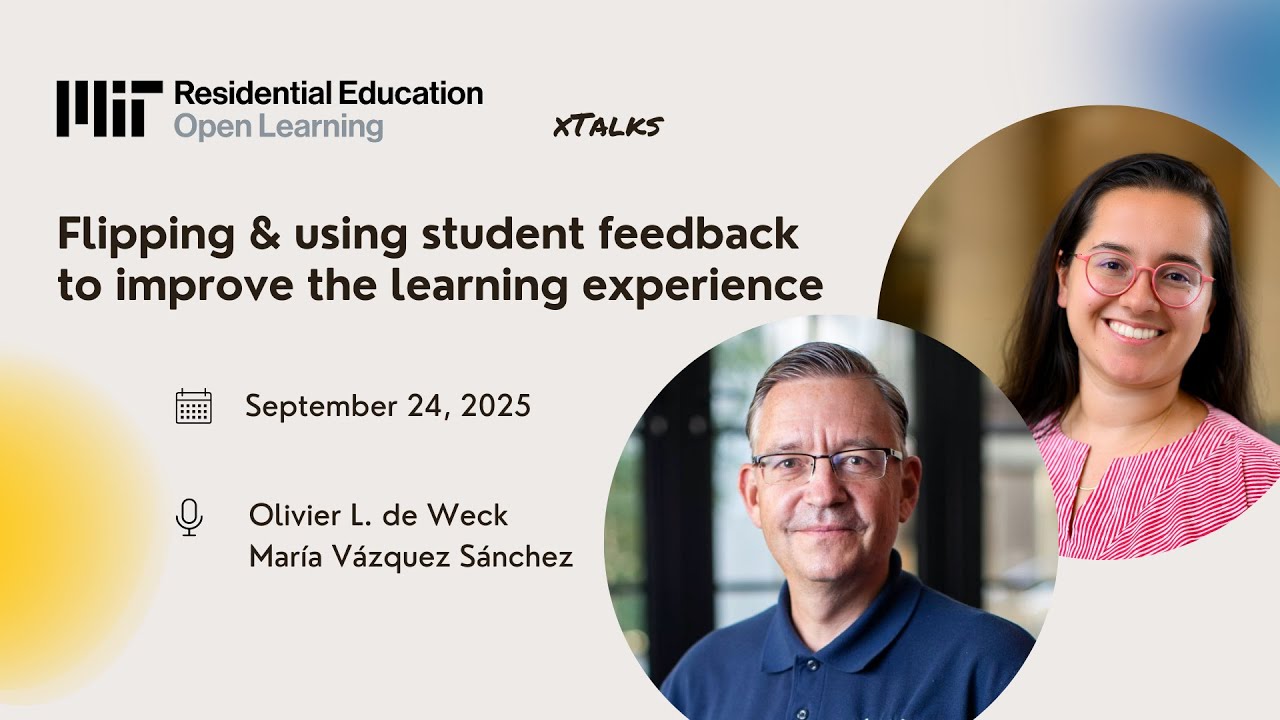
xTalk, September 24, 2025, Flipping and Using Student Feedback to Improve the Learning Experience
Keywords
Summary
142 words
Critical Evaluation
Value of the Information & Strength of the Argument
The value of the information is high, offering practical insights from real course implementations. De Weck provides detailed examples of course structure, integration challenges, and student feedback, while Vázquez Sánchez shares a systematic approach to gathering and applying feedback. The argumentation is solid, grounded in specific examples and direct quotes from students, though it lacks quantitative data beyond course ratings. The presentations are persuasive, highlighting both successes and challenges, which adds credibility.
Scientific Rigor, Source Quality, Title Accuracy
The scientific rigor is moderate; the talk is based on practical experience rather than formal research. Sources are primarily internal (MIT Open Learning, course materials, student feedback). The title accurately reflects the content. No external sources are cited beyond MIT Open Learning links. The adequacy between title and content is strong, as both presentations directly address flipping and using student feedback.
148 words
Title / Content Match
The title accurately reflects the content, focusing on flipping classrooms and using student feedback to improve learning experiences.
Quality & Reliability
8/10
The talk is presented by experienced MIT faculty and staff, grounded in practical implementation and direct student feedback. The content is credible and well-structured, though it relies on anecdotal evidence and specific course contexts rather than formal research.
Chapters
- INTRODUCTION
- OLI DE WECK & FLIPPING
- About 16.851 Intro to Satellite Engineering
- Why flip the class
- Situating 16.851 in AeroAstro
- Modularizing content
- Timeline of course improvements
- Example Canvas & MITx setup
- MITx-Canvas integration: Videos
- MITx-Canvas integration: Autograded concept questions
- MITx-Canvas integration: Gradebook
- Example Canvas Modules
- Lessons learned from student feedback
- Planning for the live sessions
- Acknowledgements
- MARIA VAZQUEZ SANCHEZ & ORGANIZING CANVAS
- About UPOP: Undergraduate Practice Opportunities Program
- Importance of Canvas
- Opportunities for improvement
- Canvas layouts for student feedback
- Asking students to share favorite Canvas sites
- Key findings from student feedback
- Example Canvas home page
- Student focus group insights
- Key design decisions
- Acknowledgements
- Example Canvas structure
- Using Canvas Course Analytics
- Lessons learned & next steps
- DISCUSSION & Q/A
- Effectively using non-flipped time
- Group vs individual work
- Experimenting with flipping
- What’s next for UPOP
Cited Sources
- MIT Open Learning - Event Page — Event page for the xTalk, providing context and possibly additional resources.
- MIT Open Learning - Residential Education — Main page for MIT Open Learning's residential education initiatives, supporting the context of the talk.
Concurring Sources
- MIT Open Learning - Residential Education — Supports the context of using technology in teaching at MIT.
Contribution & Novelties
The talk provides practical insights into flipping a graduate engineering course and redesigning a Canvas site based on student feedback. It highlights the importance of integrating learning platforms (Canvas and MITx) and the challenges of non-flipped time. The approach of using student feedback to iterate on course design is valuable.
Pour aller plus loin :
- Flipped classroom — Overview of the flipped classroom model.
- Canvas LMS — Information on the Canvas learning management system.
- MIT Open Learning — MIT’s open learning initiatives and resources.
84 words
Radar Profile
The radar profile shows high scores in quantity and quality of information, with moderate technical level and high reliability. This indicates a well-rounded presentation with substantial content and credible sources, though not deeply technical.