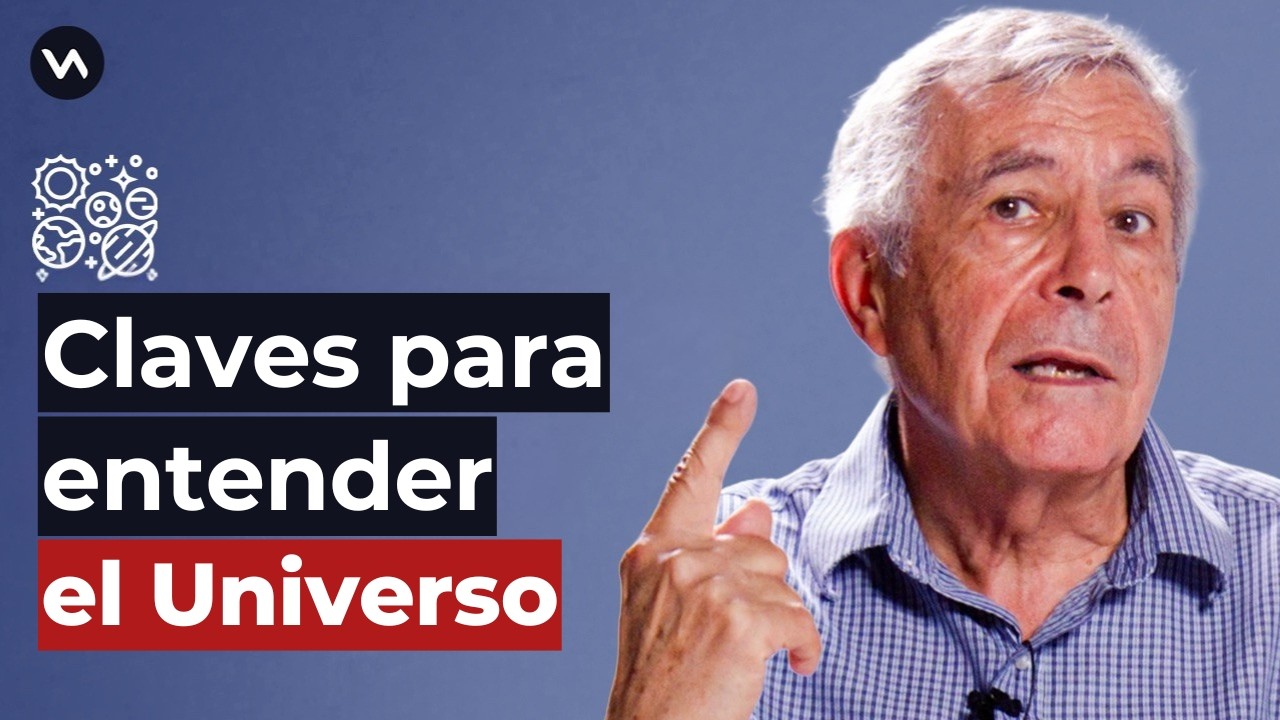
Experto en Astrofísica y Matemáticas: Lección Magistral sobre el Universo | Dr. Emili Elizalde
Keywords
Summary
141 words
Critical Evaluation
The interview is an exceptional piece of science communication, featuring Dr. Emili Elizalde, a distinguished cosmologist, who delivers a masterful exposition of modern cosmology. The content is rich in accurate historical and scientific details, demonstrating a deep understanding of the subject. Elizalde’s ability to explain complex concepts with clarity and enthusiasm is commendable, making the material accessible without oversimplifying. The argumentation is solid, grounded in established scientific knowledge, though some personal interpretations, such as pinpointing 1912 as the exact start of modern cosmology, are presented with conviction but may be debated by historians. The sources cited are credible, including his own book and references to key scientific works. The production quality is high, with a well-paced conversation that allows the expert to elaborate freely. The title accurately reflects the content, and the video fulfills its promise of a masterclass. Overall, this is a valuable resource for anyone interested in cosmology, offering both depth and accessibility.
155 words
Title / Content Match
The title accurately reflects the content: a masterclass on the universe by an astrophysics and mathematics expert.
Quality & Reliability
8/10
The content is an expert interview with a renowned cosmologist, providing accurate historical and scientific information. The speaker demonstrates deep knowledge and cites specific works, though some claims are personal interpretations (e.g., 1912 as the start of modern cosmology). The production is professional, and the discussion is well-structured.
Key Moments
Markers derived by PSI from the transcript: the creator did not define chapters.
- Introduction of Dr. Emili Elizalde and the topic of modern cosmology.
- Explanation of why 1912 marks the beginning of modern cosmology, with Henrietta Leavitt and Vesto Slipher.
- Discussion on the pre-1912 view of the universe as static and eternal.
- Overview of Einstein's general relativity and its implications for cosmology.
- Elizalde explains the concept of singularities and why they indicate theory limitations.
- Discussion on the expanding universe and the contributions of Hubble and Lemaitre.
- Exploration of dark energy and the cosmological constant.
- Reflections on the current state and future of cosmology.
Cited Sources
- Cosmología moderna desde sus orígenes — Book by Dr. Emili Elizalde, mentioned as the basis for the discussion.
- Vidas Ajenas Club — Community platform mentioned in the description for further discussion.
- Entiende la Física Cuántica — Recommended video from the channel on quantum physics.
- Encuentra el Sentido de tu Vida — Recommended video from the channel on finding meaning in life.
- ¿Dios existe? — Recommended video from the channel on the existence of God.
Concurring Sources
- Henrietta Swan Leavitt — Her discovery of the period-luminosity relation for Cepheid variables is consistent with the video's discussion.
- Vesto Slipher — His redshift measurements align with the video's account of early cosmological observations.
- Expansion of the universe — The video's explanation of cosmic expansion matches established scientific consensus.
Dissenting Sources
- Alternative views on the start of modern cosmology — Some historians may argue that modern cosmology began with Einstein's 1915 theory or Hubble's 1929 discovery, rather than 1912 as Elizalde claims.
External References
Contribution & Novelties
The video provides a unique perspective on the history of cosmology, particularly the claim that 1912 marks its scientific beginning, based on the work of Leavitt and Slipher. It offers a clear explanation of complex concepts like redshift and the cosmological constant, making them accessible to a general audience. The interview format allows for deep exploration of the subject, with Elizalde’s personal insights adding value.
Pour aller plus loin :
- Henrietta Swan Leavitt — Her work on Cepheid variables is foundational to measuring cosmic distances.
- Vesto Slipher — His redshift observations were crucial for the discovery of the expanding universe.
- General relativity — Einstein’s theory that revolutionized our understanding of gravity and spacetime.
- Dark energy — The mysterious force driving the accelerated expansion of the universe.
126 words
Radar Profile
The radar profile shows high scores in information quantity and quality, reflecting the depth and accuracy of the content. The technical level is also high, indicating a sophisticated audience. The overall reliability is strong, though some personal interpretations slightly reduce the score.
💬 Très positif. Sur les 30 commentaires analysés, les spectateurs expriment une admiration unanime pour la clarté et la passion du Dr. Elizalde, ainsi que pour la qualité de l'interview, avec des remerciements répétés pour la pédagogie et l'accessibilité des explications.