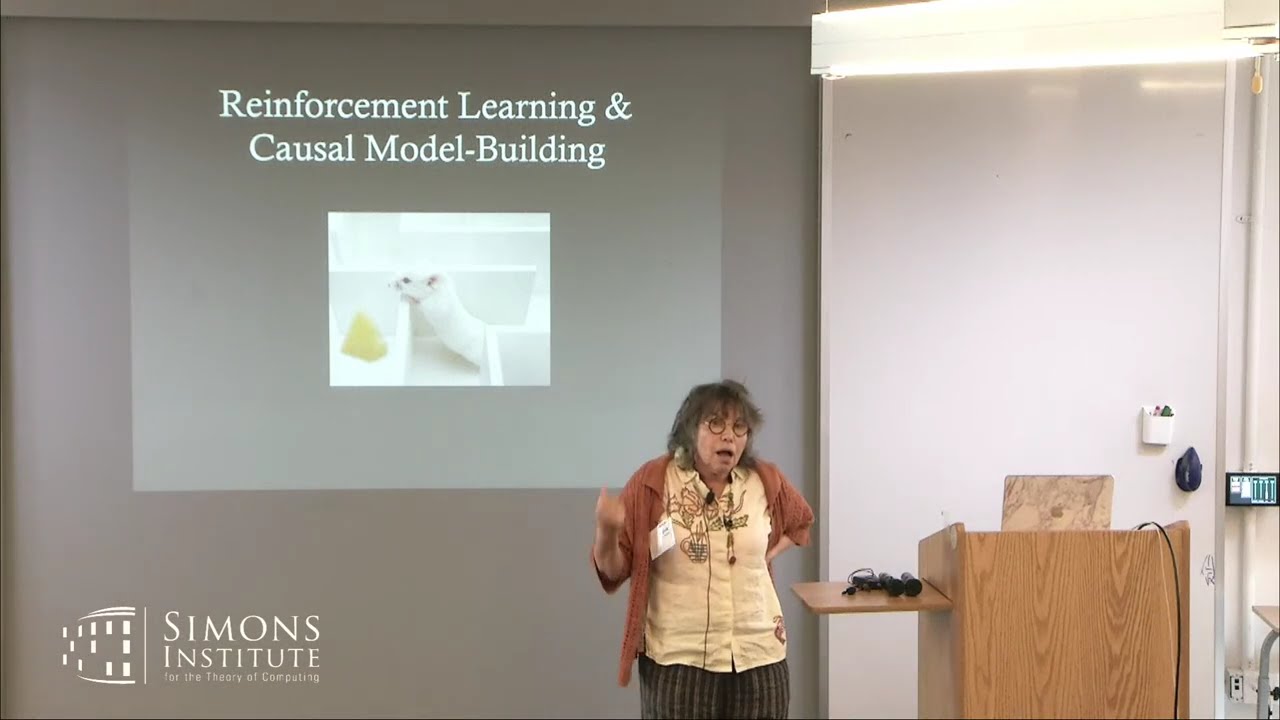
Talk by Alison Gopnik (UC Berkeley)
Keywords
Summary
163 words
Critical Evaluation
Alison Gopnik’s talk offers a compelling and thought-provoking perspective on the limitations of current AI and the potential for biologically inspired approaches to improve learning. Her argument is well-structured, drawing on established theories from cognitive science and computer science, and she effectively communicates complex ideas to a technical audience. The strength of the talk lies in its synthesis of diverse fields: she connects formal causal models (Pearl) with reinforcement learning and introduces the concept of empowerment as a unifying principle. This interdisciplinary approach is valuable and provides a fresh angle on the exploration-exploitation dilemma. However, the talk is primarily conceptual and lacks concrete algorithmic details or experimental results to support the proposed framework. While Gopnik acknowledges the intractability of Bayesian inference and the limitations of RL, she does not offer a specific implementation of intrinsically motivated RL with empowerment, leaving the feasibility of her proposal uncertain. The second half of the talk, focusing on caregiving, is intriguing but remains largely speculative, with limited empirical evidence presented. The speaker’s expertise in developmental psychology lends credibility to her claims about children’s learning, but the direct application to AI is not fully fleshed out. The audience interaction is handled well, with Gopnik clarifying her points. Overall, the talk is intellectually stimulating and raises important questions, but it would benefit from more concrete examples and a clearer roadmap for translating these ideas into practice. The title accurately reflects the content, and the talk is well-suited for a specialized audience interested in the intersection of cognitive science and AI.
254 words
Title / Content Match
The title accurately reflects the content, as the talk is a presentation by Alison Gopnik at UC Berkeley, focusing on world models and social reasoning.
Quality & Reliability
8/10
The talk is by a renowned developmental psychologist and philosopher, presenting a well-structured argument grounded in established theories (causal models, reinforcement learning) and recent research. The speaker acknowledges limitations and engages with audience questions. However, the talk is not peer-reviewed and some claims are speculative, though clearly framed as such.
Key Moments
Markers derived by PSI from the transcript: the creator did not define chapters.
- Introduction: Humans as immigrants in non-stationary environments.
- Exploration vs. exploitation tension and its relevance to AI.
- Formal causal models and Bayesian inference limitations.
- Reinforcement learning as a framework and its limitations.
- Intrinsic motivation and empowerment as a solution.
- Equating empowerment gain with causal learning.
- Introduction of caregiving as a crucial social relationship.
- Implications for AI and conclusion.
Cited Sources
- Simons Institute Talk Page — Official talk page with abstract and related materials.
Concurring Sources
- Simons Institute Talk Page — Official talk page with abstract and related materials.
Contribution & Novelties
The talk provides a novel synthesis of causal learning and reinforcement learning, proposing empowerment as a bridge between exploration and exploitation. It also highlights the often-overlooked role of caregiving in human learning, suggesting a new direction for AI research.
Pour aller plus loin :
- Causal Models (Judea Pearl) — Foundational work on causal reasoning.
- Reinforcement Learning — Overview of RL framework.
- Intrinsic Motivation in AI — Concept of intrinsic rewards in learning systems.
73 words
Radar Profile
The radar profile shows high scores in information quantity, quality, and technical level, with a slightly lower but still strong reliability score. This indicates a well-informed and technically detailed talk, though with some speculative elements.
💬 No comments provided.