An Occam's Razor Principle for Transformers?
Keywords
Summary
180 words
Critical Evaluation
The talk is intellectually stimulating and presents a compelling blend of classical learning theory and modern deep learning practice. Langford’s discussion of progressive validation is a valuable reminder of the theoretical underpinnings of online learning, and his argument that transformer training naturally aligns with this framework is insightful. The connection to Occam’s razor is thought-provoking, though the talk does not fully formalize this principle. The empirical result of a threefold reduction in extrapolation error is striking, but the talk lacks detailed experimental methodology, making it difficult to assess the robustness of this finding. The proposed implicit world model is an elegant idea, but its theoretical justification remains speculative. Langford is honest about the limitations, acknowledging that standard PAC theory does not apply and that many questions remain open. The talk is well-structured, with clear explanations and a good balance of theory and practice. However, it would benefit from more concrete examples and a deeper dive into the experimental setup. Overall, this is a high-quality talk that raises important questions and offers promising directions for future research, but it is more of an expert opinion than a rigorous scientific study.
189 words
Title / Content Match
The title poses a question about Occam's razor for transformers; the talk addresses this by discussing progressive validation and implicit world models, though the connection to Occam's razor is somewhat implicit and not fully formalized.
Quality & Reliability
8/10
Talk by a leading researcher in machine learning, presenting both established results (progressive validation) and recent work on implicit world models, with theoretical grounding and empirical evidence. Some claims are speculative and lack detailed peer-reviewed references, but the overall reasoning is rigorous and transparent.
Key Moments
Markers derived by PSI from the transcript: the creator did not define chapters.
- Introduction and setup for the talk.
- Discussion of progressive validation and its relevance to transformer training.
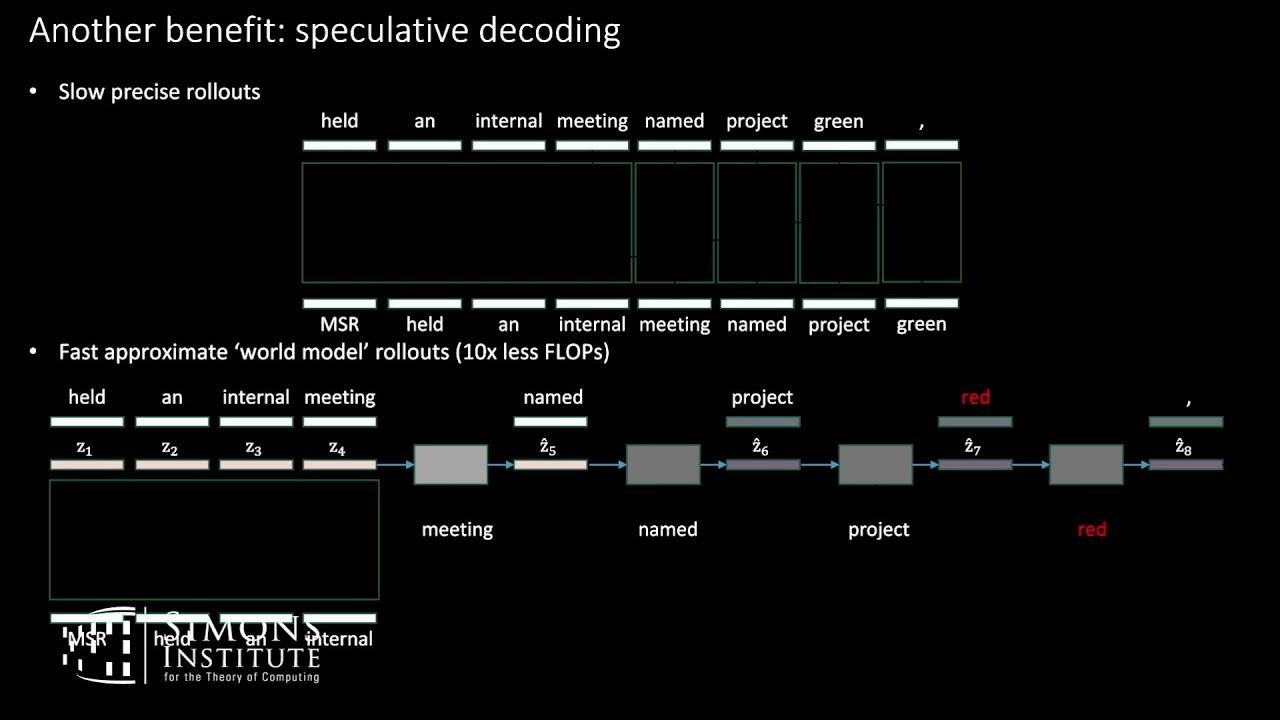
- Introduction of implicit world models and the idea of predicting next latents.
- Presentation of empirical results showing a factor of three reduction in extrapolation error.
- Discussion of open questions and the need for new theoretical frameworks.
Cited Sources
- Simons Institute talk page — Official page for the talk, providing context and possibly slides.
Concurring Sources
- Simons Institute talk page — Official page for the talk, providing context and possibly slides.
Contribution & Novelties
The talk contributes a novel perspective on Occam’s razor in the context of transformers, suggesting that simpler latent states lead to better generalization and extrapolation. It also revives the concept of progressive validation as a practical tool for modern training. The proposed implicit world model is an original approach that could improve training efficiency.
Pour aller plus loin :
- Progressive Validation — Background on the technique.
- PAC Learning — Foundational theory for sample complexity.
- World Models — Overview of world models in AI.
83 words
Radar Profile
The radar profile shows high scores in quality of information, technical level, and reliability, with a slightly lower score in quantity of information. This indicates a technically deep and reliable talk, though it may not cover a broad range of topics.
💬 No comments provided.