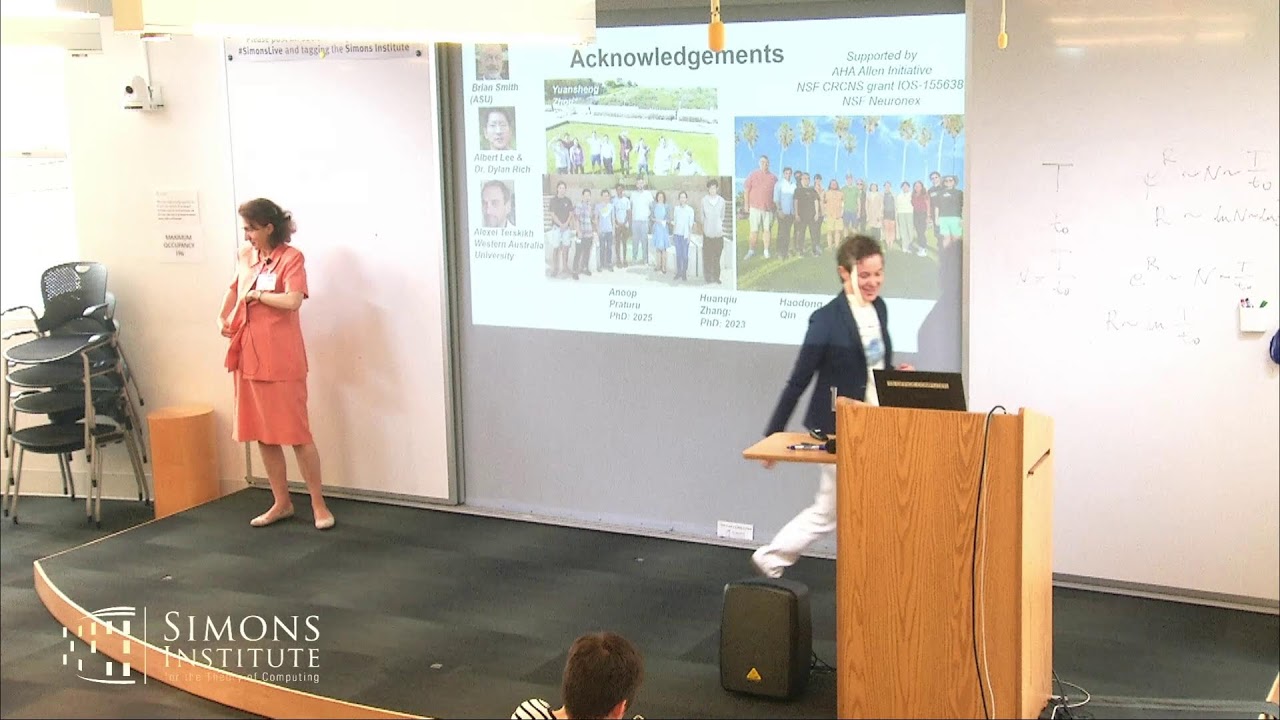
Talk by Tatyanna Sharpee (Salk Institute)
Keywords
Summary
130 words
Critical Evaluation
The talk presents an intriguing hypothesis that hyperbolic geometry underlies many natural and neural data. Sharpee’s argument is compelling, drawing on mathematical properties of trees and hierarchical systems, and she provides empirical examples from her own research, such as olfactory data and gene expression. The strength of the talk lies in its interdisciplinary approach, connecting mathematics, perception, and machine learning. However, the claim that ‘all data’ have hyperbolic geometry is overly broad and not rigorously substantiated. The evidence presented is circumstantial or based on specific datasets, and the talk lacks a systematic review of counterexamples. The methodology for detecting hyperbolicity is briefly described but not fully detailed, and the audience raises important questions about the validity of using Euclidean distances to infer hyperbolic structure. Sharpee’s responses are thoughtful but sometimes hand-wavy, acknowledging limitations. The talk is more of an expert opinion and research overview than a rigorous scientific presentation. The sources cited are not explicitly mentioned in the video, though the description links to the Simons Institute page. Overall, the talk is intellectually stimulating and provides a novel perspective, but the scientific rigor is moderate due to the speculative nature and lack of comprehensive evidence. The title is generic but accurate. The content is suitable for a specialized audience, but the analysis does not penalize for that. The presence of a publicité is not mentioned in the description, so none is noted.
232 words
Title / Content Match
The title is generic but accurately reflects the content: a talk by Tatyanna Sharpee at the Simons Institute.
Quality & Reliability
7/10
The speaker is a recognized expert in computational neuroscience, and the talk presents original research with quantitative methods. However, the claims about hyperbolic geometry in all natural data are speculative and not fully validated. The presentation is informal with audience interactions, and no formal peer-reviewed sources are cited in the video itself.
Key Moments
Markers derived by PSI from the transcript: the creator did not define chapters.
- Introduction by host and start of talk.
- Sharpee presents the hyperbolic hypothesis and three reasons for interest.
- Discussion of hierarchical systems and phylogenetic trees.
- Background on hyperbolic geometry and Poincaré disk.
- Examples from perception: children reaching for the moon and Greek architecture.
- Advantages of hyperbolic geometry for network navigation (Krioukov's work).
- Overview of hyperbolic geometry found in various biological data.
- Discussion of olfaction as a communication system and challenges.
- Strawberry data analysis: comparing geometries using topological methods.
- Methodological discussion on measuring distances and embedding.
- Conclusion and implications for motor control.
Cited Sources
- Simons Institute Talk Page — Official page for the talk, providing context and possibly additional resources.
Concurring Sources
- Hyperbolic geometry in neural representations — The talk itself presents evidence from the speaker's research.
Dissenting Sources
- Euclidean geometry in neural representations — Some studies suggest that neural representations may be Euclidean or have mixed curvature, challenging the universal hyperbolicity claim.
Contribution & Novelties
The talk proposes a unifying hypothesis that hyperbolic geometry is pervasive in natural and neural data, offering a new lens for understanding sensory coding and motor control. It suggests practical implications for machine learning, such as improved network navigation and representation learning.
Pour aller plus loin :
- Hyperbolic geometry — Background on the mathematical concept.
- Poincaré disk model — A model of hyperbolic geometry used in the talk.
- t-SNE — A dimensionality reduction technique mentioned in the talk.
- Krioukov et al. on hyperbolic geometry of complex networks — Relevant paper on network navigation.
- Salk Institute — Institution of the speaker.
100 words
Radar Profile
The radar profile shows high scores in quantity and technical level, reflecting the dense content and specialized audience. Quality and reliability are moderate, indicating the speculative nature of the claims. The overall shape suggests a technically strong but not fully rigorous presentation.