Talk by Jacob Andreas (Massachusetts Institute of Technology)
Keywords
Summary
141 words
Critical Evaluation
The talk presents a compelling and well-structured argument for improving language models’ self-knowledge. Andreas demonstrates a clear problem: models are often overconfident and provide inaccurate descriptions of their own decision-making processes. He draws an interesting parallel to human introspection, which is also flawed, but argues that engineered systems offer unique opportunities for intervention. The proposed solutions are methodologically sound, leveraging existing interpretability techniques (counterfactual analysis, feature labeling, activation patching) to generate supervision data. The results, while preliminary, show significant improvements on the targeted tasks. However, the talk is limited in scope: it focuses on simple, toy examples and does not address the scalability of these methods to more complex, real-world scenarios. Additionally, the speaker does not discuss potential risks or ethical considerations of improving models’ self-knowledge, such as the possibility of models providing misleading explanations that are more convincing. The sources cited are relevant and credible, including prior work like the Selfie paper. Overall, the talk is a valuable contribution to the field of interpretability, but it leaves many open questions and does not fully address the broader implications.
179 words
Title / Content Match
The title is generic but accurately reflects the content: a research talk by Jacob Andreas.
Quality & Reliability
8/10
Talk by a leading researcher at MIT, presenting ongoing research with clear methodology and references to prior work. Claims are supported by examples and references to published studies, though some results are not fully detailed.
Key Moments
Markers derived by PSI from the transcript: the creator did not define chapters.
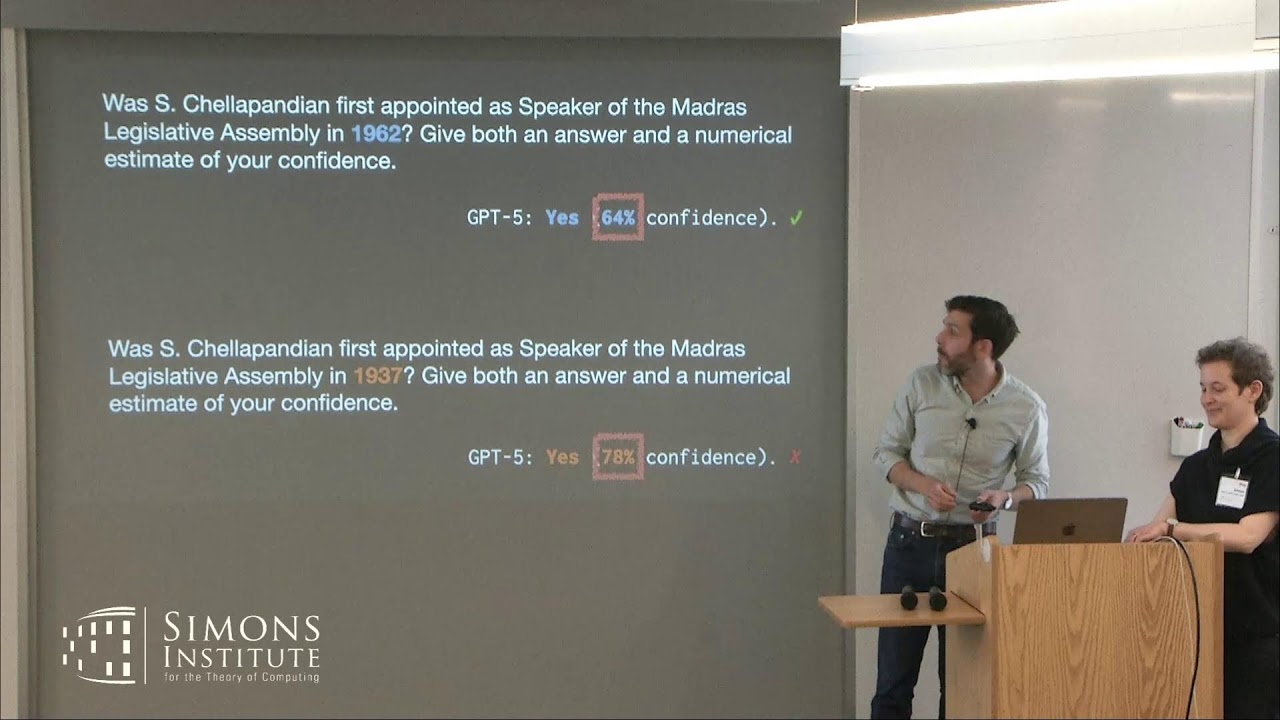
- Introduction and setup: the problem of models' self-knowledge, illustrated with a calibration example.
- Discussion of models' inability to describe their own policies, with examples of cultural stereotypes and arithmetic algorithms.
- Comparison to human introspection and the potential for engineered systems to do better.
- Proposal of supervised learning to train models to describe themselves, using interpretability tools as supervision.
- Three concrete examples: behavioral counterfactuals, feature labeling, and activation patching.
- Results: fine-tuned models improve on self-knowledge tasks, with generalization to new inputs.
- Discussion of potential applications and limitations, including the need for more scalable methods.
Cited Sources
- Simons Institute talk page — Official page for the talk, providing context and possibly additional materials.
Concurring Sources
- Selfie: Self-interpretation of language models — Mentioned in the talk as prior work showing zero-shot self-knowledge.
Contribution & Novelties
The talk presents a novel framework for training language models to better describe their own internal states and behaviors, using interpretability tools as supervision. This is an original contribution to the field of interpretability, as it directly addresses the gap between models’ actual behavior and their self-reports. The approach is practical and could be extended to more complex scenarios.
Pour aller plus loin :
- Selfie: Self-interpretation of language models — A paper by Carl Vondrick’s group showing zero-shot self-knowledge in models.
- Activation patching — A technique for identifying causal contributions of internal representations.
- Interpretability research at MIT — Jacob Andreas’s lab page, with links to related publications.
107 words
Radar Profile
The radar profile shows high scores across all dimensions, indicating a well-rounded and informative talk. The strongest aspects are the quantity and quality of information, as well as the technical depth. The reliability is also high, given the speaker's expertise and the use of established methods.