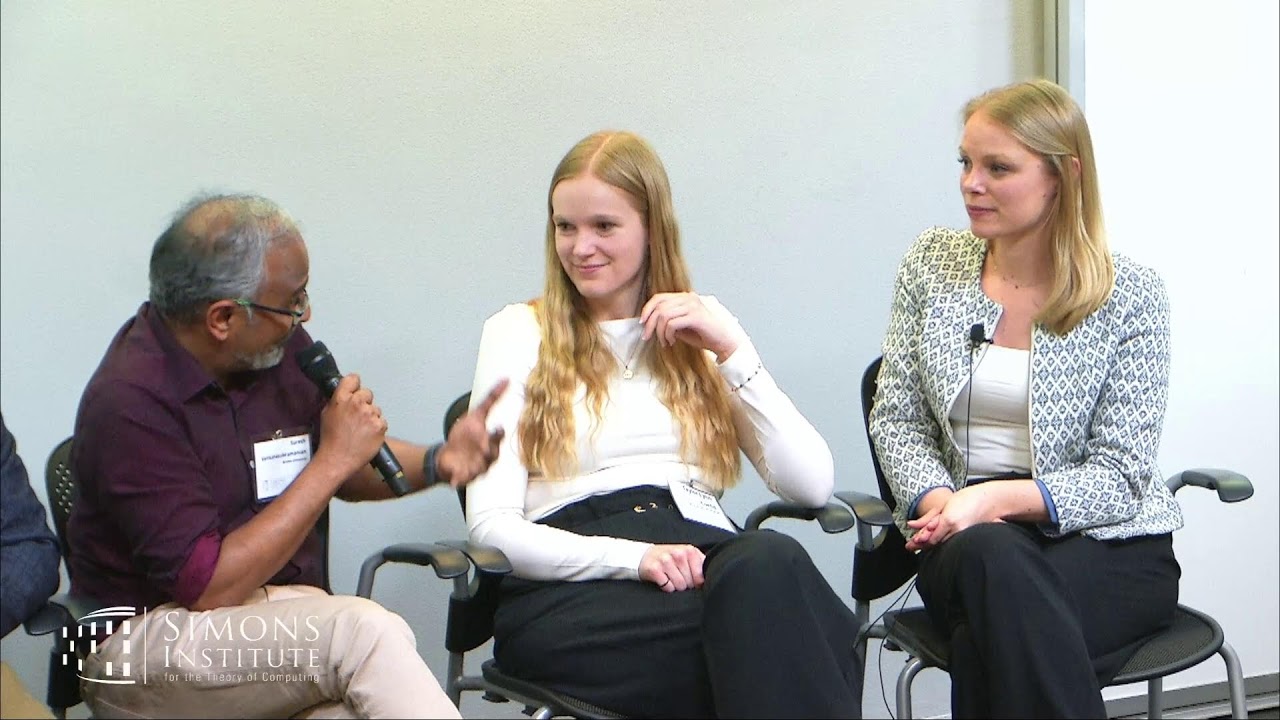
Panel Discussion
Keywords
Summary
178 words
Critical Evaluation
The panel discussion offers valuable insights into the intersection of AI research and policy, featuring experts with significant experience in academia, government advisory, and technical policy. The strength of the discussion lies in its practical perspectives: Taylor Lynn Curtis’s description of Mila’s model for integrating policy experts within a research institute highlights a concrete approach to bridging the gap between technical research and governance. Similarly, the CCST representatives’ account of the Staff Academy on AI demonstrates a tangible effort to educate legislative staff, addressing the power imbalance between experts and policymakers. The panel’s critical examination of evidence-based policy is particularly insightful, with Suresh Venkatasubramanian and Inioluwa Deborah Raji articulating how evidence can be selectively used or weaponized in contentious political contexts. This nuanced view challenges the naive assumption that more evidence automatically leads to better policy, emphasizing the role of power and politics. However, the discussion remains at a relatively high level, with limited technical depth or specific case studies. The panelists do not provide concrete examples of successful policy interventions or detailed analyses of specific regulatory frameworks. The reliance on anecdotal experiences, while authentic, limits the generalizability of the insights. The sources cited are minimal, with only a link to the workshop schedule, which does not provide direct references to the claims made. The discussion would benefit from more rigorous citations to academic literature or policy documents. The adéquation between the title and content is adequate, as the video is indeed a panel discussion, but the title is generic and does not convey the specific focus on AI governance. Overall, the panel provides a thoughtful and critical perspective on AI policy, but its impact is constrained by the lack of concrete evidence and the conversational format.
287 words
Title / Content Match
The title 'Panel Discussion' is generic but accurately reflects the content.
Quality & Reliability
8/10
Panel of experts from reputable institutions (Brown, UC Berkeley, Mila, CCST) discussing AI governance. High credibility, but no formal citations or data presented.
Key Moments
Markers derived by PSI from the transcript: the creator did not define chapters.
- Introduction of panelists and start of discussion.
- Taylor Lynn Curtis describes Mila's approach to integrating policy experts.
- Discussion on CCST Staff Academy and training for legislative staff.
- Debate on the risks of over-reliance on evidence-based policy.
- Suresh Venkatasubramanian discusses evidence weaponization in AI policy.
- Inioluwa Deborah Raji shares insights on corporate influence on policy narratives.
- Panelists discuss the role of academic institutions like HAI in policy education.
- Q&A session begins with audience questions.
Cited Sources
- Workshop Schedule: Governance at the Technological Frontier — Official workshop page providing context for the panel discussion.
Concurring Sources
- AI Now Institute — Research on AI policy and social implications, aligns with panel's concerns.
- Stanford HAI — Provides policy briefs and research on AI governance, as mentioned in the discussion.
Contribution & Novelties
The panel provides a unique perspective on the practical challenges of translating AI research into policy, emphasizing the importance of institutional bridges and the risks of evidence-based policy being weaponized. It highlights the need for independent technical perspectives in policy education.
Pour aller plus loin :
- AI Now Institute — Research on AI policy and social implications.
- Stanford HAI — Policy briefs and research on AI governance.
- Mila - Quebec AI Institute — Research and policy initiatives in AI.
79 words
Radar Profile
The radar chart shows high scores in quality of information and reliability, reflecting the expertise of the panelists. The quantity of information is moderate, and the technical level is moderate, indicating a discussion accessible to a general audience but with some depth. The overall profile suggests a balanced and credible discussion.