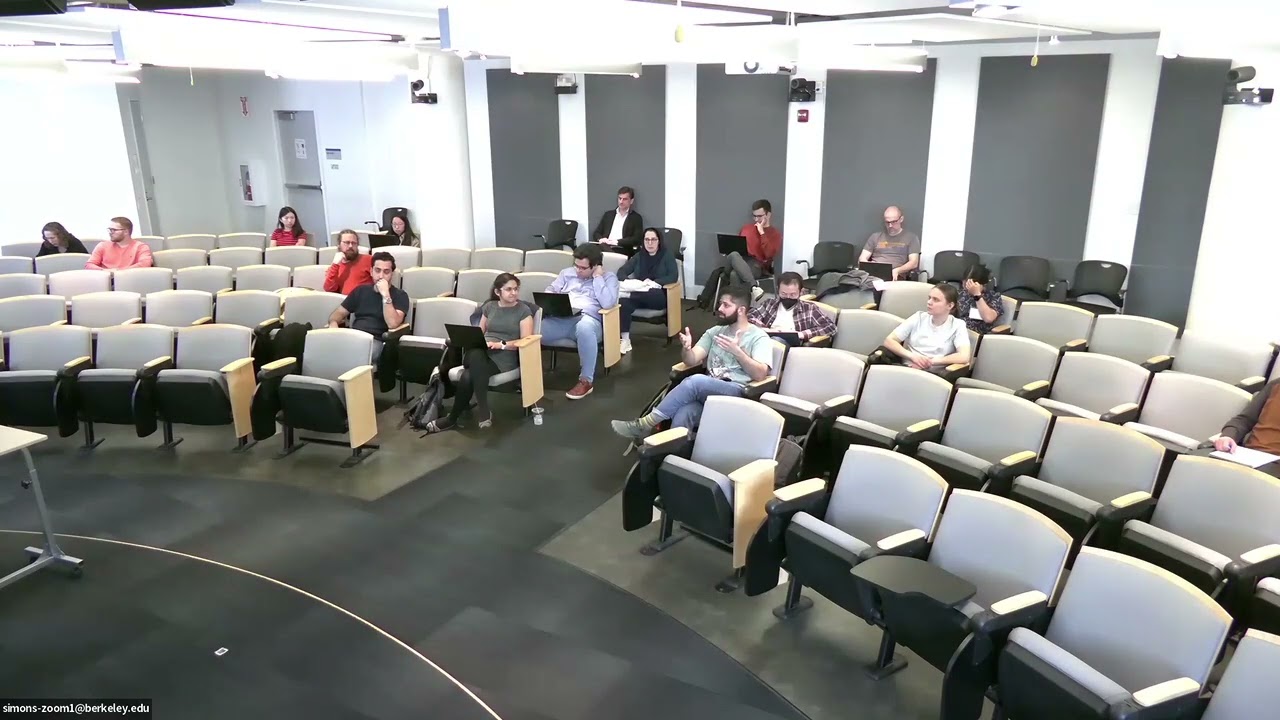
Tutorial: Incentives for Collaborative Learning and Data Sharing, Part II
Keywords
Summary
177 words
Critical Evaluation
The tutorial provides a solid introduction to data valuation, a key topic in collaborative and federated learning. The speaker, Sai Praneeth Karimireddy, is an expert in the field, and his presentation is clear and well-structured. He starts with the motivation for data-centric AI and the market failure for individual data, which sets the stage for the need for data valuation. The core of the talk focuses on the leave-one-out method and its limitations in the context of stochastic deep learning. The speaker effectively illustrates the issue of variance in influence scores with a histogram and discusses the implications for defining contribution. The interactive Q&A session is particularly valuable, as it addresses nuanced questions about the interpretation of variance, the dependence between data points, and the practical challenges of applying these methods. The speaker acknowledges the limitations of current methods and highlights open questions, which is intellectually honest. However, the tutorial is introductory and does not delve into advanced techniques or recent research in depth. The hypothetical YouTube scenario, while illustrative, is not based on verified facts, which the speaker acknowledges. The sources cited are limited to the Simons Institute talk page, which provides context but not detailed references. Overall, the tutorial is informative and thought-provoking, but it would benefit from more concrete examples and references to recent literature. The title accurately reflects the content, and the presentation is suitable for a technical audience familiar with machine learning concepts.
238 words
Title / Content Match
The title accurately reflects the content, which focuses on incentives for collaborative learning and data sharing, specifically data valuation methods.
Quality & Reliability
8/10
The tutorial is given by an expert researcher in the field, with a formal mathematical approach to data valuation. The content is well-structured, discusses fundamental concepts and open questions, and includes interactive Q&A. However, it is a tutorial, not a peer-reviewed study, and some claims are based on hypothetical scenarios.
Key Moments
Markers derived by PSI from the transcript: the creator did not define chapters.
- Introduction by Nika, who introduces the speaker Sai Praneeth Karimireddy.
- Speaker begins with motivation: data-centric AI and the market failure for individual data.
- Discussion of data intermediaries and the ecosystem of data aggregation.
- Real-world case study: YouTube training generative AI music models and copyright issues.
- Fundamental question: how to attribute value to individual data contributors.
- Introduction of leave-one-out error as a simple method for data valuation.
- Challenge: stochasticity in deep learning makes value function a random variable.
- Q&A: interpretation of variance in influence scores.
- Discussion of expected influence and the example of two harmful points.
- Further Q&A on dependence between data points and practical implications.
Cited Sources
- Simons Institute talk page — Official page for the tutorial, providing context and possibly slides.
Concurring Sources
- Simons Institute talk page — The talk page provides official information about the tutorial, aligning with the content presented.
Contribution & Novelties
The tutorial provides a comprehensive overview of data valuation methods, highlighting the challenges posed by stochasticity in deep learning. It emphasizes the need for scalable, efficient, and justifiable attribution methods, and discusses open questions in the field. The interactive Q&A adds practical insights.
Pour aller plus loin :
- Shapley value — The Shapley value is a classic solution concept in cooperative game theory, often used for data valuation.
- Data Shapley: Equitable Valuation of Data for Machine Learning — A seminal paper on using Shapley values for data valuation.
- Federated Learning — A key paradigm for collaborative learning, relevant to the tutorial’s context.
102 words
Radar Profile
The radar profile shows high scores across all dimensions, indicating a well-rounded tutorial with strong information content, quality, technical depth, and reliability. The weakest point is the limited number of cited sources, but the interactive format and expert presentation compensate.