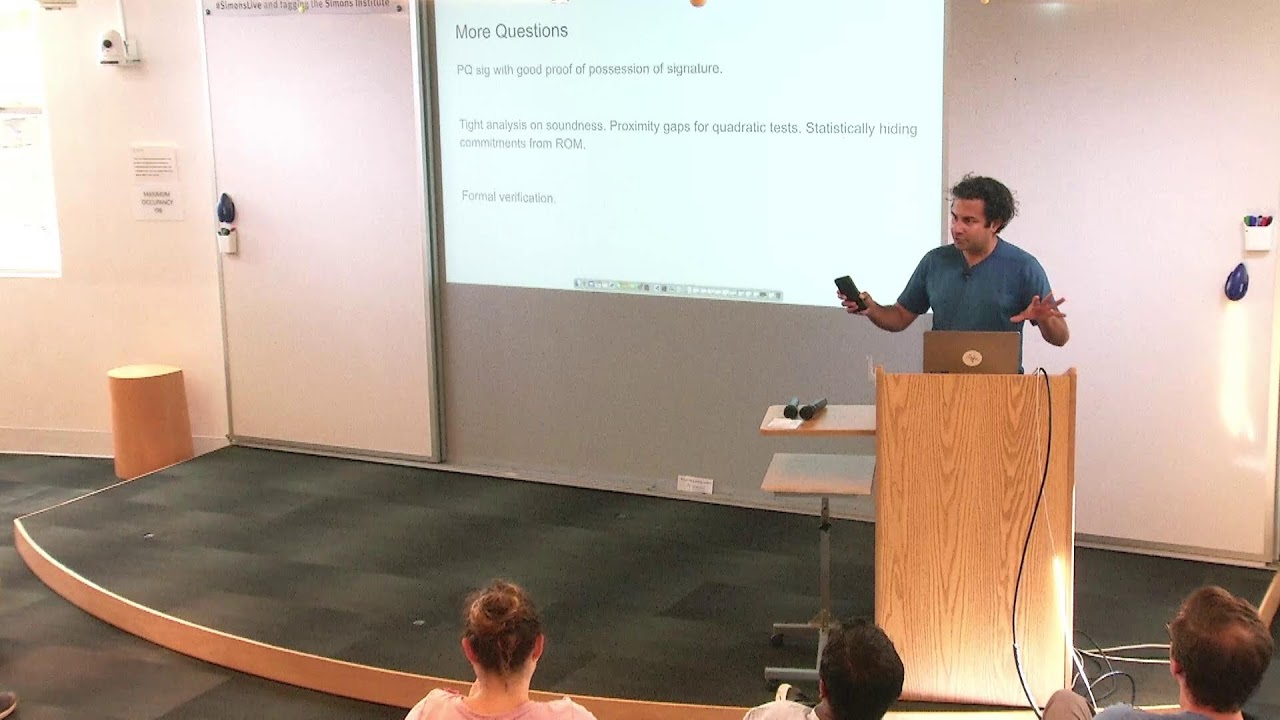
The modern anonymous credential (how ZK landed in Google Wallet)
Keywords
Summary
180 words
Critical Evaluation
The talk provides a valuable perspective on the real-world deployment of cryptographic protocols, specifically the ISO/IEC 18013-5 standard for mobile driver’s licenses. Shelat’s expertise is evident, and he effectively bridges the gap between theoretical cryptography and practical implementation. The discussion of the protocol’s design, including the use of salted hashes and Reed-Solomon encoding, is technically accurate and well-explained. The emphasis on device binding and the constraints of secure elements highlights a critical practical issue that is often overlooked in academic research. The talk also raises important questions about accessibility and the digital divide, as the secure element requirement may exclude low-cost phones. However, the talk is primarily an opinion piece based on Shelat’s experience, and some claims, such as the percentage of phones with secure elements, are not rigorously sourced. The lack of a formal evaluation of the protocol’s security properties is a minor weakness, but the talk is not intended as a formal analysis. Overall, the content is informative and thought-provoking, offering insights into the challenges of deploying cryptographic solutions in the real world. The title accurately reflects the content, and the talk is well-structured, with clear explanations and relevant examples. The audience questions add depth to the discussion, addressing issues such as attribute selection and device compatibility. The talk does not include any promotional content, and the focus remains on technical and societal aspects. The main limitation is the lack of empirical data to support some claims, but this does not significantly detract from the overall value of the presentation.
252 words
Title / Content Match
The title accurately reflects the content, focusing on modern anonymous credentials and their implementation in Google Wallet, with a discussion of zero-knowledge techniques.
Quality & Reliability
8/10
The talk is given by an expert (Abhi Shelat, Northeastern/Google) and presents technical details of the ISO/IEC mdoc protocol, including cryptographic mechanisms. The content is grounded in real deployments (Apple/Google) and references standards. However, it is an opinion/experience talk, not a peer-reviewed study, and some claims (e.g., phone statistics) are anecdotal.
Key Moments
Markers derived by PSI from the transcript: the creator did not define chapters.
- Introduction to the problem of uploading ID photos online and the risks to privacy.
- Historical context: digital credentials envisioned in 1985, but no deployment until recently.
- Explanation of the ISO/IEC 18013-5 standard and its two-round protocol for selective disclosure.
- Technical details: salted hashes and Reed-Solomon encoding for selective disclosure.
- Discussion of device binding and the use of secure elements to prevent credential copying.
- Challenges with secure elements: limited to RSA and ECDSA, no support for bilinear pairings.
- Accessibility issue: only 1% of phones under $400 have the required secure element.
- Reflections on the gap between cryptographic research and real-world deployment.
Cited Sources
- Simons Institute talk page — Official page for the talk, providing context and possibly additional resources.
Concurring Sources
- ISO/IEC 18013-5:2021 — The standard for mobile driver's licenses, which the talk discusses in detail.
Contribution & Novelties
The talk provides a unique insider perspective on the deployment of anonymous credentials in Google Wallet, highlighting the practical challenges and the gap between academic cryptography and industry standards. It emphasizes the importance of understanding real-world constraints, such as secure element limitations and accessibility issues.
Pour aller plus loin :
- ISO/IEC 18013-5:2021 — The standard for mobile driver’s licenses, directly relevant to the protocol discussed.
- Zero-knowledge proof — Foundational concept underlying selective disclosure.
- Reed-Solomon error correction — Technique used in the protocol for encoding attributes.
85 words
Radar Profile
The radar profile shows high scores in information quantity, quality, technical level, and reliability, indicating a well-rounded and technically sound presentation. The talk excels in providing detailed technical information and expert insights, with a strong reliability based on the speaker's experience and the use of established standards.