Secure Computation and Low-Complexity Cryptography
Keywords
Summary
102 words
Critical Evaluation
The talk provides a high-level overview of the complexity of secure computation, delivered by a leading expert. The speaker effectively outlines the main optimization metrics and the trade-offs between them. The discussion of the circuit size barrier and the potential to break it with new techniques is insightful. The talk is well-structured, starting with foundational concepts and gradually introducing more advanced ideas. The speaker’s informal style makes the content accessible, though some parts may be challenging for non-experts. The talk does not provide detailed proofs or specific references, but it serves as a valuable survey of the field. The connection to low-complexity cryptography is well-motivated, and the speaker suggests interesting open questions. Overall, the talk is informative and thought-provoking, though it could benefit from more concrete examples and references.
129 words
Title / Content Match
The title accurately reflects the content: the talk focuses on secure computation and its connections to low-complexity cryptography.
Quality & Reliability
8/10
Talk by a leading researcher in secure computation, presenting a broad survey of complexity questions. The content is technically sound and based on established research, but as a survey it does not provide full proofs or detailed references. The speaker is affiliated with Technion and AWS, indicating expertise. The presentation is clear and well-structured, with some informal remarks.
Key Moments
Markers derived by PSI from the transcript: the creator did not define chapters.
- Introduction to secure computation and its goal of eliminating trusted parties.
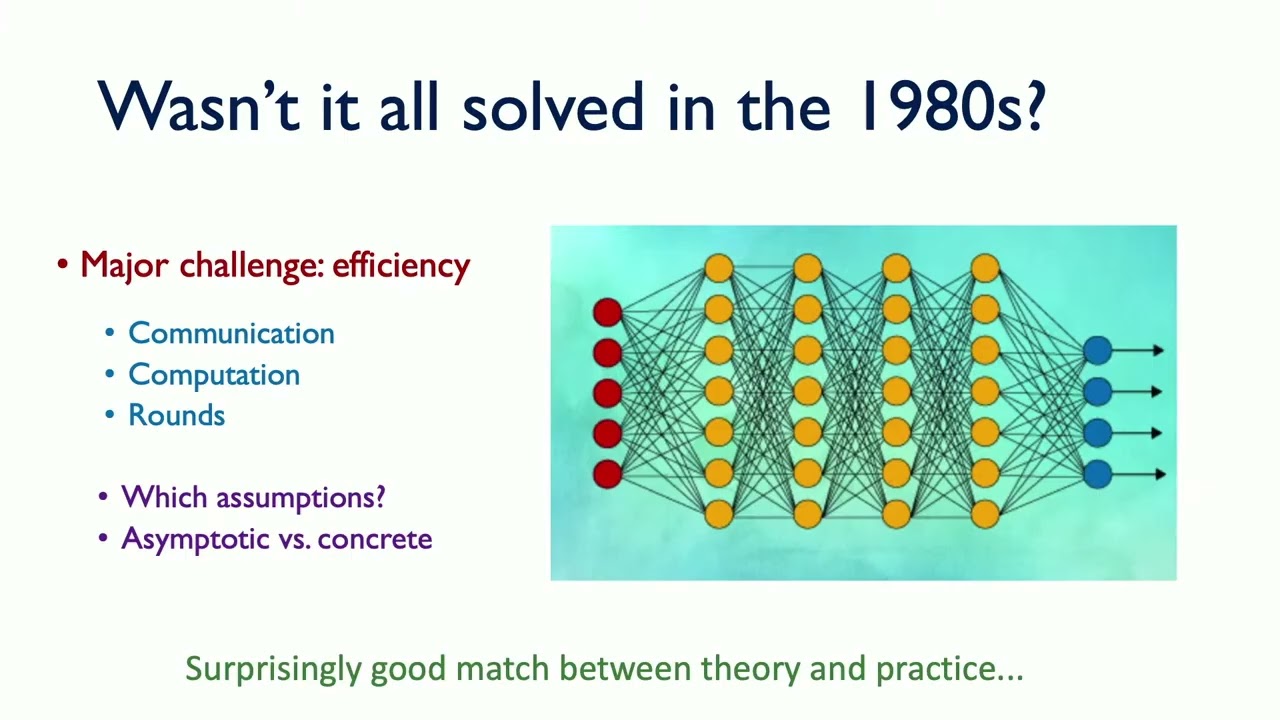
- Discussion of the main efficiency metrics: communication, computation, and rounds.
- Overview of classical approaches: garbled circuits and GMW.
- Introduction of newer techniques that break the circuit size barrier.
- Discussion of the information-theoretic setting with honest majority.
- Exploration of the computational cost metric and its subjectivity.
- Comparison of RAM model vs. circuit model for computation cost.
- Introduction of the asymptotic landscape and the role of security parameter.
- Discussion of communication complexity and lower bounds.
- Exploration of round complexity and its trade-offs.
Cited Sources
- Simons Institute Talk Page — Official page for the talk, providing context and possibly slides.
Concurring Sources
- Simons Institute Talk Page — Official page for the talk, providing context and possibly slides.
Contribution & Novelties
The talk provides a broad survey of the complexity of secure computation, highlighting the trade-offs between communication, computation, and rounds. It emphasizes the importance of optimizing one metric at a time and the flexibility in assumptions. The speaker connects these questions to low-complexity cryptography, suggesting new research directions.
Pour aller plus loin :
- Garbled Circuits — Foundational concept in secure computation.
- Oblivious Transfer — Key primitive used in many protocols.
- Secure Multi-Party Computation — General framework for secure computation.
79 words
Radar Profile
The radar profile shows high scores in quantity and quality of information, with a high technical level. The reliability is also high, reflecting the expertise of the speaker. The talk is well-balanced across these dimensions.
💬 No comments were provided for analysis.