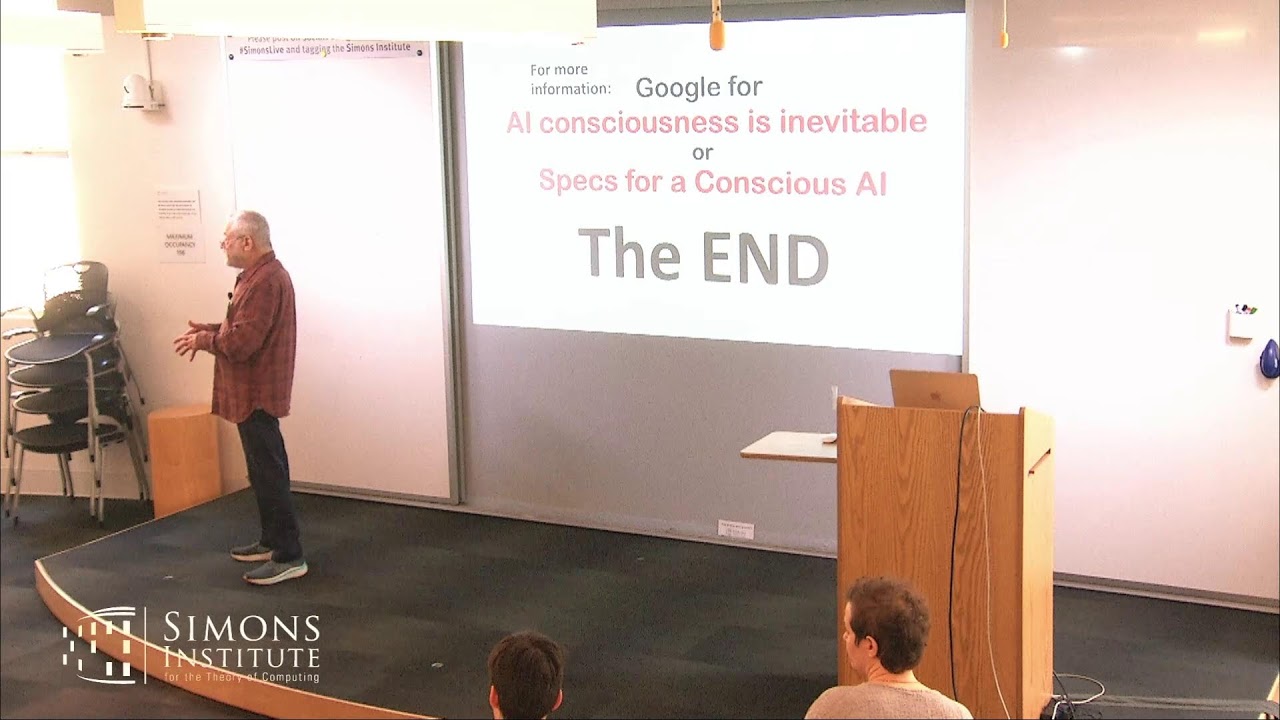
The Conscious Turing Machine (CTM): a Theoretical Computer Science Examination of Consciousness
Keywords
Summary
177 words
Critical Evaluation
The talk presents a compelling theoretical framework for consciousness, grounded in established concepts from computer science and cognitive science. Blum’s CTM model is a significant contribution to the field, offering a formal, computational alternative to more philosophical or neuroscientific approaches. The model’s strength lies in its clarity and precision: it defines consciousness as the broadcast of chunks in a global workspace, with processors competing via a tournament mechanism. This formalization allows for rigorous analysis and potential computational implementation. However, the talk is primarily conceptual and lacks empirical evidence or detailed technical specifications. Blum himself acknowledges that the model is theoretical and does not aim to model the brain directly. This raises questions about its testability and falsifiability, which are crucial for scientific validation. The model’s reliance on the tournament mechanism and the concept of ‘Brainish’ are intriguing but remain underdeveloped in the presentation. The speaker’s expertise in theoretical computer science lends credibility, but the lack of references to empirical studies or existing literature on consciousness weakens the scientific rigor. The talk is accessible to a general audience, but the depth of the discussion is limited by time constraints. The adéquation between title and content is excellent, as the talk indeed examines consciousness from a theoretical computer science perspective. Overall, the talk offers valuable insights and a novel framework, but its scientific impact would be enhanced by further elaboration and empirical grounding.
231 words
Title / Content Match
The title accurately reflects the content: a theoretical computer science examination of consciousness via the Conscious Turing Machine model.
Quality & Reliability
7/10
The talk presents a theoretical model of consciousness based on Turing machines and Baars' global workspace theory. The speaker is a renowned computer scientist, and the model is formal and well-defined. However, the talk is largely conceptual and lacks empirical validation or detailed technical exposition, which limits its immediate scientific reliability.
Key Moments
Markers derived by PSI from the transcript: the creator did not define chapters.
- Introduction and personal motivation to understand consciousness.
- Definition of consciousness and introduction to the CTM model.
- Comparison with Baars' global workspace theory.
- Explanation of chunks and Brainish language.
- Example of infant's first conscious experiences.
- Discussion of the tournament mechanism and processor competition.
- Explanation of how chunks gain meaning through weights.
- Q&A session begins.
Cited Sources
- Simons Institute Talk Page — Official page for the talk, providing context and possibly slides.
Concurring Sources
- Global Workspace Theory — Baars' theory, which the CTM extends and formalizes.
Dissenting Sources
- Integrated Information Theory — IIT proposes a different formal approach to consciousness, focusing on information integration, which contrasts with the CTM's global workspace approach.
Contribution & Novelties
The CTM model provides a formal, computational framework for consciousness, integrating Turing machine concepts with Baars’ global workspace theory. It introduces the notion of ‘Brainish’ as a multimodal language for internal communication and proposes a tournament mechanism for selecting conscious thoughts. This offers a precise alternative to more vague cognitive theories.
Pour aller plus loin :
- Global Workspace Theory — Provides background on Baars’ theory, which the CTM builds upon.
- Turing Machine — The foundational computational model that inspires the CTM.
- Consciousness — Overview of the philosophical and scientific study of consciousness, relevant to the CTM’s goals.
97 words
Radar Profile
The radar profile shows a balanced distribution across scores, with slightly higher scores in quality and reliability, reflecting the speaker's expertise and the formal nature of the model. The lower score in quantity suggests the talk is concise and focused, while the technical level is moderate, making it accessible to a broad audience.
💬 No comments were provided for analysis.