Testing Noise Assumptions of Learning Algorithms
Keywords
Summary
190 words
Critical Evaluation
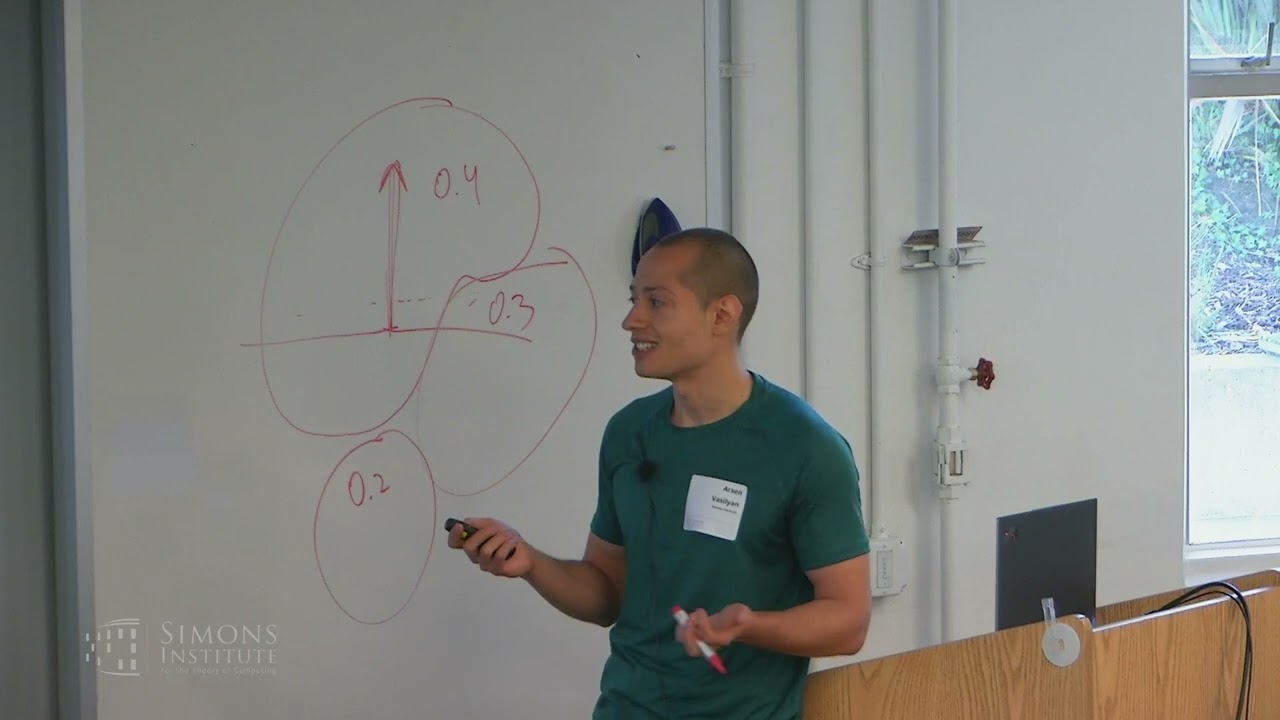
The talk presents a novel and significant contribution to computational learning theory by introducing the concept of testable learning for noise models. The speaker clearly motivates the problem, explaining the limitations of existing approaches and the need for algorithms that can certify optimality. The technical content is rigorous, with precise definitions of soundness and completeness, and the main result is stated with appropriate conditions. The presentation is well-structured, starting with background, then introducing the framework, and finally discussing the main ideas. The speaker effectively communicates complex ideas, using intuitive examples and diagrams. The work builds on prior research, and the speaker appropriately credits related work, such as the testable learning framework of Rubinfeld and Vasilyan. The talk also highlights a separation result, which adds depth to the contribution. However, the presentation is at a high technical level, and some details are glossed over, which may limit accessibility for a general audience. The video is a recording of a seminar, and the quality is good, with clear slides and audio. The description provides a link to the talk’s page on the Simons Institute website, which may contain additional resources. Overall, this is a high-quality presentation of original research, with clear implications for the field. The main limitation is the lack of peer-reviewed publication details, but the content is credible given the context and the speaker’s affiliation.
225 words
Title / Content Match
The title accurately reflects the content, which focuses on testing noise assumptions in learning algorithms.
Quality & Reliability
8/10
Presentation of original research by a recognized researcher at a prestigious institute, with clear technical content and references to prior work. The talk is a formal academic presentation, and the claims are supported by theoretical results. However, the video is a recording of a talk, and the details are not fully peer-reviewed in this format.
Key Moments
Markers derived by PSI from the transcript: the creator did not define chapters.
- Introduction and background on learning with label noise
- Definition of Massart noise and motivation
- Introduction of testable learning framework
- Main result: efficient testable learning algorithm for Massart noise
- Comparison with previous testable learning work
- Main ideas for random classification noise
- Separation result for RCN with noise rate 1/2
- Technical details of the algorithm
- Discussion of implications and future work
Cited Sources
- Simons Institute talk page — Official page for the talk, providing abstract and possibly slides.
Concurring Sources
- Simons Institute talk page — Official page for the talk, providing abstract and possibly slides.
Contribution & Novelties
The talk introduces a new framework for testable learning under noise models, extending the previous testable learning framework to handle label noise. The main contribution is an efficient algorithm for learning halfspaces under Gaussian marginals with Massart noise that provides a certificate of optimality. This is a significant step towards making learning algorithms more reliable in practice. The separation result for random classification noise with noise rate 1/2 highlights the computational challenges of testable learning.
Pour aller plus loin :
- Testable Learning — General concept of PAC learning, relevant background.
- Massart noise model — Overview of noise models in machine learning.
- Rubinfeld and Vasilyan’s testable learning framework — Original paper on testable learning, though the URL is not verified.
119 words
Radar Profile
The radar profile shows high scores in information quantity, quality, and technical level, with a slightly lower but still strong score in global reliability. This indicates a technically dense and reliable presentation, suitable for an expert audience.