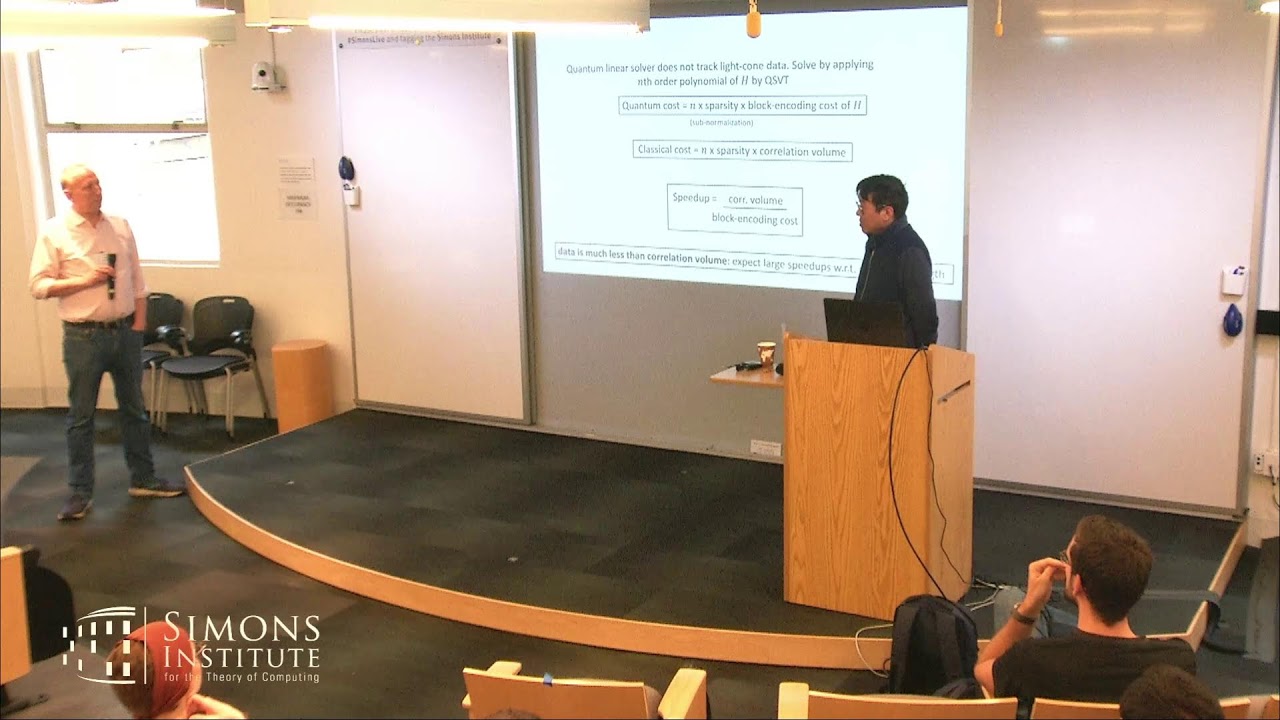
Quantum advantage in quantum simulation in the age of classical simulation
Keywords
Summary
163 words
Critical Evaluation
The talk presents a compelling and nuanced perspective on quantum advantage in quantum chemistry, challenging the conventional approach of targeting problems that are classically hard. Chan’s argument is well-structured and grounded in specific examples, such as the FeMo-cofactor and chromium dimer, demonstrating that classical methods can often solve problems previously thought to require quantum computers. He correctly points out that many challenges in chemistry are not inherently quantum, such as long timescales or experimental data analysis, and that classical heuristics are powerful and continuously improving. The emphasis on incorporating heuristics into quantum algorithms is insightful and aligns with recent developments in hybrid quantum-classical approaches. However, the talk is an opinion piece rather than a rigorous formal analysis, and some claims lack formal proof. For instance, the assertion that classical methods can achieve chemical accuracy for FeMo-cofactor is based on empirical evidence and extrapolation, not a rigorous guarantee. Additionally, the suggestion that quantum advantage should be sought under classical heuristic assumptions is somewhat vague and lacks concrete examples of where such advantage might be realized. The talk also does not address potential limitations of classical heuristics, such as their failure for strongly correlated systems. Overall, the talk is valuable for its critical perspective and practical insights, but it would benefit from more formal arguments and specific proposals for quantum advantage. The title accurately reflects the content, and the presentation is accessible to a technical audience. The lack of a formal proof and the reliance on empirical evidence slightly reduce the overall reliability, but the speaker’s expertise and the quality of the examples justify a high score.
265 words
Title / Content Match
The title accurately reflects the content, which discusses the potential for quantum advantage in simulation given the power of classical heuristics.
Quality & Reliability
8/10
The talk is by a leading expert in quantum chemistry, presenting a well-argued perspective with references to specific studies and methods. However, it is an opinion piece rather than a peer-reviewed presentation, and some claims lack formal proof.
Key Moments
Markers derived by PSI from the transcript: the creator did not define chapters.
- Introduction to the talk and the team.
- Discussion of the common approach to quantum advantage and its limitations.
- Example of FeMo-cofactor and classical simulation success.
- Explanation of why classical methods work: entanglement fragility and configuration concentration.
- Discussion of real challenges: not all are quantum-related.
- Introduction of heuristics and their role in classical and quantum algorithms.
- Proposal to seek quantum advantage under classical heuristic assumptions.
- Discussion of common assumptions and potential for quantum speedups.
Cited Sources
- Simons Institute Talk Page — Official page for the talk, providing context and possibly slides.
Concurring Sources
- Simons Institute Talk Page — Official page for the talk, providing context and possibly slides.
Contribution & Novelties
The talk offers a fresh perspective on quantum advantage in quantum chemistry, arguing that classical heuristics are powerful and that quantum advantage should be sought under similar assumptions. It highlights the importance of incorporating heuristics into quantum algorithms and suggests a shift in focus from formal intractability to practical speedups.
Pour aller plus loin :
- Quantum computing for chemistry — Overview of quantum computing applications in chemistry.
- Coupled cluster method — Key classical method mentioned in the talk.
- Density matrix renormalization group — Another classical method used for strongly correlated systems.
- Quantum phase estimation — Core quantum algorithm for energy estimation.
- FeMo-cofactor — The nitrogenase cofactor discussed as a benchmark.
110 words
Radar Profile
The radar profile shows high scores across all dimensions, indicating a well-balanced and informative talk. The speaker demonstrates deep expertise and provides a critical analysis of quantum advantage, making it a valuable resource for researchers.