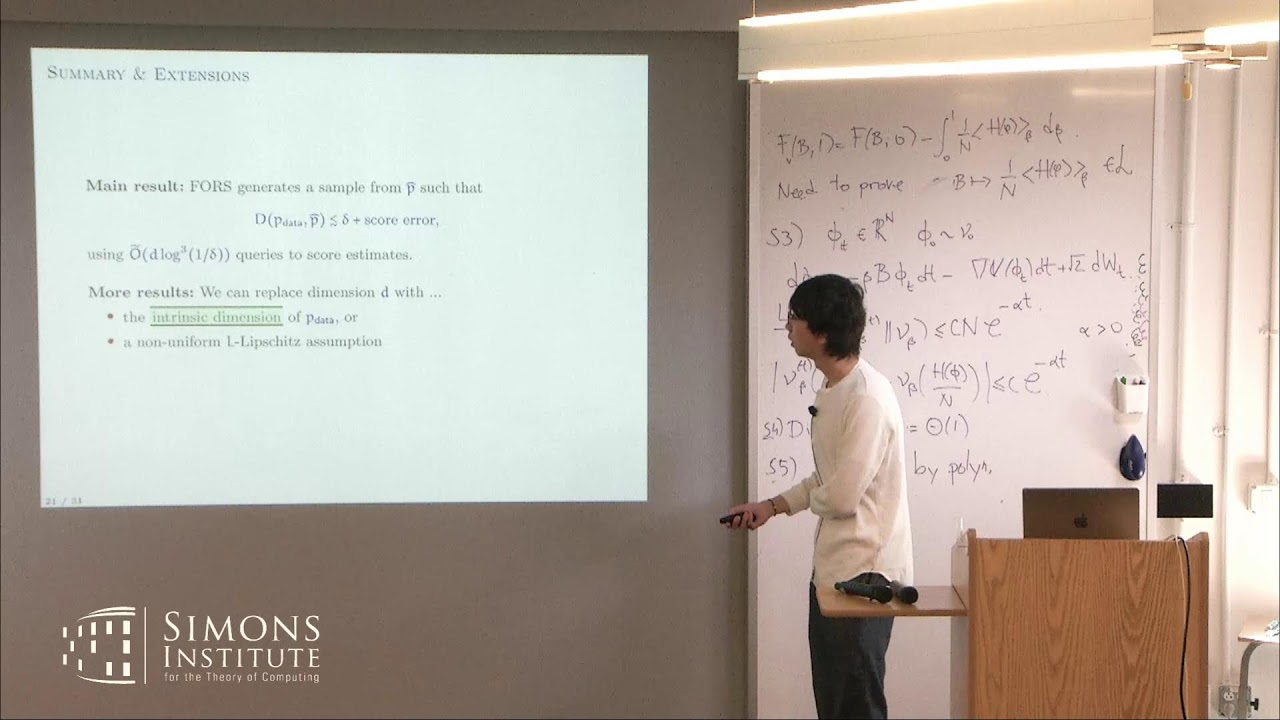
High-Accuracy Sampling for Diffusion Models and Log-Concave Distributions
Keywords
Summary
108 words
Critical Evaluation
The presentation is highly technical and rigorous, aimed at an expert audience in theoretical computer science and machine learning. The speaker clearly explains the motivation, the technical challenges, and the proposed solutions. The work is original and significant, as it provides exponential improvements in sampling complexity for diffusion models and establishes a separation between sampling and optimization in the stochastic gradient setting. The speaker addresses a question about practical evidence for discretization being the bottleneck, providing a reasonable response. The talk is well-structured, with a clear abstract problem formulation and a detailed algorithm description. The sources cited are the two arXiv papers and the Simons Institute talk page, which are appropriate and verifiable. The main limitation is that the talk is highly technical and may not be accessible to a broader audience, but this is not a flaw given the context. The title accurately reflects the content. Overall, the talk is of high quality and contributes significantly to the field.
160 words
Title / Content Match
The title accurately reflects the content, focusing on high-accuracy sampling methods for diffusion models and log-concave distributions.
Quality & Reliability
8/10
The talk presents original research with rigorous theoretical results, published in top venues (ICML, CoLT). The speaker is an expert from MIT. The presentation includes clear technical details and acknowledges concurrent work.
Key Moments
Markers derived by PSI from the transcript: the creator did not define chapters.
- Introduction and motivation for high-accuracy sampling in generative models.
- Discussion of discretization bias in diffusion model sampling and the need for unbiased methods.
- Formal problem statement: sampling from a tilted distribution with unknown tilt function.
- Introduction of the Bernoulli factory technique for unbiased estimation.
- Application to diffusion model sampling: polylog complexity result.
- Application to log-concave sampling and separation from convex optimization.
- Comparison with concurrent work and discussion of assumptions.
- Q&A session addressing practical evidence and technical details.
Cited Sources
- High-Accuracy Sampling for Diffusion Models (ICML 2026) — Main paper presenting the diffusion model sampling algorithm.
- High-Accuracy Log-Concave Sampling (CoLT 2026) — Paper presenting the log-concave sampling results.
- Simons Institute Talk Page — Official talk page with abstract and details.
Concurring Sources
- Concurrent work on ODE-based high-accuracy sampling — Mentioned in the talk as achieving similar polylog complexity under stronger assumptions.
Contribution & Novelties
The talk presents a novel algorithmic framework that achieves polylogarithmic sampling complexity for both diffusion models and log-concave distributions, significantly improving upon previous polynomial dependencies. The key innovation is the use of unbiased stochastic queries and rejection sampling to correct discretization bias, leveraging Bernoulli factory techniques. This work also establishes a separation between sampling and optimization in the stochastic gradient setting, which is a fundamental theoretical contribution.
Pour aller plus loin :
- Bernoulli factory — Relevant for the unbiased estimation technique used.
- Diffusion models — Background on the generative modeling framework.
- Log-concave distributions — Relevant to the sampling problem addressed.
100 words
Radar Profile
The radar profile shows high scores in quantity and quality of information, technical level, and reliability, indicating a dense and rigorous presentation. The talk is highly specialized, with a strong theoretical focus.