Optimization by Decoded Quantum Interferometry | Quantum Colloquium
Keywords
Summary
113 words
Critical Evaluation
The talk presents a novel quantum algorithm, DQI, with a clear and well-structured exposition. Jordan provides necessary background in coding theory and quantum computing, making the talk accessible to a technical audience. The algorithm’s connection to Fourier analysis and decoding is insightful, and the potential for exponential speedup in specific problems is intriguing. However, the talk is largely based on a preprint that has not yet undergone peer review, and some claims, such as the exponential speedup for optimal polynomial intersection, rely on assumptions about classical hardness that are not fully proven. The discussion of max-k-XORSAT is more nuanced, acknowledging that DQI does not outperform specialized classical algorithms. The panel discussion adds valuable perspectives, but the overall assessment is that while the ideas are promising, further validation and peer review are needed. The title accurately reflects the content, and the talk is well-presented, but the lack of formal publication and the preliminary nature of some results temper the overall evaluation.
160 words
Title / Content Match
The title accurately reflects the content, which focuses on a new quantum algorithm for optimization.
Quality & Reliability
8/10
Talk by a recognized expert in quantum algorithms, presenting a novel algorithm with a preprint on arXiv. The presentation is technical and rigorous, but the results are not yet peer-reviewed and some claims rely on unproven assumptions.
Key Moments
Markers derived by PSI from the transcript: the creator did not define chapters.
- Introduction and motivation for quantum speedup in optimization.
- Background on coding theory: codes, decoding problems, and duality.
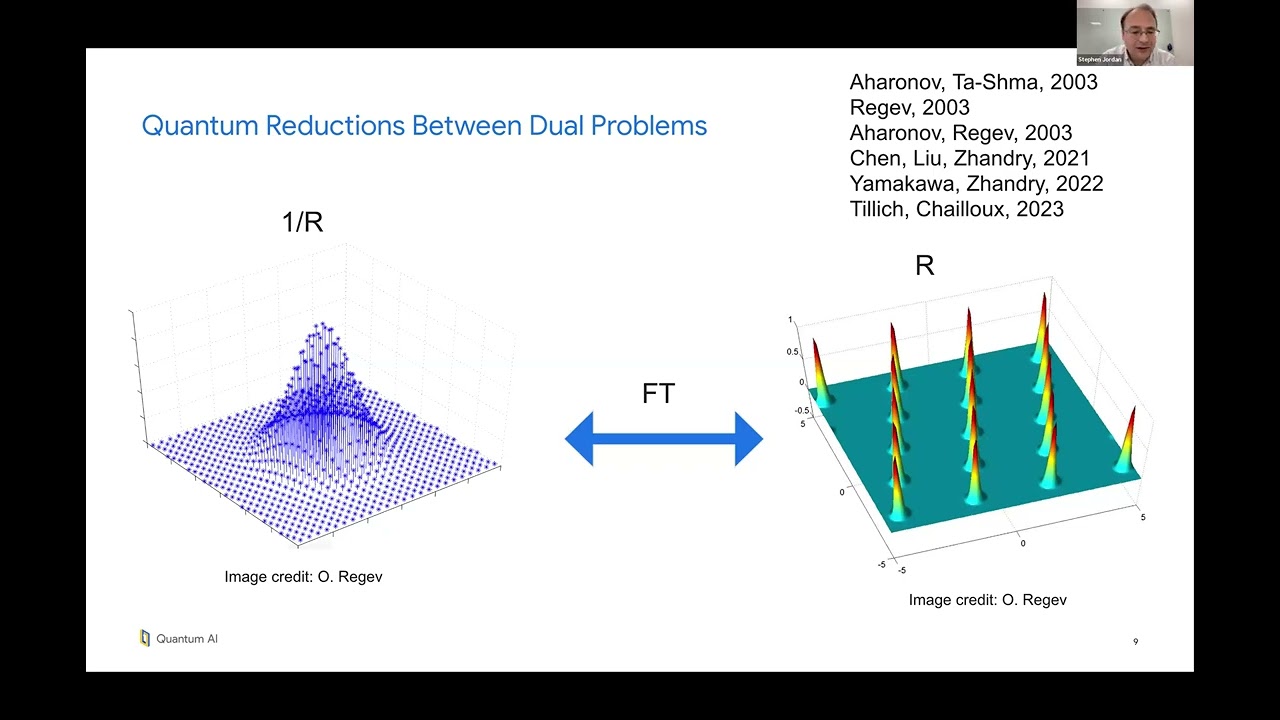
- Historical context: quantum reductions and lattice problems.
- Introduction to Decoded Quantum Interferometry (DQI) algorithm.
- Application to optimal polynomial intersection and exponential speedup.
- Application to max-k-XORSAT and comparison with classical algorithms.
- Connection to Yamakawa-Zhandry quantum query complexity speedup.
- Discussion of open problems and future directions.
- Panel discussion with John Wright, Ronald de Wolf, and Mark Zhandry.
Cited Sources
- Decoded Quantum Interferometry: A Quantum Algorithm for Optimization — The main paper describing the DQI algorithm and its applications.
- Simons Institute Event Page — Official event page for the talk, providing additional context and information.
Concurring Sources
- Quantum Algorithm Zoo — Maintained by the speaker, it lists many quantum algorithms, providing a broader context for DQI.
Contribution & Novelties
The talk introduces DQI, a novel quantum algorithm that leverages the sparse Fourier spectrum of cost functions to reduce optimization to decoding, potentially achieving exponential speedups in certain cases. This approach differs from Hamiltonian-based methods like QAOA and adiabatic optimization. The algorithm is applied to optimal polynomial intersection and max-k-XORSAT, showing promise in specific instances.
Pour aller plus loin :
- Quantum Algorithm Zoo — A comprehensive catalog of quantum algorithms, maintained by Stephen Jordan, useful for context.
- Belief Propagation — A classical algorithm for decoding LDPC codes, relevant to the max-k-XORSAT application.
- Quantum Fourier Transform — The quantum analogue of the discrete Fourier transform, central to DQI.
107 words
Radar Profile
The radar profile shows high scores in technical level and information quality, reflecting the advanced and detailed nature of the talk. The lower score in reliability is due to the preliminary nature of the results, which are not yet peer-reviewed.
💬 No comments were provided for analysis.