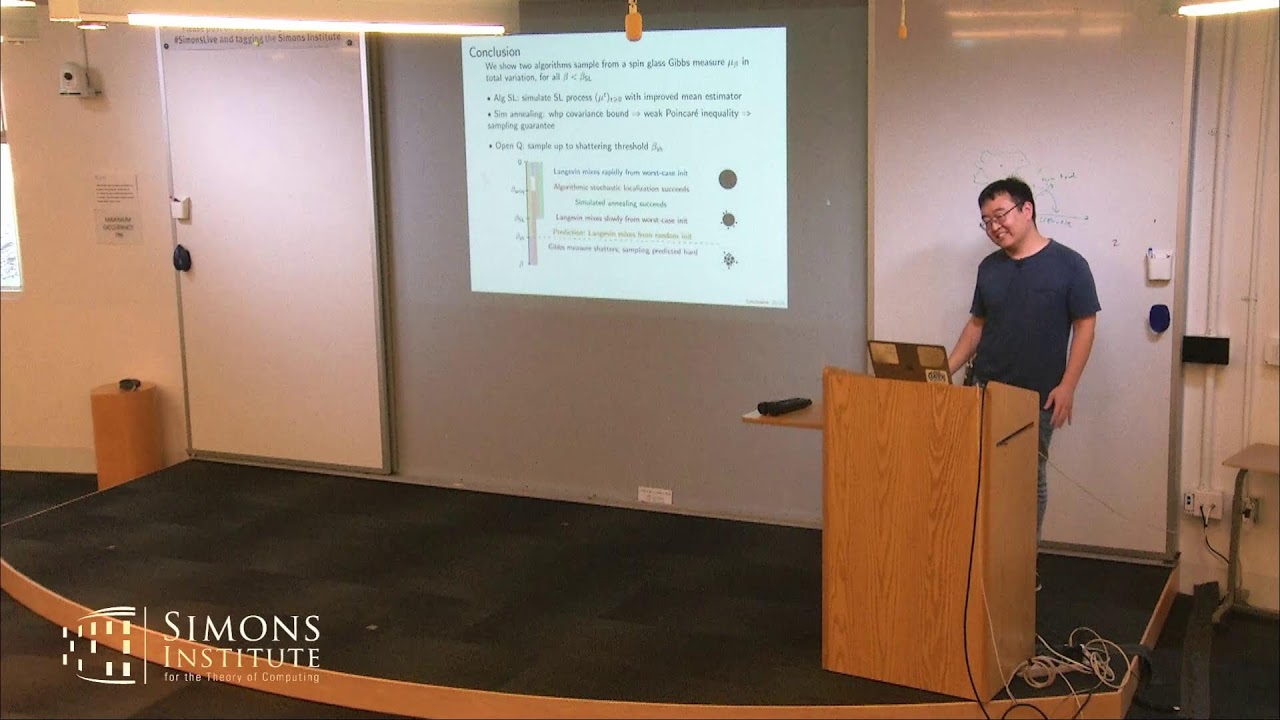
Sampling from spherical spin glasses: diffusions and simulated annealing
Keywords
Summary
112 words
Critical Evaluation
The talk presents significant theoretical advances in sampling from disordered systems, a problem at the interface of probability, statistical physics, and algorithms. The speaker clearly states the problem, the algorithms, and the main results, providing context on prior work and conjectures. The proofs are sketched, but the talk focuses on the high-level ideas and the novelty of the contributions. The use of stochastic localization as both an algorithm and a proof technique is elegant and connects to recent developments in diffusion models. The results improve upon previous work by achieving total variation guarantees and extending the temperature range for simulated annealing. The presentation is rigorous, with appropriate caveats about the gap to the conjectured threshold. The sources are limited to the talk’s own papers and the Simons Institute page, but the content is self-contained. The talk does not address potential limitations or open questions in detail, but it is a research talk, not a survey. Overall, the talk is of high quality and provides valuable insights for researchers in the field.
171 words
Title / Content Match
The title accurately reflects the content, focusing on sampling algorithms for spin glasses using diffusions and simulated annealing.
Quality & Reliability
8/10
Talk by a leading researcher presenting rigorous mathematical results, with clear statements and references to joint works. The content is highly technical and relies on established methods, but the presentation is concise and assumes expert audience.
Key Moments
Markers derived by PSI from the transcript: the creator did not define chapters.
- Introduction and motivation for sampling from high-dimensional measures
- Definition of mean-field spin glass and Gibbs measure
- Statement of main results and algorithms (simulated annealing and stochastic localization)
- Explanation of Langevin dynamics and mixing guarantees
- Discussion of phase transitions and computational thresholds
- Description of simulated annealing algorithm and its analysis
- Introduction to stochastic localization and its use as algorithm and proof technique
- Main results and comparison with previous work
- Proof sketch of the local-to-global principle for simulated annealing
- Conclusion and outlook
Cited Sources
- Simons Institute talk page — Official page for the talk, providing abstract and links to related materials.
Concurring Sources
- Simons Institute talk page — Official abstract and description align with the talk content.
Contribution & Novelties
The talk presents two new algorithmic results for sampling from spin glasses: a diffusion-based algorithm achieving total variation guarantees, and a simulated annealing algorithm with a novel local-to-global analysis. These results extend the temperature range for efficient sampling and provide the first guarantees for Markov chains beyond the uniqueness threshold. The techniques may be applicable to other multimodal distributions.
Pour aller plus loin :
- Stochastic localization — Background on the method.
- Langevin dynamics — Basic concept.
- Simulated annealing — Classical algorithm.
81 words
Radar Profile
The radar profile shows high scores in information quality, technical level, and reliability, with slightly lower scores in information quantity and global reliability, reflecting the specialized nature and concise presentation.