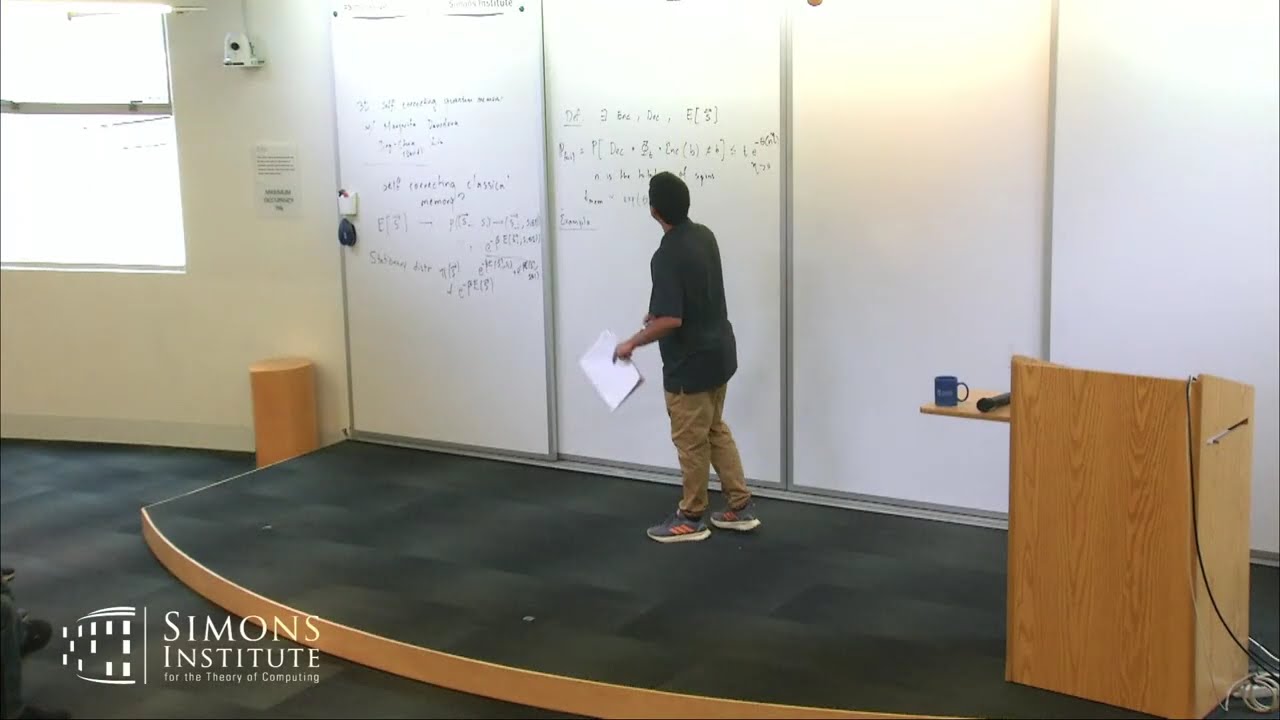
A 3D self-correcting quantum memory
Keywords
Summary
129 words
Critical Evaluation
The talk presents a significant theoretical advance in quantum error correction, addressing a long-standing open problem. The speakers demonstrate deep expertise and provide a clear conceptual framework. The argumentation is rigorous, relying on established techniques from statistical mechanics and coding theory. The construction is novel and the proof of self-correction is compelling. However, the talk is highly technical and may be inaccessible to non-specialists. The presentation focuses on the main ideas, with some details omitted, but the overall logic is sound. The sources cited are primarily the speakers’ own work and related literature, which is appropriate for a research talk. The title accurately reflects the content. The talk does not include a public Q&A, but the audience interactions during the talk show engagement and clarify technical points. Overall, this is an excellent presentation of original research, with minor limitations in depth due to time constraints.
145 words
Title / Content Match
The title accurately reflects the content, which focuses on the construction and analysis of a 3D self-correcting quantum memory.
Quality & Reliability
8/10
Presentation of original research at a reputable workshop, with technical depth and rigorous argumentation. However, the talk is not peer-reviewed and lacks detailed proofs.
Key Moments
Markers derived by PSI from the transcript: the creator did not define chapters.
- Introduction and motivation for self-correcting quantum memories
- Definition of self-correcting classical memory and the 2D Ising model example
- Challenges in constructing quantum self-correcting memories
- Construction of the 3D self-correcting quantum memory
- Proof sketch of self-correction and memory time
- Discussion of implications and open questions
Cited Sources
- Simons Institute talk page — Official page for the talk, providing abstract and related materials.
Concurring Sources
- Simons Institute talk page — Official page for the talk, providing abstract and related materials.
Contribution & Novelties
This work provides the first explicit construction of a 3D self-correcting quantum memory, resolving a major open problem. It introduces new techniques combining topology, statistical mechanics, and quantum coding theory, and opens avenues for passive quantum error correction.
Pour aller plus loin :
- Quantum error correction — Background on quantum error correction.
- Topological order — Relevant to the topological aspects of the construction.
- Stabilizer code — The class of quantum codes used.
72 words
Radar Profile
The radar profile shows high scores in technical depth and information quality, with slightly lower scores in accessibility and breadth. This indicates a highly specialized talk aimed at experts, with strong scientific content but limited general appeal.