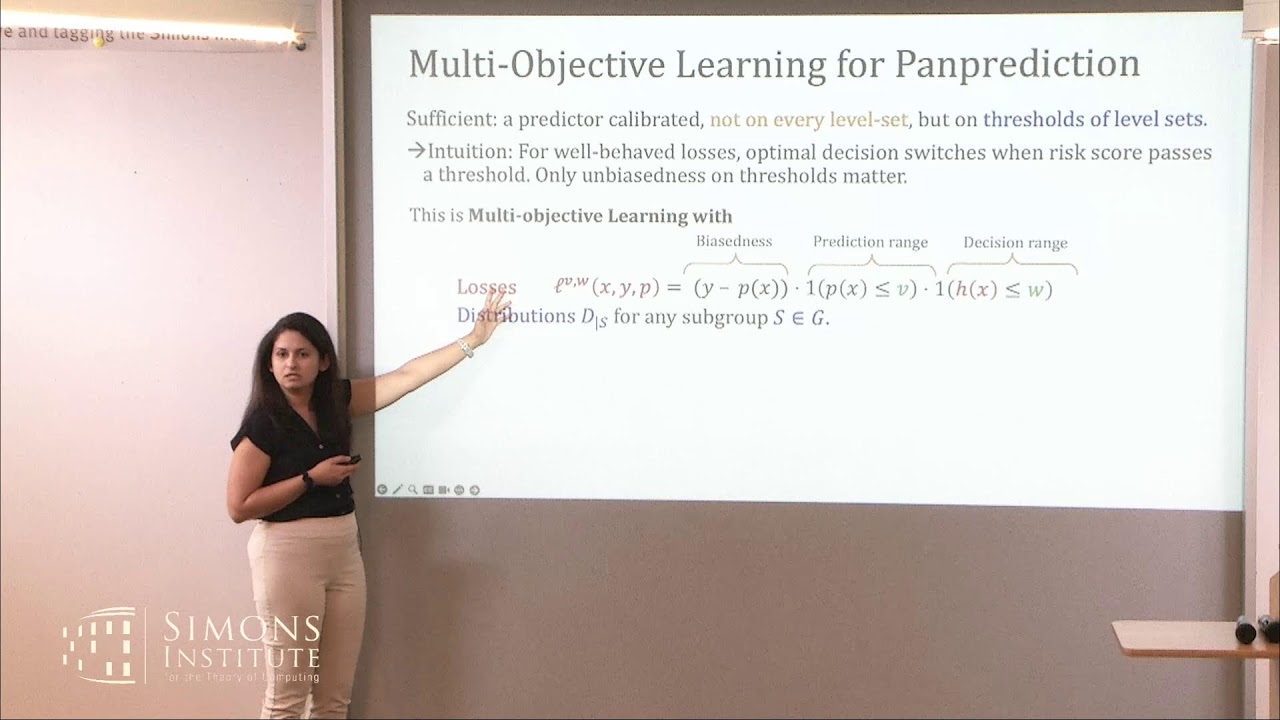
Multi-objective Learning: An Algorithmic Toolbox for Optimal Predictions Anytime Anywhere!
Keywords
Summary
157 words
Critical Evaluation
The talk delivers a high-quality, technically rigorous overview of multi-objective learning, a topic of growing importance in machine learning theory. Haghtalab’s presentation is clear and well-structured, starting with motivation and definitions, then moving to algorithmic results and applications. The content is grounded in established theoretical frameworks, such as PAC learning and calibration, and extends them in a meaningful way. The algorithmic toolbox she presents is a significant contribution, offering both sample complexity guarantees and efficient methods, which is crucial for practical applicability. The talk also benefits from its connection to prior work, including collaborations with Avrim Blum, which lends credibility and context. However, as a conference-style talk, it does not provide full proofs or detailed derivations, which limits its depth for those seeking complete technical understanding. The discussion of open problems is valuable but brief. Overall, the talk is a strong synthesis of existing ideas and novel contributions, suitable for an audience with a background in theoretical computer science and machine learning.
162 words
Title / Content Match
The title accurately reflects the content: the talk introduces multi-objective learning as a unifying framework and presents an algorithmic toolbox for achieving optimal predictions across multiple tasks and losses.
Quality & Reliability
8/10
The talk is given by a leading researcher in theoretical machine learning, Nika Haghtalab, at a prestigious venue (Simons Institute). It presents a coherent algorithmic framework with rigorous theoretical foundations, referencing prior work and open problems. The content is technical and well-structured, though it is a presentation of ongoing research rather than a peer-reviewed publication.
Key Moments
Markers derived by PSI from the transcript: the creator did not define chapters.
- Introduction and personal reflection on Avrim Blum's influence.
- Motivation: example of predicting cardiac events for different populations.
- Definition of multi-objective learning and its relation to PAC learning.
- Examples: per-group guarantees and calibration as fine-grained objectives.
- Unifying perspective: connections to federated learning, fairness, and group DRO.
- Algorithmic toolbox: sample complexity and algorithmic paradigms.
- Applications and open questions.
Cited Sources
- Simons Institute Talk Page — Official talk page with abstract and related resources.
Concurring Sources
- Simons Institute Talk Page — Official page confirming the talk's content and context.
Contribution & Novelties
The talk introduces a unifying algorithmic framework for multi-objective learning, providing sample complexity bounds and efficient algorithms that generalize across multiple distributions and losses. This is a novel contribution that connects several existing lines of research, such as multi-distribution learning, group DRO, and omniprediction, under a single theoretical umbrella.
Pour aller plus loin :
- Multi-distribution learning — Relevant paper on learning across multiple distributions.
- Group distributionally robust optimization — Foundational work on group DRO.
- Omniprediction — Paper on omniprediction and calibration.
81 words
Radar Profile
The radar profile shows high scores in information quality and technical level, indicating a dense, expert-level presentation. The slightly lower score in quantity of information reflects the talk's focus on a specific framework rather than a broad survey. Overall, the talk is highly reliable and technically deep.